Rebane's Ruminations
November 2026
S M T W T F S
1234567
891011121314
15161718192021
22232425262728
2930  

ARCHIVES


OUR LINKS


YubaNet
White House Blog
Watts Up With That?
The Union
Sierra Thread
RL “Bob” Crabb
Barry Pruett Blog

  • George Rebane

    Statesco2emissions • ‘A Looming Policy Disaster’ by Jason Scott Johnston of the University of Pennsylvania presents a cool-headed look at the current climate change issue.  In it this paper makes the point that a “sustained, critical look at climate change economics and science is long overdue.”  For those still seeking a reasonable answer to this enviro-political conundrum, Johnston’s readable contribution is strongly recommended.  In it he examines the costs and benefits of various proposed responses including the difficulties in implementing the Lieberman-Warner bill and the potential tsunami of litigation it would start.

    • ‘Global Warming: Correcting the Data’ by Patrick Michaels of the Cato Institute is a companion piece in the Fall 2008 issue of Regulation.  In here Michaels brings us a fresh look at the temperature data the presentation of which forms the basis of the claimed crisis.  This summary of the relevant science is from an independent perspective to the coverage that MSM provides, and that is the focus on blogs such as NC Media Watch and Watts Up With That.

    • With the election drawing nigh, I invite you to view this video about Aaron Klein who is running for re-election to the Sierra College Board of Trustees.  Based on the record of his previous term, intelligence, and energy, Jo Ann and I are unabashed Aaron Klein supporters.


  • George Rebane

    Harvesting_2

    “Last spring, (Switzerland) began mandating that geneticists conduct their research without trampling on a plant’s dignity.” reports the 10oct08 WSJ on its front page.  The piece goes on to detail how new constitutional modifications are making research in plant genetics a tortuous trail of following mandated procedures which are beyond silly.  Some excerpts from the article by Gautam Naik.

    The rule, based on a constitutional amendment, came into being after the Swiss Parliament asked a panel of philosophers, lawyers, geneticists and theologians to establish the meaning of flora’s dignity.

    Where does it stop?” asks Yves Poirier, a molecular biologist at the laboratory of plant biotechnology at the University of Lausanne. “Should we now defend the dignity of microbes and viruses?

    Things took a surreal turn when it was disclosed that some (plant ethics) panel members believe plants have feelings, Dr. Poirier says.

    Defenders of the law argue that it reflects a broader, progressive effort to protect the sanctity of living things.

    In another unusual move, the people of Ecuador last month voted for a new constitution that is the first to recognize ecosystem rights enforceable in a court of law. Thus, the nation’s rivers, forests and air are no longer mere property, but right-bearing entities with “the right to exist, persist and…regenerate.”

    Dr. Keller in Zurich has more mundane concerns. He wants to breed wheat that can resist powdery mildew. In lab experiments, Dr. Keller found that by transferring certain genes from barley to wheat, he could make the wheat resistant to disease. … In June, about 35 members of a group opposed to the genetic modification of crops, invaded the test field. Clad in white overalls and masks, they scythed and trampled the plants, causing plenty of damage. … “They just cut them,” says Dr. Keller, gesturing to wheat stumps left in the field. “Where’s the dignity in that?”

    So how long will it be until the Moonbeams of America will start mobilizing – first in California, of course – to write into law the newly ‘discovered’ rights of plants and entire ecosystems.  Led by California, America has been the major breadbasket of the world – above all the other things we do well, we can grow stuff like no one else on this planet.  Will we soon begin to have highly publicized demonstrations in our wheat and soybean fields, and at the gates of John Deere and Caterpillar demanding that the dignity of these crops not be violated?  I can see the mandated requirement for species-specific, fieldside memorial services before any crop is harvested.  After all, this is America and we will have to show some leadership in this new area of eco-sensitivity.   

  • George Rebane

    Dollar A correspondent sent me a ‘made simple’ version of our federal tax policy that is attributed to David R. Kamerschen, Ph.D., Professor of Economics, University of Georgia.  The anecdote, while accurate enough as far as it goes, leaves out an important point that seems to be the crux of the socialist’s argument for a more equal distribution of income.  I’ll cover that after we read the good professor’s economics lesson.

    “Suppose that every day, ten men go out for beer and the bill for all ten comes to $100. If they paid their bill the way we pay our taxes, it would go something like this:

    The first four men (the poorest) would pay nothing.
    The fifth would pay $1.
    The sixth would pay $3.
    The seventh would pay $7.
    The eighth would pay $12.
    The ninth would pay $18.
    The tenth man (the richest) would pay $59.

    So, that’s what they decided to do. The ten men drank in the bar every day and seemed quite happy with the arrangement, until one day, the owner threw them a curve. ‘Since you are all such good customers, he said, ‘I’m going to reduce the cost of your daily beer by $20. Drinks for the ten now cost just $80.

    (more…)

  • George Rebane

    Victoria_2 

    Two back-to-back trips in as many weeks.  Last weekend we celebrated my 50th high school reunion in southern California with a bunch of old geezers who didn’t recognize each other – well, a few did.  And now we’re back from a weekend on Vancouver Island attending a triennial gathering with friends.  The scenery was classic northwest with low scudding clouds, bands of rain, and intermittent impenetrable fogs.  We took the ferry from Port Angeles to Victoria, a wonderfully scenic and tidy city with sweeping views of the Strait of Juan de Fuca.  After a day plus exploring the town’s waterfront and antique stores, we drove through aboriginal forested mountains and lakes to the small resort town of Tofino nestled in the archipelago that shields the Pacific side of the big island.  On the way back after the festivities, we stopped for lunch in Port Alberni, the island’s biggest inland town and former home to several pulp mills.  Now only one remains and uses technology to produce more with a couple of hundred employees that formerly numbered over four thousand.  These people know economic hard times.  We took the long and picturesque ferry ride from Nanaimo back to the mainland.  It is now an hour’s wait to cross the border back into the US of A.  Remember the good old days of going to and coming from Canada?

    Tofino

    During the current financial crisis, a correspondent is appropriately angered by what he considers as piling on in an already difficult situation.  He suggested that I insert his short rumination among my own – 
    “Producer, advertisers, and writers of the Good Morning America show should be arrested for doing the equivalent of “yelling fire in a crowded theatre.”  Their fear peddling has gone over the line.  With a demographic of retirees and homemakers GMA has stooped to the selling of panic.  They have a Financial Crisis Hotline icon flashing constantly as they interview doomsday interviewees and anchormen, and women with nothing more than a communications (or theatrical) degree assume the role of financial planners and economists.  The same pseudo anchormen and women spend the mornings peddling fear in the hopes of creating ‘runs on banks’ and a ‘run on the stock market.’  Fear sells, and GMA should have sold out weeks ago.   Lock the bums up.” 

  • Mike McDaniel

    As long as we look to the government for solutions there will always be a problem.

    StkchartI would be a hypocrite to be a financial advisor and not believe in free market capitalism.  Anyone invested in the markets must believe in free market capitalism.  A characteristic of our free market system is the fact that there will be good times and bad times.  An investor must learn to take the good with the bad. No one faults the markets when they are rocketing higher. But, when it comes time to revert to the mean we look for bailouts.  So the main stream media calls on our politicians in Washington to relieve the free market participants of the bad times inherent in free markets.

    [The “fat cat” bankers are not free from blame even though the government did not catch their hands in the cookie jar. Their punishments have been handed to them by the markets (see the demise of Bear Stern, Lehman Brothers, and others).  The market continues to levy justice to the executives that engineered, concealed and pawned off the toxic debt to investors.]

    It has been reported that the recent $700,000,000,000 bailout sparked a 99-1 ratio of constituents against the bailout to those who favored it. Could it be that Americans don’t think our politicians are capable of solving this crisis? Could it be that our politicians (both past and present) helped create the financial crisis of today?  Yes and Yes.

    In my opinion, the current crisis was generated and has frustrated investors due to the following:

     The socialist dream of housing for every American mandated by our politicians (regardless of the homeowner’s ability to pay back the mortgage) was a catalyst for the crisis.  Each of the State of the Union addresses going back to 1994 that I can remember showed a president (Clinton and Bush) touting their administrations ability to get the uneducated, less financially fortunate Americans into homes of their own.  This “accomplishment” comes at a price.

     The Federal Reserve (under Alan Greenspan) kept key interest rates too low for too long.  The over supply of funds to our nations bankers encouraged our bankers to design unconventional loans as a means of getting funds into circulation.  Once qualified homeowners refinanced 2-3 times in 3-5 years, bankers designed plans to expand the definition of “qualified.”

     Bankers looked to a laundry list of government regulatory agencies (SEC, OST, FDIC, HUD, US Treasury, and Federal Reserve to name a few) for acceptance, oversight and approval of the newly designed loans.  The banker’s new “unconventional loans” passed EVERY government agency’s litmus test.

     Investors and credit rating agencies relied on and made investments based on the perceived oversight by the SEC, OST, FDIC, US Treasury, and Federal Reserve that was non existent.   Supervision was entrusted to various government agencies at the peril of investors around the world.

     The corruption, mismanagement, and inabilities of management at Freddie Mac and Fannie Mae (both are Government Sponsored Enterprises) produced, concealed and then exacerbated the problem.

     Lastly, investors that flocked to “safe haven” investments such as gold/silver, energy, agriculture, foreign currencies have not been rewarded for their beliefs/actions due to our government’s heavy handed intervention.  Our government’s bailout inclinations have stepped in to manipulate the world markets.  The market will return to a “free market” when the government returns to its typical role. 

    The overall trend is clear. Systems put into place by politicians to aid the free market system have and will continue to fail taxpayers and investors.  As long as we look to our politicians for solutions there will always be problems. 

    Mike McDaniel is a Financial Advisor and principal of McDaniel Wealth Management. He can be reached at (530) 478-0326. 

  • Aaron Klein, Trustee

    It is a great privilege and a high honor to have represented you as your Sierra College Trustee for the last four years. We’ve accomplished a lot, but we’ve still got more to do, and that’s why I’m running for re-election.

    AaronkleinThomas Jefferson summed up why I’m so passionate about public education, when he wrote, “perhaps the most important bill in our code is that for the diffusion of knowledge among the people…there is no greater foundation for the preservation of freedom and happiness.” The opportunities that we have in this community are built on education, and particularly, Sierra College.

    Four years ago, that opportunity was at risk. Three straight years of deficits totaling $850,000. Courses cut, library hours slashed, student tutoring and labs decimated. I looked at that and said, we need change. And 90,000 people stood up, and change is exactly what we delivered to Sierra College.

    Four years later, Sierra College is on the move. We brought fresh new leadership to the table. Balanced the budget four years in a row. Built $2 million in new surpluses. Grew our reserves from $6 million to $8.1 million dollars. And through all of that, we have steadily increased access to college. More students than ever before are being equipped with the skills they need to thrive in a four year university, or secure a real-world, high-paying job.

    As much as we’ve turned the ship, we still have more to do. When I came into office, we had no strategic plan. No way to link our priorities to our budgeting. And no plan to pay for the retiree benefit promises made by trustees many, many years ago.

    I’m very proud that the state accreditation commission came in, endorsed the course we are on, commended the college on a variety of fronts, and gave our staff a sense of urgency about getting them accomplished. And we all ought to be proud of the incredible work our faculty and staff have done in response. They are faithful public servants who deserve our thanks.

    Now, our opponents are grasping at straws, desperate for some way to make the last four years of balanced budgets look worse than the years of deficits before them. That’s a tough job, and I don’t envy their task!

    They’ve tried to do this by redefining the words “balanced budget” as “spend however much you want, as long as you can borrow the money to make up the difference,” and their argument for this is that the rest of the State of California does it that way. I think our taxpayers deserve better than that.

    So we have a profound choice in this election: we can either return to the policies of the past that gave us runaway spending, massive deficits, cut courses, lost opportunity, and proposals for mountains of new taxes.

    Or, we can continue the agenda for change that we started four years ago. Continue balancing the budget, continue increasing access to college, and continue building a more prosperous future for all of our citizens.

    For those who believe in a stronger Sierra College, I ask for your vote. You can learn more about our cause for change at www.AaronKlein.com, or give me a call at 530-323-2607.

    Aaron Klein is a Sierra College Trustee, and has made his career in entrepreneurial business. He resides with his wife and son in Colfax.

    [gjr – Aaron Klein is a friend and colleague whose campaign Jo Ann and I have supported financially.]

  • George Rebane

    The Community Reinvestment Act will turn out to be one of the IEDs (improvised economy destroyers) that Congress buried long ago in the financial fabric of our country.  Now what it spawned has gone off.

    ShockedThroughout the history (since 1977) of this great piece of social engineering, people of goodwill from both sides of the aisle have warned about the ways which implementing the CRA has mangled the finance of housing markets.  Now the monster has come to life and threatens to interrupt all credit channels in the country, and perhaps in most of the world.

    Having run three companies, I am shocked – see Captain Renault (Claude Rains) scene in the Bogart/Berman film ‘Casablanca’ – at the fraction of American businesses that use debt capital to finance operations instead of or in addition to financing expansion.  Financing operations with debt means that you borrow money for everything from paying salaries to the light bill.  And if you can no longer borrow, your business quickly comes to a grinding halt.  Depending on your size, this is an event that will ripple through your suppliers and your customers, in addition to throwing your employees out of work.

    (more…)

  • George Rebane

    My belief tenets of the Educated Liberal (EL) received a thorough comment by an educated liberal friend and correspondent.  The 39 listed tenets were in two groups – the first 29 were derived from my own experience and people of a similar outlook, and the last ten were from G. Stone, a liberal law professor Cleave at the University of Chicago.  The latter were assessed as “factual” and my 29 were labeled as “pejorative caricatures” of the EL mind.  My friend is not a loner inhabiting some ideological extremum, but holds views shared by many (most?) ELs.  In the sequel I will assign him to that group.

    First, I want to make sure that we all understand that liberals, libertarians, and conservatives do hold certain tenets of social philosophy in common – from the sound of the subject comment, one could presume that this intersection was empty.  Most certainly, all ideological camps seem to strive for the same objectives of a society blessed with health and well-being in an environment that serves to develop individual potential.  Given this understanding, I take Stone’s tenets to task as being, perhaps, necessary to characterize the EL, but by no means sufficient as grist for an understanding of, let alone for a debate on, the distinguishing differences between the three points – liberal, libertarian, conservative – on the political spectrum. 

    For the non-technical reader I introduce the term ‘discriminant’ (from the field of pattern recognition) as an added requirement for a worthy ideological tenet.  A discriminant is a specific attribute shared by two sets of things.  We wish to separate or identify the members of each set by using some value of a useful discriminant as a threshold.  For instance to predict whether a randomly selected male is a member of an NBA team, one could use height as a simple discriminant to cleave the population of males.  Short guys – say, under six feet – don’t usually play in the NBA.  Another discriminant to cleave the then surviving set of tall men could be race – ‘white guys can’t jump’ and all that.  You get the idea how such discriminants can be used to pare down the survivors to a group of men most of whom would be on a NBA team.   We note that discriminants don’t have to  be perfect to be useful – every man with a PSA reading for prostate cancer has been told that by his physician.  I would not be surprised if ‘discriminant’ also finds its way into our everyday non-technical conversation.  Recall that terms like ‘feedback’ (control theory), ‘in the loop’ (control theory), ‘short circuit’ (circuit theory) and ‘on line’ or ‘online’ (network theory) are no longer just the jargon of engineers.

    (more…)

  • George Rebane

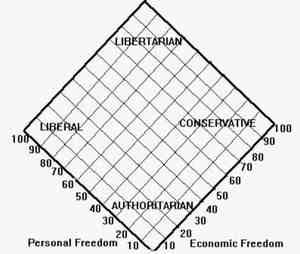
    In the heat of this election season I recently finished a lengthy exchange with a long-time, much younger, and well educated friend.  He sees himself as a left-leaning libertarian, who wondered again how anyone with two brain cells to pound together could be an intellectual and Christian at the same Libertarian time – well, actually a libertarian Christian.  In my attempt to persuade him that the feat was nowhere near as complicated as walking while chewing gum, I began ruminating once more on the exact opposite question: how can an educated person be a liberal?  The reality of it stares us in the face daily.  Besides the usual screed screamers that inhabit both sides of the political spectrum, there really are people of learning and goodwill who are of the collectivist bent.

    More musings on this drove me to the starting point whereon was inscribed another more seminal question – what are the belief tenets of an educated liberal?  Since I have come to know many liberals over the decades, most of whom are still close friends, I started scribbling down some of these tenets revealed from the many long and detailed conversations with these educated liberals.

    Few people decide and act according to a known belief system comprised of tenets which may or not be coherent and consistent.  Most people seem to act according to a jumble of heuristics or rules-of-thumb that life has added to their kit.  Sometimes a consistent subset of these are glued together during moments of reflection and become shared wisdom.  I first realized this about myself when I reached the half century mark during a year that was also my annus horribilis.  As a result I produced the first edition of my belief system or credo that ran to about eleven pages and contained over seventy tenets.  For me it was an eye-opener, and, as more water passed under the bridge, its succeeding editions continue to be valuable signposts of my growth, or to some, my decay.

    Since then I have often fantasized about a world where people of good will hand each other their credo when they first meet (even before they embark on the “principled negotiations” taught by Fisher, Patton, and Ury).  In my fantasy such deep and immediate knowledge of the other abets a society of harmonious efficiency and stimulating discourse as friends, colleagues, perhaps even voters who debate certain tenets of the other in the spirit of understanding and improvement.  And then my reverie ends.

    (more…)

  • George Rebane

    The ancient Vedic philosophers taught that the universe was cyclic and very old.  Its age is measured in kalpas for which the Vedantic derivatives of Hinduism and Buddhism have a variety of spectacular Bigbounce definitions.  From my late teen years, my own favorite is the length of time it takes a granite cube, 25 kilometers on a side, to be worn away by an angel who brushes it with a feather every millennium.  In one such tradition, the age of the universe is a single ‘great kalpa’ or about 1.25 trillion years.  And then what?

    Since about fifty years ago we have been told by cosmologists that our universe started with the Big Bang some 13.7 billion years ago from an infinitesimally small singularity of matter/energy/information?, and is now expanding at an accelerating rate.  The theory was then expanded to include a Big Crunch that would be the terminal event of our universe when it all collapsed under enormous gravitational pressure into a similar kind of singularity (not to be confused with The Singularity).  All this was still one big cycle or perhaps no cycle at all, it could keep expanding forever as one cold, lifeless, and unbelievably large volume of sub-elemental particles (proton decay) – but still be one long event.

    When I studied about this during my years as a physics undergraduate, I was deeply disturbed about such a collection of one-shot universe theories.  It was simply unsatisfying; in my gut I wanted the universe to be cyclic as taught by the ancients – everything we perceive has its oscillations of birth-death-birth-death-…, why not also the biggest thing we know about?  My hopes were partially satisfied when cosmologists began seeing in their equations the possibility of multiple universes existing in the cosmos.  Ours was just one of a countless number of these which would pop into existence and then either end in a crunch or dissipate like a puff of smoke.

    (more…)

No comments on Ruminations – 10oct2008