Rebane's Ruminations
November 2026
S M T W T F S
1234567
891011121314
15161718192021
22232425262728
2930  

ARCHIVES


OUR LINKS


YubaNet
White House Blog
Watts Up With That?
The Union
Sierra Thread
RL “Bob” Crabb
Barry Pruett Blog

  • George Rebane

    MemorialDay2  

    Since you gave all,
        the world was spared and we have reached for stars.
    Since you gave all,
        some have not learned, and now apologize for wars.
    Since you gave all,
        there still are those who hold with honor no one mars.
    Since you gave all,
        we will rebuild America, for children ours and yours.
    Since you gave all.

  • George Rebane

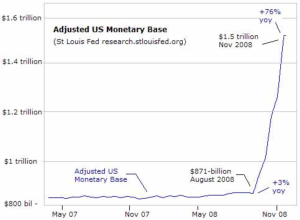
    AdjMonetaryBase You hear a lot about this today, and almost no one understands it.  According to the sociologists and educators who study what the electorate comprehends, ‘debt monetization’ means about as much to the average voter as the explanation of a freshly painted corral post does to a cow.  And here Wikipedia is of less than no help –

    Debt monetization occurs when a nation’s central bank (for example, the Federal Reserve in the United States) “buys” government bonds.  If a government’s expenses exceed its tax revenue, if nothing is done the government will draw resources (capital) out of the private market. Since there is a limited amount of capital available in the market, there will be less available to fund business growth if the government takes out a substantial portion. If the debt is monetized, the capital is thereby returned to the private market. (emphasis mine)

    This tells us that if the Fed buys Treasuries, then “capital is thereby returned to the private market”.  Well, no.

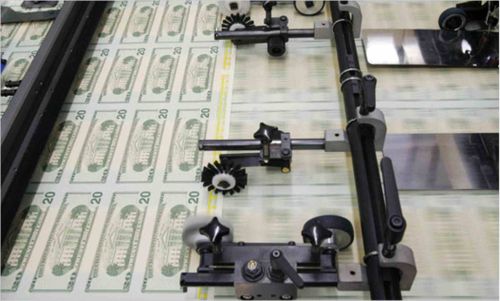
    First of all, the Fed doesn’t keep wads of cash on hand.  Its assets consist of other securities that it has ‘bought’.  And what does it use for all that buying?  Give yourself an ‘A’ if you said freshly printed fiat money backed by less than a gentle breeze.  There is no capital “thereby”, or any other way, “RETURNED to the private market.”  It’s simply an injection of new cash into the US Treasury’s general fund that the federal government then uses to pay for its spending.

    Every one of those ‘monetized’ dollars eventually winds up in the (American and the world) economy diluting the buying power of every other dollar that arrived there first.  The resulting inflation is how it “draws resources (capital) out of the private market.”  That means the dollars that you and I still hold in our wallets, money market funds, CDs, etc will now compete with more dollars out there for the goods and services that we need.  And we wind up paying more of our dollars for them.

    Just so we know; the Fed pulls money out of the market when it SELLS its assets for cash money, and then takes those dollars out of circulation (makes them disappear).  That reduces the amount of cash floating out there, and this activity is then deflationary.

    Debt monetization – kinda has a nice sanitary ring to it, as if it will somehow help set things right with our ongoing financial crisis.  So let’s all be team players, and not tell Team Obama how we feel about this.

    PrintingDollars

  • George Rebane

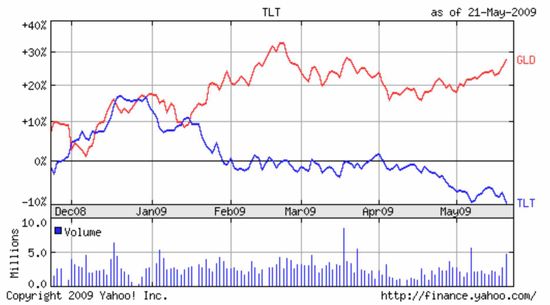
    The dollar continues its quiet plunge.  Porter Stansberry reports on today’s buzz in world financial circles that the US will soon lose its AAA debt rating, as Great Britain did two days ago.  Bill Gross, world’s largest bond-fund manager, agrees and told Bloomberg that

    … the U.S. will eventually lose its triple-A rating. Gross notes that the U.K. was downgraded last night, and the U.K. and U.S. “are similar in debt levels and debt trends.” Both countries have prospective deficits of 10% annually, “as far as the eye can see,” and those debts may approach 100% of GDP, “a level at which country downgrades tend to occur.”

    TLTandGLD

    (TLT is the iShares ETF that tracks 20-year treasuries; GLD is the gold bullion ETF)

    Meanwhile in Nevada County – at the other end of the world’s financial axis – I attended the annual presentation to the county’s government and business leaders on the ‘state of the county’.  This luncheon – excellent food BTW – is sponsored by the Nevada County Business Association, and today featured representatives from the four major jurisdictions – County, Truckee, Nevada City, and Grass Valley.

    (more…)

  • George Rebane

    California will become the first federalized state in the Union.  The 10th Amendment will be quietly abrogated, as have already many other parts of our Constitution.  Merriam-Webster –

    federalize – to bring under the jurisdiction of a federal government

    As such, California will become a rump state with a rump legislature.  Schwarznegger has already had to strap on his dress knee-pads for his audience with Obama, and he will be going back again and again.

    The federalizing process has already begun with Obama firing a warning shot across Sacramento’s bow in the case of laying off some unionized state employees (see 9may09 RR)  Now with the defeat of the 1A through 1E propositions, California will seek massive loans from the feds to paper over its busted budgets.  This will put the state on the same leash as the corporations that have received federal bailouts.

    And lest, dear Reader, you think that your state is safe, think again.  California will be only the first domino to fall into the federal black hole.  I predict that more states will follow, and soon the country will be divided into federalized and pre-federalized states.  And like any well-oiled black hole – what goes in does not come out.  The roads to socialism are many, and not all are well marked.

    You read it here first.

    [23may09 update]  Found this WSJ video as a good backgrounder to how federalizing states is starting.

    http://s.wsj.net/media/swf/main.swf

    TeaParty6June

  • George Rebane

    MAMbrain Let’s look ahead ten years or so.  You have finished lunch and are about to go back to work when you see something in a store window and go inside.  You examine the article and decide to pull up a couple of similar articles for comparison.  By thinking a command you make an overlay display appear in your field of view.  You are already on line as was your cell phone back in the old days. 

    You now move the cursor on the browser’s interface to ‘thought recognition’ and by thinking, you command the browser to go to your favorite ecommerce aggregator’s site, and call up similar products by simply looking at the product’s barcode in your hand.  The displays of competing products appear in a matrix in front of you, which you examine while expanding certain features, and then you make a decision.  You will buy the article in your hand from the store’s website, and have it shipped to your home.  Moving the cursor while ‘clicking’ on some links, and you’re done shopping.

    You now ‘hear’ a silent voice that reminds you of the early afternoon meeting during which you will make a presentation.  The shopping detour will make you a little late to the meeting, and you decide to call your assistant to tell everyone that you’ll be late.  Again by thought, you pull up the communication interface and by thinking your assistant’s name and silently commanding ‘call’, your assistant soon answers and you recognize the familiar voice.  Without moving your lips, you quietly tell her of the schedule change, and then decide that you will text the notification to the other attendees yourself.

    Again by thought, you form the text message and command its transmission to your colleagues as you walk toward your office building down the street.  It occurs to you that there is a slide in your PowerPoint that you forgot to include.  You pull up your presentation, and it floats in front of you as an overlay of the passing scene during your brisk walk back.  Quickly you identify where the new slide will go.  Its composition will require a bar chart that combines both your corporate data with some census data from the Department of Commerce.

    Again, while walking, into the building you pull up the corporate data array, with a cursor select the part you want, go on line to a government site that you had bookmarked and grab the corresponding data you need.  Before you get out of the elevator, you have composed the needed bar chart and inserted the new slide.  As you walk to the conference room, you pull up and view your afternoon schedule and the emails in your inbox.

    Your colleagues are already assembled in the conference room, some chatting, some quietly staring out the window, working as you have been while your returned from lunch.  People greet you as they sit down.  Again by thought alone, you upload your revised PowerPoint to the company’s data archive and command the conference room display system to bring it up for viewing as you begin your presentation in ‘traditional mode’.

    You and your colleagues decided to attend the presentation as a group because old habits die hard, and you did want to discuss it face-to-face using normal human interaction.  There are still some things you can get from face-to-face that you can’t from a machine user interface   You could, of course, have done all this on line with everyone in their office/cubicle ‘viewing’ and ‘hearing’ the presentation with complete ability to interact.

    (more…)

  • George Rebane

    ChadCrowe Praise the Lord, tomorrow’s California election will not draw many to the polls.  And those who will vote, will likely defeat the hokey smorgasbord that desperate Sacramento politicians have cooked up for us.  This morning’s WSJ op-ed summarizes it nicely –

    California politicians have operated for years as if the purpose of government is not to provide reliable public services at low cost, but to feed public employee unions. Sacramento also needs to rethink its highly progressive antigrowth tax code, where the tax rates are the highest outside of New York City. The Golden State now ranks worst or second worst on most ratings of state business climate. This drives away entrepreneurs and high-income taxpayers, which in turn leads to lower revenues.

    It concludes by suggesting a state flat tax, but observes that the difficulty in achieving it by saying that “(t)his kind of reform will only come from Golden State voters who aren’t yet on the public dole or the public payrolls. Howard Jarvis led such a charge 30 years ago. It needs to happen again for California to break out of its tax and spend death spiral.”  An uphill battle indeed.

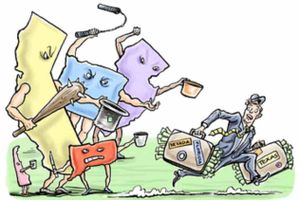
    Meanwhile left-wing groups – e.g. Center for Budget and Policy Priorities – are continuing their assault on the ‘rich’.  Arthur Laffer and Stephen Moore (‘Soak the Rich, Lose the Rich’, 18may09 WSJ, Chad Crowe graphic) cite an Ohio University study finding

    that from 1998 to 2007, more than 1,100 people every day including Sundays and holidays moved from the nine highest income-tax states such as California, New Jersey, New York and Ohio and relocated mostly to the nine tax-haven states with no income tax, including Florida, Nevada, New Hampshire and Texas. We also found that over these same years the no-income tax states created 89% more jobs and had 32% faster personal income growth than their high-tax counterparts.

    The piece goes on to cite additional data on the effects of states attempting to redistribute income through taxation.  The picture is not pretty, yet such class warfare arrows seem to be the only ones remaining in the socialist quiver.

    Finally, Texas Governor Rick Perry recognizes that the states are not only competing with each other, saying, “Our state is competing with Germany, France, Japan and China for business. We’d better have a pro-growth tax system or those American jobs will be out-sourced.”

    The Laffer/Moore piece concludes with –

    Texas created more new jobs in 2008 than all other 49 states combined. And Texas is the only state other than Georgia and North Dakota that is cutting taxes this year.

    [19may09 update] In his regular Tuesday column, Jeff Ackerman of The Union has, perhaps, a more useful view of the election and our response to it.

  • George Rebane

    Hillsdale College is a unique and remarkable learning institution in our country.  It takes no state monies and is free to teach truth as revealed through academic study, without having to spin it according to what government likes or does not.  Hillsdale publishes Imprimis, its monthly publication of ideas that goes to 1.7 million subscribers, I am one of them.

    Last month Mark Steyn, Distinguished Visiting Fellow of Journalism at the college, wrote the title article as one of the many currently ongoing attempts across the land to awaken a formerly free people now well on our way to losing our heritage and birthright.  A striking quote that should resonate with all is from a European, already resigned to his fate as a kept creature of the state – “I have never learned to fight for my freedom. I was only good at enjoying it.”

    LibertyTakesBreak In a compelling commentary Steyn outlines the five stages of the downward spiral and identifies our place on it.  In the broad sense –

    Europe’s addiction to big government, unaffordable entitlements, cradle-to-grave welfare, and a dependence on mass immigration needed to sustain it has become an existential threat to some of the oldest nation-states in the world.
     
    And now the last holdout, the United States, is embarking on the same grim path: After the President unveiled his budget, I heard Americans complain, oh, it’s another Jimmy Carter, or LBJ’s Great Society, or the new New Deal. You should be so lucky. Those nickel-and-dime comparisons barely begin to encompass the wholesale Europeanization that’s underway. The 44th president’s multi-trillion-dollar budget, the first of many, adds more to the national debt than all the previous 43 presidents combined, from George Washington to George Dubya. The President wants Europeanized health care, Europeanized daycare, Europeanized education, and, as the Europeans have discovered, even with Europeanized tax rates you can’t make that math add up. In Sweden, state spending accounts for 54% of GDP. In America, it was 34%—ten years ago. Today, it’s about 40%. In four years’ time, that number will be trending very Swede-like.

    Here is the pdf of ‘Live Free or Die’.  We all need to read it before returning to our dismissive slumbers.


  • [This is my first monthly column in a new series starting today in The Union – Nevada County's newspaper.  The “$1.4 million a year” in the article is a typo subsequent to my submittal to The Union.  Depending how you factor in real estate spending (building/buying), pensions, Social Security, insurance payments, and healthcare benefits, we can think of the retirees as being a billion plus dollar ‘industry’ for Nevada County.]

    We’re losing a good part of Nevada County’s biggest cash importers. Our local economy is based primarily on cash inflows from tourism, industry, government and retirees. These “big four” account for almost all the county’s cash inflow, the rest of the economic activity is comprised of our selling each other hamburgers, health maintenance services, groceries, and plumbing repairs. But these activities can’t survive without new cash coming in from someplace else.

    Nevada County’s population has about twice the fraction of people older than 60 and the number of retirees who live in most of California’s other counties. Our county’s population has hovered shy of 100,000 for most of this decade. And the reason our economy and quality of life have remained in the pleasant range is that the big four have been bringing in the money, a lot of which gets spent in the county a few times before it again leaks out. That’s the way economies work.

    On the back of an envelope, we can figure that the county’s more than 20,000 retirees bring in almost $1.4 million a year. These retirees should be viewed as an industry of sorts. This industry is very green and puts a small burden on the county’s infrastructure.

    They don’t holler and hoop too much, so it’s hard to tell who and how many of them there are. But they do pay their taxes religiously, go out and trade at the local establishments, and with their memberships, subscriptions, contributions, and attendance, they support most of the considerable cultural life this community has to offer.

    But for the most part, this important segment of our community is invisible. Nevada County is a natural mecca for people looking to retire. Yet we don’t look at them as an economic asset that helps support the things that make living here a pleasure for us all. We basically ignore them, and, I believe, do so at our collective peril.

    Instead, what gets our economic development attention is trying to talk a flat-land manufacturer into starting a plant here. Due to our location, Nevada County barely makes a business case for locating or keeping information-based businesses — engineering design, call centers, insurance/investment companies — here.

    Anyone up with the news knows that California has become a nemesis to business- and wealth-generating enterprises. With its high taxes, regulatory burdens, and environmental activism, California has managed to crawl to the bottom of the pile in almost every category that supports productive economic activity.

    All this affects private individuals, especially the retirees who turn out to be the county’s most mobile demographic. People about to retire or already retired can get their checks sent anywhere. Fortunately, many of them have chosen these beautiful foothills as the place to stick their mailboxes. But here comes the rub.

    Most early retirees come here to buy a nice house with a yard or even some acreage. Country life is a lot of fun — until more passing years make it not so much fun. Their next move is to a nice condo or connected housing in a planned retirement community (not a Leisure World). This place should have all the amenities, such as a pool, rec center, community room, RV storage, and even a workshop so you can give that table saw one more chance at your fingers.

    My point is that most retirees who are ready to leave their house and yard/acreage are not yet ready for a rest home, assisted living, or hospice. They still have good years left in them, years suitable for a more convenient living space. And Nevada County provides essentially none of such digs.

    Moreover, having such living space would serve as an added attraction for out-of-county retirees wanting to move here, skip the yard and acreage drill, and go directly into an adult-planned development. Nevada County could easily rank with the Santa Barbaras and Scottsdales of the country as prime retirement turf.

    The alternative, given a good push by California’s 10.3 percent income tax, is to get the hell out of Dodge and go to some place like Nevada, Arkansas, North Carolina, or Tennessee. It’s easy to pick a place outside of California where you can get a nice retirement condo and an 11 percent increase in your annual spendable. And many Nevada County retirees are taking that option as they look around and see no suitable place here for their next stage of life. We need to fix that and keep our cash cows right here in Nevada County.

    =======

    George Rebane is a retired systems scientist and entrepreneur in Nevada County who blogs regularly on Rebane’s Ruminations (www.georgerebane.com).

  • George Rebane

    WolframAlpha launches this afternoon with a live webcast (more here).  Wolfram Research’s knowledge computing engine, the new internet phenom, will launch after 5pm PDT.  RR readers were made aware of this leap forward for online re/search here.

    Socialism Some worthwhile remarks from down under on Australia’s new budget – recall that their current prime minister is the ‘proud to be a socialist’ Kevin Rudd.  It concludes with “…a society that discourages wealth creation and capital formation through so-called progressive taxation is eventually going to make itself a lot poorer and a lot less free.”  Free people longing to stay free have some very similar thoughts, no matter their hemisphere.  H/T to RR reader MM.

    Intel fined $1.45 billion by the EU and cheered on by Obama’s administration (more here).  When it comes to enterprise, socialists don’t want anyone good to win and no loser should lose.  A glimpse into our future – the consumers be damned.

  • George Rebane

    [This is an abbreviated summary of the invited talk -‘Requirements for a Winning Republican Strategy’ – I gave to the Nevada County Republican Central Committee last night (13may09) at the Rood Center.]

     
    IceCreamCone Fourth graders Sammy and Suzie were running for class president.  Each asked their parents for advice on their speech to the class.  Sammy’s conservative parents advised him to emphasize solid conservative principles and the rewards that may derive from their practice.  Suzie’s liberal parents similarly gave their advice on a strategy that would better her chances for winning the office. 

    On election day the teacher asked Sammy to give his speech first.  This he did, outlining in detail the elements of personal responsibility and industry which if practiced by the class would enable Sammy to propose a list of class rewards to the teacher and principal, most of which would surely be granted.  It was a reasonable and detailed case, well made and, seemingly well received by his classmates.  When it was Suzie’s turn to speak, she walked quickly to the front of the class and said, ‘Everyone who votes for me gets a free ice cream cone.’ and as quickly went back to her seat and sat down.  Suzie won by a landslide.

    Today most American workers can no longer sell their labor competitively to maintain the quality of life (QoL) that they consider as their birthright.  The Democrats know this and have a well-oiled strategy for taking advantage of the situation to sell their socialistic nostrums to an eager and inviting electorate.  But the Republicans deny this reality, and continue to push the idea that all success needs is a good work ethic, its determined application, and perseverance.

    Some background.  The Department of Education has been measuring the intellectual underpinnings of the American workforce over the last thirty plus years with what today is called the ‘National Assessment of Adult Literacy’.  It used to be called the ‘National Assessment of Workforce Literacy’ , but that title became an embarrassment because of its contents and conclusions about our continuing capacity to innovate and produce, hence the more vanilla and less specific title.

    America’s current population of about 305 million contains 140 million workers and 150 million registered voters.  The overwhelming majority of us are products of a broken state-run educational system that has long benefitted teachers and staff over students and parents.  The cited survey tells us that about 40% of our adults range from illiterate to barely literate, and 95% of us have trouble identifying the subject or intent of a written paragraph.  (Note that most writing for broad audiences today ties to solve this with one sentence paragraphs.)

    More grim are our statistics in numeracy – the layman’s ability to do arithmetic, deal with big and small numbers, understand the graphic display of data, follow simple logic, … .  At best, only one person out of twenty adults can be considered numerate.  In our society, ‘I don’t do numbers.’ is acceptable with no shame whatsoever in polite company.  On the contrary, such an admission draws conciliation and sympathetic concurrence from those in earshot.  As authors Bryan Caplan (The Myth of the Rational Voter – Why Democracies Choose Bad Policies) and John Allen Paulos’ classic (Innumeracy – Mathematical Illiteracy and Its Consequences) explain, we are an innumerate nation incapable of rational examination of social issues since they ALL start and end with numbers.  We mostly emote, then vote.

    Forty years ago we produced half of the world’s PhD’s.  Today we produce about one out of seven, all which are not in fields that enable wealth generation, since wealth generation is almost totally based on some form of technology, its innovation, and application.  And we, along with the rest of the world, are caught up in a whirlwind of accelerating technology that daily displaces workers at all skill levels, and increases the productivity of those who can manage the advanced work environments that produce the products and services which maintain our quality of life.

    The final salt in the labor competition wound is that we all arrive on earth with unequal abilities.  For example, consider that half of us have two-digit IQs in a world where now high three digits is the competitive norm.  No matter how equally we allocate opportunity on the starting line at the edge of a level playing field, the smarter and more risk tolerant will quickly pull ahead – way ahead.  Our habit of politically equating ‘egalitarian outcome’ with ‘equal opportunity’ has done nothing but punish society’s best and brightest, and has wound up harming everyone but the state’s power elite.

    On top of all this, in the last 25 years the world’s workforce – the number of workers who now compete in a worldwide economy – has doubled from about 1.5 billion to three billion.  In economics and sociology this phenomenon, enabled by USSR’s collapse, is called the Great Doubling.  In a comprehensive paper, Thomas Richard Freeman (2006) concludes that today “(t)he assumption that only advanced countries have the educated work force necessary for innovation and production of high tech products is no longer true.”

    Despite this reality, Republicans continue to plan and plunge blindly forward, giving little evidence that they recognize any of this.  The Democrats, however, seem to understand exactly the state of our electorate, and have fashioned their winning campaign strategy around the tried and tested socialist prescriptions.  They simply promise everyone who votes for them a ‘free ice cream cone’. As we have seen, this works like gangbusters, with every new undereducated generation entering the workforce.  And more so today, because deep in their hearts most American workers know they can no longer compete, and need the strong arm of the state to grab for them that which as individuals they no longer can.

    And a continuing series of polls confirms this assessment.  A recent Gallup poll reports that 47% of American workers believe that our government is not too big, and could even be bigger.  IRS data shows that today 53% of Americans pay no income tax at all.  With these attitudes and practices in place, why would anyone from these segments of the electorate vote for a politician or party that promises hard work, self-reliance, and risk taking as prerequisites for personal success.  The easier way, offered by the Democrats and summarized by the Peter/Paul Principle, is a no brainer.

    Peter/Paul Principle – Whenever you promise to rob Peter to pay Paul, you can count on the full support of Paul.

    From the above data on the electorate, we see that the tipping point has already been passed – the Pauls already outnumber the Peters.  In a democracy this is a political headwind that no party can ignore, let alone surmount.  The Republicans have to also promise AND DELIVER a ‘free ice cream cone’.

    This is strong medicine indeed for a party that has always approached elections with only the stalwart Republican principles and prescriptions – Lower Taxes, Fewer Laws and Regulations, Personal Responsibility, Private Property, Individual Liberty, National Security, Free Trade, … .  While these will still be a necessary component of the Republican platform, they will no longer be sufficient for victory at the polls.  Success at the polls will now require both principles and an ice cream cone (wealth transfer).

    But the Republican ice cream cone must be more than the empty and unsustainable promises of the socialists.  It must involve the earned transfer of wealth through fulfilling, meaningful jobs in the private sector.  And delivering the Republican ice cream cone cannot kill the geese that lay the golden eggs.

    So the bottom line is that a new Republican strategy must henceforth contain BOTH principled governance based on conservative values, but also include a sustainable means of earned wealth transfer that benefits society while recognizing the realistic limitations of our workforce in an environment of accelerating technology.

    To give a concrete (with no claims of its being the best) example of how such an earned wealth transfer program is carried out, we conclude by briefly introducing the Non-Profit Service Corporation (NPSC).  The NPSCs would be made possible under appropriate legislation, and the long-awaited, revised tax code.  Its major attributes are –

    • The purpose of the NPSCs is to gradually assume the over-reaching and inefficient functions performed today by the government through its employment of the non-wealth producing and/or non-competitive segment of the workforce;
    • NPSCs can only be owned by for-profit private corporations paying US taxes;
    • The NPSCs would be wealth-consuming activities that will provide the various social services – schools, universities, prisons, eldercare, youth services, infrastructure maintenance, land and forest management, park services, … .
    • For-profits will set up, (jointly) own, and fund the various NPSCs, and get favorable tax treatment as a result;
    • The NPSCs charter is to benefit both the servers (their employees) and service-receivers (‘customers’);
    • Government will charter NPSCs, and retain important NPSC auditing and rating functions.

    Since the NPSCs would be established, owned, funded, and operated by functioning, for-profit corporations, we would expect a much more efficient use of monies expended to deliver an equivalent level and quality of services.  These services are already inefficiently funded out of the country’s tax base.  Under this more efficient and decentralized scheme, the funding and operation of NPSCs under a revised tax code would also result in an overall reduction of taxes paid by corporations and individuals.

2 comments on In Memoriam and Eternal Gratitude