Rebane's Ruminations
November 2026
S M T W T F S
1234567
891011121314
15161718192021
22232425262728
2930  

ARCHIVES


OUR LINKS


YubaNet
White House Blog
Watts Up With That?
The Union
Sierra Thread
RL “Bob” Crabb
Barry Pruett Blog

  • George Rebane

    [This is the submitted form of my April column that appeared in the online (with figure omitted) and printed versions of the 14apr12 Union.]

    By now most of us have heard of Stockton, the next California city teetering on the edge of bankruptcy as a result of a fiscal history that “has eerie similarities to a Ponzi scheme” according to its city manager Bob Deis.  The story is common to thousands of cities and counties across the land, and the core of each is years of lavish wage and pension benefits promised and delivered to the public sector employees in all the afflicted jurisdictions.

    So now Stockton has already “suspended some payments to bondholders and is negotiating with creditors and unions”.  But Stockton, unlike many municipalities still drinking their koolaid, is open about its shortcomings.  A recent (1apr12) WSJ article reports that “Stockton admitted that its biggest problem has been a lack of transparency resulting in a host of ‘hidden costs’ in labor agreements for ‘obligations that are often difficult for citizens to identify or understand.’ ”

    On the national scale the problem has been most recently researched and reported in the Cato Institute’s ‘State and Local Pension Plans’ by Jagadeesh Gokhale.  There we find that the financial health of most plans nosedived during the 2001 to 2009 interval.  What kept the apparent ponzi schemes going was that plan managers were allowed by the Governmental Accounting Standards Board (GASB) to discount calculation of future plan liabilities at literally any interest rates which barely allowed them to keep a straight face.

    California’s ponzi is still being foisted on the basis of the giant California Public Employees Retirement System projecting payouts and liabilities on the basis of their portfolio earning a now reduced (yes, indeed) rate of 7.5% annually, and that while Governor Moonbeam is going to raise taxes again to rebuild the state’s economy.  You can’t make this stuff up.

    (more…)

  • "Socialism is a philosophy of failure, the creed of ignorance, and the gospel of envy, its inherent virtue is the equal sharing of misery."  Winston Churchill

    George Rebane

    [This is the transcript of my regular bi-weekly KVMR radio commentary broadcast on 13 April 2012.]

    Years ago when our kids were in early grade school, mom would bake a big batch of delicious chocolate chip cookies every Sunday evening for the kids’ lunches in the coming week.  The cookies went into a big cookie jar that lived on the white-tiled kitchen counter.  The Monday lunches always got their full complement of cookies and so did the Tuesday lunches.  But mysteriously by Tuesday evening the cookie jar was empty.  Well, it wasn’t a mystery at all, each kid took every opportunity to reach in the jar and grab a few when going through the kitchen.

    What to do to make the cookies last the whole week?  I had just finished reading an essay by a college professor named Garrett Hardin titled ‘The Tragedy of the Commons’, and the solution came like a flash.  It turns out that we had made the cookie jar into a commons, and as the good professor made clear, all commons are destroyed by their consumers.  All we had to do was to divide up the cookies into bags with each kid’s name on it, and each could do what they wanted with their own stash.  Miraculously the cookies lasted the whole week as each managed their own supply – they even used the cookies to barter for things like trading chores.  The main thing was that on Sunday nights the cookies immediately had owners who managed them through the week to their own benefit.

    Dr Hardin was a renowned social scientist whose ideas were variously embraced and vilified by both the right and the left.  He formalized the idea of a commons as a commonly held and consumed resource like the pasture land of a village in which the local inhabitants would let their milk cows graze (think of the Boston commons).  The bad part of a commons is that the incremental cost of consuming an increased share of the commons is not paid by that consumer.

    Hardin told the story of a commons that had a carrying capacity of ten cows, each one belonging to a different family.  Soon one of them decided to get a little extra income by introducing another cow.  So now eleven cows ate the grass and each one got a little less but that didn’t matter in the scheme of things – yet.  Soon another family saw the benefit of an extra cow and added theirs.  This was rapidly picked up by the other families, and twenty skinnier cows were eating less grass and giving less milk.  It didn’t take long for the third cows to be added in the attempt to make up for the poor milk production.  And you can see, that before long, the commons was bare of grass, the cows didn’t give milk and had to be sold or slaughtered, and everyone lost.

    But while the game went on, if you decided to be a good citizen and not add another cow, you immediately got penalized.  That is what Hardin was trying to tell people, altruistic behavior doesn’t work in sustaining a commons, especially when it is consumed at near its carrying capacity.  And so the commons are eventually destroyed.  And again we have the problem of what to do.

    The obvious answer is to police the commons.  Put in place a bureaucracy with regulatory and policing powers that sets and enforces the standards.  This is how we have come to deal with commons such as our air, publicly owned lands, rivers, and also social services.   The problem with the consumption policing is that it is expensive and its expense becomes unaffordable over time.  And it is very often totally ineffective, sometimes even accelerating the destruction of the commons.  Here we all know which commons we are talking about – think of Medicare and Medicaid, think of the various welfare programs which compel school dropouts and unemployment, think of public service employee pension agreements.

    These are all commons that have broken their cost-to-consumer feedback mechanisms as taught by Hardin.  Voters and politicians each consume these government commons for their own purposes.  And each one takes a bit more benefit for himself without having to bear the cost of that increment, and thereby leaves the commons more depleted for the next round of consumers, until finally it becomes untenable to maintain, and it is destroyed.

    Socialism is a form of governance based on an entire society unsustainably consuming from diverse commons set up to provide every possible benefit from cradle to grave.  But somehow it always leads to a tragic end when that personal responsibility link is replaced with the expectation of altruism or the police.

    My name is Rebane, and I also expand on these and other themes in my Union columns, and on georgerebane.com where this transcript appears.  These opinions are not necessarily shared by KVMR.  Thank you for listening.

  • George Rebane

    A friend and correspondent who shares many of my worldviews sent me a link to science writer Matt Ridley's hopeful piece on "seventeen reasons to be cheerful".  RR readers of these pages know that I am of the opinion that the western world is now beyond the tipping point, that we are headed for a gut-wrenching redirection of civilization at the rapidly approaching confluence of dysfunctional political ideologies, accelerating technology, and wholesale popular 'dumbth' (q.v.).  Ignoring many substantiating facets of this argument, Ridley gives us a salutary view of how we got here, and a very optimistic look into our future.  While definitely blindered, the seventeen reasons will nevertheless  bring cheer to some readers who judge my glass to be excessively dark.  Enjoy.

    (more…)

  • “In a truly free society, public affairs are not confined to the affairs of government.”  F.A. Hayek

    George Rebane

    Tea Party Patriots co-founder Mark Meckler will be on Fox Business’ John Stossel at 6pm PDT on 12 April.  No doubt he will be talking about the new structure of the tea party movement, and how it will comport with political parties during this election year.

    We know that all kinds of Indian 'nations' have been coming out of the woodwork to take advantage of the ‘casino mentality’ of instant cash from the palefaces.  But today the progress of Indian sovereignty is gaining momentum (the Iroquois have even started issuing their own passports), and the map of Indian reservations in the US is a harbinger of embedded nation-states in the North American landmass, similar to the Monte Carlos and Luxembourgs of Europe.  These tribes are another set of players militating for the Great Divide in order to implement self-determination of culturally cohesive peoples.  The Bureau of Indian Affairs has already achieved troglodyte status in the federal government.

    Obama has now made it clear in word and deed that pushing ‘fairness’ instead of improving the economy is the way to win over the so-called minds of his core constituency during this election year.  On the economy he has nothing to offer, either in his record or his plan forward.  The only thing left to sell is the perceived fairness of pushing through the Buffett Rule of ‘taxing the rich’, which at best will raise an extra $4B a year against predicted deficits that accrue at more than that in a single day.  However, Obama knows that his minions are not smart enough to understand the impact on job creation of taxing owners of Sub-S enterprises such as local merchants, auto dealers, and small manufactories.  If we can just slip it to the hated ‘1%’, then it doesn’t matter if we get to work for a living or not – after all, what’s a socially just government, if not for a check in the mail (easy street on the Obama Plantation)?

    Freely set and visible prices communicate many things in a marketplace.  Among them is the relative value to the consumer of competing products and services.  But have you noticed that when you go to your healthcare provider, there is no ready availability of prices for the various consultations (office visit, minor surgery, annual physical) or the prescribed tests, specialists, and drugs.  Moreover, you have a better chance of pulling hen’s teeth than to find out any real information about your potential malady, the reliability of its diagnosis pursuant to testing, or the prognosis after going through some standard of care.

    These could all be stated as probabilities or odds (‘One in thirty-two chance that you have the dreaded disease if the test comes back positive, and one in seven chance of it coming back positive even if you don’t have the disease.  The test costs $5,000, do you want to go ahead with it?’), numbers that would give you a better handle on how to spend your money.  But then again, if it’s not your money then who the hell cares about all that malarkey?  Do the test!

  • George Rebane

    Kurzweil reports that computer scientist Dr Hava Siegelmann (Univ of Mass, Amherst) “is translating her 1993 discovery of what she has dubbed 'super-Turing' computation into an adaptable computational system that learns and evolves, using input from the environment in a way much more like our brains do than classic Turing-type computers."

    "This model is inspired by the brain.  It is a mathematical formulation of the brain’s neural networks with their adaptive abilities. The authors show that when the model is installed in an environment offering constant sensory stimuli like the real world, and when all stimulus-response pairs are considered over the machine’s lifetime, the Super Turing model yields an exponentially greater repertoire of behaviors than the classical computer or Turing model. They demonstrate that the Super-Turing model is superior for human-like tasks and learning.”  (my italics)

    This presumably is the next iteration to brain-like machines like those based temporal hierarchical memory (THM, pdf) modules that were introduced by Jeff Hawkins (here) and now under development.  The key ingredient to both machines is their ability to learn from data and their environment, and then solve problems and/or act on what they have learned.  Both super-Turing and THM computation promise quantum leaps in performance beyond IBM’s impressive Watson genre of super-computers (here)

    The introduction and application of such machines is just the next step toward the Singularity event itself.  It will be of great interest to see toward what applications these new AIs will be directed.  The only sure thing is that more educated humans will feel their pressure and presence in the workplace.

  • George Rebane

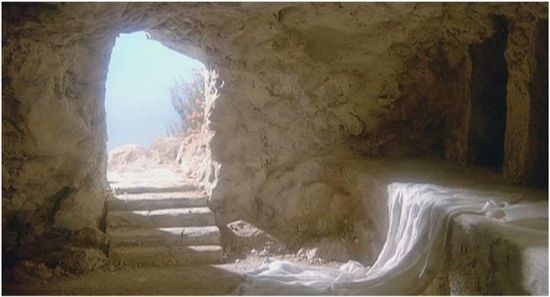
    HeIsRisen
    Hearing that strong assertion, the Christian answers joyfully, ‘He is risen indeed!’

    For us, Christmas is the promise, and Easter its fulfillment.  The summation of all Christianity is Christ’s covenant in the promised transcendence of Man, all concentrated into one simple declaration – ‘He is risen!’  Without this, our faith is a fraud; with it, Christianity promises Man to become an unending part of God’s love of all of Creation.

  • George Rebane

    Surfing Bob Crabb’s blog, I tarried on his 6apr12 post ‘The haunting question’ which invites the reader to abandon their left/right extremes and seek the political middle ground.  Bob is a master cartoonist of the soci-political genre and an astute observer of the Human Foible.  His graphic talents are augmented by his able lexicographic fare.  Mr Crabb has long made his cache the careful threading of that illusive center of American politics.  In this IMHO he succeeds more often than most.  But when the really turbulent issues require him to lean this way more than that, it seems he does take greater comfort from a tack to port.

    Upon reflection, what intrigued me about his 6apr12 post was the now obligatory standard for characterizing both ‘extremes’ that he used to summarize the political poles.  The American Left as “environmentalists, …, tree-hugging, frog loving communists” whose unifying goals are “gutting the Constitution and surrendering to UN authority”.  The American Right are predictably “property rights people and greedy opportunists” who desire to “pave every acre of (an) earth” that is to be ruled by multi-national corporations and the almighty dollar”.

    The illuminating part of this oft-imbibed screed is that the Left freely admits to its goals in its many publications/speeches that call for a re-interpretation of the Constitution so that it is not seen (per Obama) as a “document of negative liberties”, of restrictions and inhibitions on the role and power of government.  And the Left’s public promotion of a global government that does away with sovereign nation-states and equitably redistributes wealth across the globe is now over a century old.

    On the Right we find no one who wants to “pave every acre of earth” or to have a government by hegemony of global multi-nationals to rule over us.  (In capitalistic free markets competing corporations can only profit and prosper by growing the wealth of their customers and the economies in which they live.)  So the Left’s characterization of the Right continues to require ridiculous hyperbole that may catch an anecdotal extreme here and there.

    And that is the nature of the debate that those seeking the center-line regurgitate to both sides.  But those who think, on either side, will reject such kumbayahs to the middle.  Even President Obama, who wants to make FDR look like a raving capitalist, this week cemented his stand on the futility of leaving his progressive pole.

    Peggy Noonan in the 7apr12 WSJ reports on Obama’s polar outing last Tuesday to the nation’s mainstream media editors who are his constant supporters and long-acknowledged friends –

    And yet the president rapped their knuckles for insufficient support. In the Q-and-A he offered criticism that "bears on your reporting": "I think that there is oftentimes the impulse to suggest that if the two parties are disagreeing, then they're equally at fault and the truth lies somewhere in the middle." An "equivalence is presented" that is unfortunate. It "reinforces . . . cynicism." But the current debate is not "one of those situations where there's an equivalence." Journalists are failing to "put the current debate in some historical context."  That "context," as he sees it, is that Democrats are doing the right thing, Republicans the wrong thing, Democrats are serious, Republicans are "not serious."

    It is clear that when the brass knuckles come out in this election year, this man wants no compromise about where the both sides should meet to do battle.  This is not to be hand-to-hand, close quarters combat in the middle, but a long range artillery exchange fought from both extremes of the political landscape.  And guess what, I think that both sides are right on the mark on their stance.

    Nothing will make it more clear to the dimly lit electorate than highlighting the differences as much as possible.  Everyone knows that the so-called center of the road is where the business-as-usual takes place which has gotten us to where we are, where all principle winds up as putrid roadkill.  And in taking these clear positions Bob Crabb’s haunting question, ‘What if both sides are right?’ is already answered – no mushy, muddling middle for voters in 2012.

  • George Rebane

    In my long career I have experienced uncounted communications with the IRS in the corporate world, through the non-profits seeking to do good, and on personal tax matters.  Now, it’s no secret that the IRS is populated with some of the dimmest and nastiest bulbs in the federal firmament who have no idea how the wealth is created that keeps the nation’s wheels turning, including those big wheels of the federal government they unwittingly serve (and these numbers are about to be increased by thousands more to enforce the diktats of Obamacare).

    I suggest that, to help draw attention to the damage these bureaucrats cause to the body politic and the public weal, every communication with the IRS should end with a postscript that summarizes and draws attention to the gratuitous and punishing costs they impose on us and our economic enterprises.  A suggested draft could be worded as follows –

    ‘P.S.  The work to complete and transmit this reply has cost me/organization xx staff hours in deciphering your original request, researching information required for reply, consulting with tax professionals, filling the appropriate forms, and returning them to you.  The direct dollar cost of just this one unproductive effort is approximately $xx, a sum which could have been used for more profitable purposes in furthering my/organization’s objectives, and securing the jobs this company provides.’

  • George Rebane

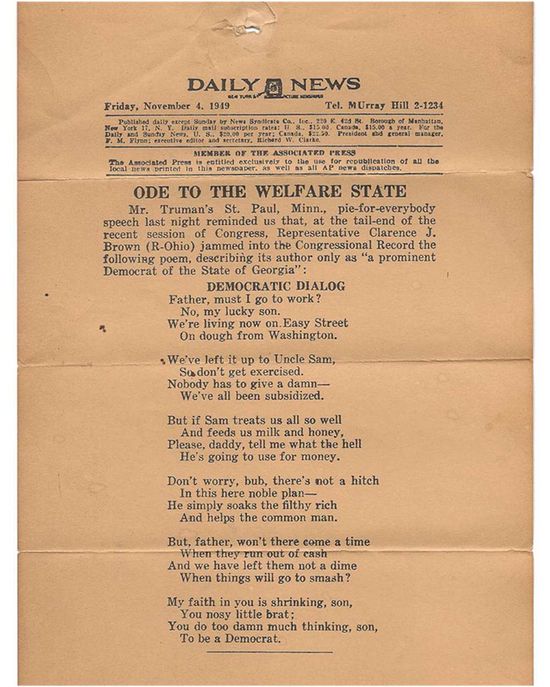
    A reader sent me this little blast from the past, published in the year I first set foot on these shores.  The ode below was composed as it became clear that the nation’s flirtation with communism in the Great Depression had not been fully purged by Truman’s partial efforts to sunset some of the more egregious New Deal programs after WW2.

    As taught by many economists and political philosophers of the classical liberal persuasion and Austrian schools (Mises, Hayek, Hazlitt, Friedman, …), socialism is a cancer of democracy.  Any trace that is left, inevitably begins throwing out shoots and growing again.  There is little hope of eradicating it, only assiduously nipping it in the bud before it begins its inevitable road to metastasizing the body politic.

    And we have not nipped it in the bud.  Instead our public schools have now graduated two successive generations of citizens who are either collectivists or don’t know the difference between collectivism and a freshly painted corral post.  But we cannot claim to have not been warned, and are now arrived at the end of the long road which for both ourselves and the Europeans is turning into a trail of tears.

    OdetoWelfare

  • George Rebane

    Memo to file:  The President again denigrated his base constituencies today when he lectured them on how SCOTUS must deal with Obamacare.  The former Harvard constitutional law professor solemnly informed his supporters that it would be unprecedented and the worst form of judicial activism for SCOTUS to overturn Obamcare’s individual mandate.  After all, this piece of legislation is one that had been passed by majorities in both houses of Congress, presuming that other such legislation becomes law without the support of Congressional majorities.  Therefore overturning a law with such a compelling provenance would be epochally improper.

    And with little risk of embarrassment, all this was delivered to his stalwart, yet butt stupid, supporters in the most serious terms in the Rose Garden as the Canadian prime minister and Mexican president looked on.  More educated commentators were a little stunned when later asked to properly frame these remarks.  But everyone seemed to agree that the statement was indeed directed correctly to the politically receptive and established aggregate capacities of those that have always characterized his base, in spite of the remarks being totally devoid of factual content.

    (more…)

43 comments on On the sorry road to Stockton (updated 16apr12)