

George Rebane
It’s usually tough to divide up a set of assets when a partnership breaks up, spouses get divorced, or any set of in/divisible assets or resources must be allocated between multiple parties. The study of fair division algorithms has seen a considerable amount of research and it isn’t over yet. A good fair division algo that is adopted by negotiating parties will go a long way toward achieving a mutually acceptable outcome. I have found Fair Division: from cake-cutting to dispute resolution (1996) by Brams and Taylor to be an excellent survey of such algos.
We all know how two people should divide a cake into equal pieces so that neither would have a reasonable complaint – the algo prescribes that one cuts the cake, the other chooses his piece. But what happens when there are three or more people who want to divide the cake equally, or even to divide the cake into agreed upon portions? You can see how things can get complicated very quickly.
In this edition we will consider a simple yet powerful algo – let’s call it FD01 (developed by Bronislaw Knaster) – that allows two parties to divide up a disparate set of indivisible assets, one of which consists of cash. The entire schema for FD01 is shown in the spreadsheet figure below.
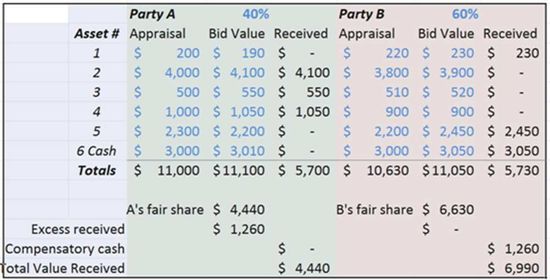
The left column lists the six assets (the cash asset is not required). Parties A and B agree that their split is 40-60 respectively as shown. Each party has the assets appraised. This step is not required, and may be completed mutually if desired, or the two appraisals may even be shared.
Both parties, using all the information available to each that may include tax considerations, future plans, and knowledge of the other’s propensities, will now place a ‘bid value’ by each asset that represents his own assessment of what he considers to be the dollar value of the asset to be used in the subsequent calculations. Each party submits a sealed bid list for all assets to be divided. The bid values for each are listed in their respective columns.
As agreed before hand, the bids may be submitted to a mutually agreed upon agent who applies the FD01 algo, or the parties may just work the shown spreadsheet by themselves. The next step is to assign each asset to its highest bidder. Each party then receives the assets at their own bid values as shown in the Receive column. In the example, Party A received assets #2,3,4 for a self-assessed total of $5,700. Pary B received assets #1,5,6 for a self-assessed total of $5,730.
Party A’s value for all the assets totaled $11,100 of which he would expect to receive a fair share of at least 40% or $4,440 as indicated. Party B’s commensurate total value turned out to be $11,050 of which he would expect to receive a fair share of at least 60% or $6,650 as indicated.
Returning to the self-assessed total values that each received in the division of listed assets, it is clear that Party A received $1,260 in excess of his $4,440 fair share. At the same time Party B’s self-assessed value of received assets falls short of his expected fair share of $6,630. The algo concludes with each party writing a check to the amount of their self-assessed excess to the other party. In the example Party A, after writing Party B a $1,260 check, winds up with $4,440, his exact self-assessed fair share. Party B receives a total of $6,990 which is nominally $360 in excess of his $6,630 self-assessed fair share. Neither party has grounds for complaint since each received at least as much as they each expected from the fair division.
Finally, from Party A’s perspective the bid total for Party B was $5,400 and his fair share should have been 60% of $11,100 or $6,660. Therefore, from Party A’s perspective the assets received by Party B gave him a $1,260 shortfall. Party A is then satisfied that the $1,260 check he gave to Party B brought him up to his fair share as assessed by Party A. Both parties have therefore done well in their own and in each other’s eyes.
Multi-party use of the FD01 algo
If three or more parties wish to use FD01 in fairly dividing a list of assets according to agreed on proportions, then the algo can be applied sequentially. If three parties are involved, then two parties working together will bid against the third party. After that the two remaining parties will divide their mutual assets from the first division as described above. It should be clear that this same divide-and-conquer approach can be used with any number of parties.
There are more complex fair division algos that can be used in a one-shot fashion for multiple parties.
I leave you with an exit exercise – try to game FD01 with some bidding strategy that would benefit one side against the other. If you succeed, tell us about it – or not 😉


Leave a Reply