
George Rebane
[For a change of pace from the heated discussions of our country’s future and the fate of Man, I ran into this little vignette from a past correspondence, and thought that I would share it to see what kind of a response it would draw from the eclectic intellects I am grateful to count as RR readers. Jo Ann’s late Uncle Jerry was a chemist, artist, and a well-read intellect himself. This piece is from the 6apr07 entry in my journal.]
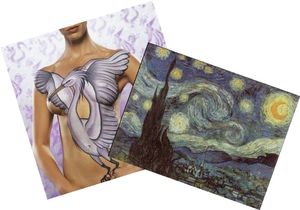 Some time ago Uncle Jerry and I went around on the question ‘what is art?’ Or longer, can a person tell if something he is experiencing is art? After some back and forth Jerry came to the conclusion that art can not be defined, only experienced and assessed on an ad hoc basis. He also implied that being able to arrive at a precise definition of art would somehow cheapen or detract from the entire notion of art in the human experience. I, as a technician, value the utility of precise operational definitions and believe that their abundance in any culture only serves to improve the human condition. By ‘operational’ I mean formal or algorithmic to the point that ultimately it can either be programmed on or learned by a non-human (e.g. machine or alien intelligence).
With this preamble I will now ramble on and reconstruct the definition of art that became my contribution to that lost exchange. …
Art is an intentionally created stimulus the purpose of which is to give pleasure to its Beholder by first and foremost removing him from the time and place of its experience, and in the process evoking either a new idea or notion that expands/extends the Beholder’s understanding of ‘what is’, and/or ‘what was’ for an experience the Beholder remembers. Second, art invites extension and repetition of its being experienced. And the more powerful the art is for the Beholder, the more that art will create a longing or yearning for experiencing it again.
Finally, art has the ability to extend and/or augment the Beholder in his very being. From that first experience the Beholder will now look at himself and the world in a manner changed. This in the sense that the art now joins or is integrated into his overall measure of how he henceforth beholds and experiences life. The relative power of art to the Beholder is itself measured in terms of the intensity and duration of each such effect on the Beholder.
The intentionally created stimulus called art can take the form of a static thing or a time extended experience – i.e. a painting, sculpture, …, or a song, symphony, movie, … . For concreteness we restrict the purposeful creator to be a human. Else the Grand Canyon can be included in the definition of art, with the putative artist being God. In this case the purposive link becomes a matter of debate which operational definitions seek to avoid.
The above definition has so far been personal and subjective to the extent that it is a one-to-one communication between the artist and the Beholder through the mediating art. Art in the cultural context is the extension of the above definition to a significant fraction of the members of a specific culture. In that sense, art requires a statistic to be added – e.g. more than 50% of the Moravians consider ‘this’ to be art. One American or twenty Americans cannot by fiat define ‘American art’ or art from America. For such a broadly accepted notion, more like-minded Americans need to be involved.
However, twenty people, perhaps, can designate something as art specifically for the members of the Nevada County Brass Musicians Marching Society or people visiting the Getty Museum. Their definition will be accepted to the extent that the one-to-one communications between Artist and Beholders is successful.
Finally, an Artist is a person who can create art on a volitional basis, and in so doing finds fulfillment.


Leave a comment