

George Rebane
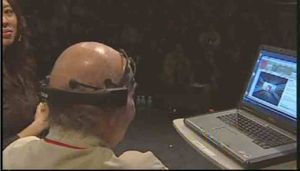 Controlling complex things with just thought has now been demonstrated by the company Emotiv Systems. I featured this revolutionary human-machine interface in the 15aug08 Singularity Signpost (please read for background) to give RR readers a heads up (pun intended) on the rapidity with which exotic technologies are being brought to fruition as we approach the Singularity. Emotiv has announced that it will start supplying this interface to developers of products ranging from computer games to vehicles and everything in between.
The non-invasive brain interface is now a reality. A machine can learn what your multi-point EEG is when you are thinking of complex controls like ‘rotate clockwise’, ‘go forward’, ‘close the file’, ‘make it disappear’, etc. Soon people will be dreaming up all kinds of things and situations where an individual (able bodied or disabled) can control any computer-mediated thing, device, or process by thought alone, or thought augmented by facial expressions. I suspect that it will not be too long until we can also get rid of the funny looking head piece, but as with anything this new, we first have go through the crawl-walk-run process.
To see what I’m describing here, please look at this video presented by Fora.tv (not a bad site to put in your Favorites if you’re interested in where Mankind is going). The 20 minute video is a bit long, but you’ll be astounded when a founder of Emotiv, Tan Le, demonstrates the beta version of the system with the recently departed AI legend Marvin Minsky as a subject.
For a more detailed look at Emotiv and its current plans and products, you can visit its website here. Those of you afflicted with capitalistic tendencies will no doubt muster an inner smile when you realize that a venture-funded private company beat the Army Research Organization undertaking a similar project. The applications of this kind of interface to military systems should be obvious. One can hope that Emotiv’s IPO will be soon, and that they will not first be gobbled up by a Google or Microsoft.
Finally, the tone of my last post notwithstanding, I do wish everyone a healthy and rewarding 2009, and hereby affirm that in this regard I have petitioned the Highest Authority that this will indeed come to pass.
*********
Tech Talk Addendum – Apparently what the Emotiv team of engineers/scientists did was to crack the code on how to decode the electronic song of billions of ongoing neural firings of the brain into a manageable number of EEG signals (under 20) that can easily be measured through a few scalp contacts. This signal can be viewed as point in, say, 14-space (the number of electrodes in their current head piece) which ‘hovers’ at a certain location, or ‘travels’ on a specific path or trajectory in this space over a few seconds interval when the subject is thinking of a specific command (‘volume louder’).
The computer must first learn where this point is or what this path in 14-space looks like, and it does that through a learning session as shown in the Fora.tv video. Every time the subject thinks the same thought command, the command’s measured point hovers at a slightly different point, or its trajectory takes a neighboring but slightly different route through this 14-space. The computer algorithm learns the variability of such points or paths, and stores in memory a ‘bubble’ of such points or ‘tube’ of such paths labeled, say, ‘volume louder’. Then when the subject next thinks ‘volume louder’, his EEG will create the point in 14-space, and if it is located in the ‘volume louder’ bubble or remains in the ‘volume louder’ tube long enough, then the computer will recognize that command and turn the volume up.
For any given repertoire of commands required to control some thing or process, the computer learns and stores the appropriate set of these labeled bubbles or trajectory tubes. And when the subject thinks the next command, the computer matches the scalp measured EEG point or trajectory with each of the stored bubbles or tubes. The the bubble or tube in which the EEG point stays the longest wins, and its related command is executed.
This is a simplified description and there are a number of other steps involved in cleaning up, transforming, and mapping the signals into the stored bubbles or tubes, but you get the idea of a likely approach that Emotiv is using. At least that is the approach that I would exhaust if given the problem of creating a “mind control” interface.


Leave a Reply