George Rebane
[This is the full length piece the first part of which was published today in the 15jul09 Union under the less dramatic title ‘Public Pensions – a breakdown’, although the latter part could be taken as a double entendre. (updated 16aug09) The full length version appears in the newspaper’s online edition. gjr]
Sophistry – a deliberately invalid argument displaying ingenuity in reasoning in the hope of deceiving someone.
The public pension ponzi is rapidly coming unglued as already pointed out in this newspaper and many others across the land. Only the most glaciated or glazed minds still believe the public sector has not been overpaid and over pensioned. The damage radius of the pension ponzi is much greater and more immediate than Madoff’s, and you are in it whether or not you pay taxes, and especially if you are a government employee.
In this short piece we’ll take a look at a typical pension formula and see how it is ‘used’. Without this basic knowledge, all you can do is react emotionally to the crisis. With it, hopefully, you will be able to direct your efforts productively. California and its pension fund manager Calpers will again be our poster child.
The basic Calpers formula that calculates a government employee’s annual pension is very simple –
Annual Pension = (# of Years Worked) x (Highest Annual Salary) x (Multiplier)
The multiplier is somewhere in the two to three percent range, and is usually set by the jurisdiction (city, county) or agency (CARB, NID). Grass Valley recently raised its multiplier from 2 to 2.5%. The multiplier will also vary for categories of work and retirement age – police and fire usually have higher multipliers.
Important to note right away – any percent change in any of the three factors in the formula becomes the percent change in the annual pension.
To nail it down, let’s use some numbers. Say Sam worked 30 years for Agency37 and maxed his annual salary at $90,000 somewhere along the way (the highest salary doesn’t have to be the one you have at termination or retirement). The current multiplier for Agency37 is 2.5% for retiring at 55. Sam’s annual pension from Agency37 then calculates to
30 x $90,000 x 0.025 = $67,500.
If Sam is expected to live until, say, 83, then Calpers has to have more than $1,062,000 in Sam’s name earning interest at 4.5% per year to throw off 28 yearly pension payments of $67.5K until Sam is expected to die. Calpers will invest this amount in a portfolio with thousands of other retirement accounts, and at retirement, handles Sam’s account as an annuity. An annuity is a fixed amount invested at a given interest rate that starts being drawn down by regular payments made to its owner. At the end of a stipulated number of payments the annuity amount is drained to zero. When Sam retires, this $1,062,000 needs to be in place at Calpers. (And yes, Sam is now a millionaire.)
This ‘given interest rate’ is another big bugaboo and source of a lot of mischief. The higher you assume it is, the less you have to have at the start of Sam’s retirement, and the less Agency37 thinks it must cough up when Sam does retire. For example Agency37’s books cook much better by simply assuming that Calpers investments will appreciate at 7.5% annually instead of the more realistic 4.5% used above. Why? Because with 7.5% Agency37 needs to provide only $781,200 for Sam’s retirement.
But we all understand that this is a game. Agency37 must pay Sam $67,500 a year for life, regardless of what numbers are used to cook the books.
And if somewhere along the way Agency37 decides to ‘upgrade’ its retirement program by increasing the multiplier from, say, 2 to 2.5%, as Grass Valley recently did, then this automatically incurs a huge and instant unfunded liability for the city. The jurisdiction will be underfunded by 20% for increasing the multiplier by ‘only a measly 0.5%’. The uninformed voters, ignorant of the basic formula, will focus on this seemingly insignificant fraction, and go back to their knitting without a clue that their liability just increased 25%. And this has happened thousands of times across California in recent years.
So far this has been pretty simple stuff, but absolutely required if you want to understand and discuss the major cost of government. But this is just the start of where the fun begins on public pensions. We will now see how the future cost of the pension system becomes an unknown to all concerned, how government employees game the system, and how the accountable jurisdictions make it into a ponzi scheme as they hope that the music never stops.
(more…)


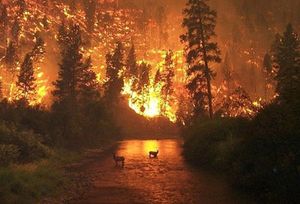 The newspaper’s headline blares that ‘The Yuba Fire 30% Contained’, you nod your head thinking that it is good news since yesterday the fire was reported to be only 5% contained. But then you take a look at the published burn area maps for the last two days and see that today’s fire area is significantly larger. And then you realize that you still have no idea what it means when someone tells you that a wildfire is X% contained.


