Rebane's Ruminations
November 2026
S M T W T F S
1234567
891011121314
15161718192021
22232425262728
2930  

ARCHIVES


OUR LINKS


YubaNet
White House Blog
Watts Up With That?
The Union
Sierra Thread
RL “Bob” Crabb
Barry Pruett Blog

  • George Rebane

    This is a weblog entry to update our ‘progress’ toward a fundamental transformation of America.  As has been discussed, we are past the tipping point with two alternative destinations that will redefine the social, economic, and political landscape of the North American landmass.  The first is the United Socialist States of America (USSA) that seeks a more draconian version of what has not worked in Europe.  The second is the Great Divide, which will fragment the continent into regions containing people sharing a more common culture and socio-political worldview.

    I suspect that the GD will require mass migrations (think of the formation of Pakistan in 1947) and may end up with the territory divided into a confederation of mostly autonomous mega-states sharing perhaps a ‘free trade’ zone.  But most certainly these mega-states will not share economic systems, language, or political philosophies in the sense of the Bastiat Triangle (q.v.).

    2012 is an election of great foreboding and diminishing hope for conservative Americans.  That the tipping point has been passed – the lazy, the lame, and the lightly learned populate way more than 50% of the electorate in a widening 'democracy' – will make it very likely that President Obama will serve a second term with, perhaps, an even more compliant Congress like the one he had during his first two years in office.

    As our first post-American President, Barack Obama sees his current job as a stepping stone to higher office.  Ascribing him as a secular socialist is the ‘model’ that continues to support the most reliable predictions about the social and economic policies that he seeks to impose on us.  By any measure, he is the most divisive president that the country has had since Abe Lincoln, and from the conservetarian vantage, the worst one since Lyndon Johnson.

    (more…)

  • George Rebane

    There is no question that governments at all levels have become less efficient from the taxpayers’ viewpoint.  This inefficiency is felt from many quarters and with respect to applied metrics, ranging from ‘bang per buck’, through layers of onerous regulations and mandates, to the ongoing removal of freedoms often through gratuitous criminalizations.

    We live in a county that, on the whole, is fiscally well managed.  However, in recent years many of us have started to notice some pretty significant lapses in how our elected officials do business.   As examples, we may consider the string of bad decisions made during the recent AtPac lawsuit (q.v.), the demonstrated and endured lack of competency in the county counsel’s office, and our county’s official discounting/denial of its unfunded pension obligations.  On all of these, the inquiring citizen faces a phalanx of tightly circled wagons, and is ridiculed for bringing up individual issues.

    The portent of the county’s unfunded liabilities are undoubtedly the biggest sword hanging over our taxable heads.  The amount that the county will have to pay out in the future (the out-years) is actually a complex calculation, and depends on not only the legal obligation to the public service retireds, but also on how much CalPERS will have in our account.  We have to remember that PERS is just an investment manager for the retirement funds the county remits to it.  PERS has no obligation to do anything except disperse what is in the Nevada County’s account.  (And then we are in a risk pool with a couple of hundred other jurisdictions like the profligate City of Bell, which is a whole other dimension of risk.)

    This account may go up or down, depending on the vagaries of the securities markets and how astute the PERS portfolio managers are.  Their obligation as a fiduciary is only to do their best, come what may, and also to tell us their best estimate of what our unfunded part is when payments come due.  And that is where the problems start.  Local jurisdictions all over the country are basically in arrears, and many cities and counties are on the brink of Chapter 9 bankruptcy.

    In California, Stockton is our next city that is prepared to file.  The San Francisco Chronicle has a more complete report on the entire situation in the state, and it isn’t pretty.

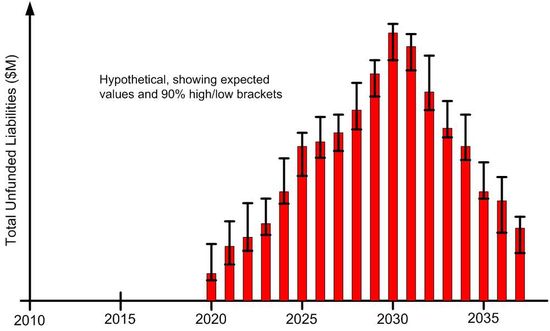
    Added to the above calculations we have at least one “side fund” and yet to be explained amounts of monies due that are not shown on the county’s financial statements.  The situation is murky indeed, and our electeds are not exactly leaning forward to clear up the obligations that are facing us.  What I would like to see is a chart like the one below that shows by year Nevada County’s total known and anticipated obligations with error brackets showing the high-to-low range.

    UnfundLiabDisplay
    For more a higher level perspective, we recall the 2009 quote by Mr Ron Seeling, Chief Actuary of CalPERS –

    “I don’t want to sugarcoat anything. We are facing decades without significant turnarounds in assets, decades of …unsustainable pension costs of between 25 percent of pay for a miscellaneous plan and 40 to 50 percent of pay for a safety plan …unsustainable pension costs. We’ve got to find some other solutions.”

    And things have gotten worse since then.

    (more…)

  • George Rebane

    This afternoon TechForum2012 passed into history as a wonderfully successful new type of luncheon speaker series focusing on the accelerating technologies that will affect all of us in how we work, play, learn, live long, and prosper.  The event was sponsored by the Sierra Economics and Science Foundation to support its ongoing and expanding merit scholarship program built around its flagship annual TechTest, now in its sixth year.

    It was heartening to see the community join in to support this fundraiser to encourage Nevada County’s young people to choose careers in science, technology, engineering, and mathematics (STEM).  America’s decline in STEM qualified workers has put our country at risk, and we believe that grass roots programs such as these developed and funded by SESF are a hopeful start on America’s road back.  The fundamental objective of the TechTest programs is to serve as a template and resource to other counties and regions across the country, inviting them to stand on our shoulders and start their own merit scholarship support efforts to invite qualified young people to choose STEM careers.

    TechForum2012_24feb12

    Today’s SRO event had an attendance of over 160 community leaders from the media, government, education, and business.  Our guest speaker was Mr Rick Hutley, VP of Global Innovations for Cisco.  Rick Hutley is a world class business executive and motivational speaker on the leading edge technologies that are shaping all of our tomorrows.  Russ Steele, SESF’s Executive Director, and I had the pleasure of starting the day with Rick with a congenial breakfast at Toffanelli’s.

    The entire event was planned and managed by SESF volunteers Ms Laura van den Berg (Event Manager), Mr George Foster, and Mr Russ Steele representing the SESF board.  Laura did an outstanding job in pulling together the furball that these projects all start out as, and served as the event’s mistress of ceremonies.  Truth be told, she did marshall husband Luuk to help here and there.

    Special thanks go to the distinguished array of TechForum2012 sponsors that include NCTV, The Union, KVMR, KNCO, AJA Video Systems, NCCA, Christine Foster Realtor, Olympia Mortgage and Investment, Grass Valley Chamber of Commerce, Nevada City Chamber of Commerce, ERC, the County of Nevada, and, of course Cisco Systems Inc.  Their prompt and visible support made this launch a merited and meaningful standard for future TechForum events.

    On a personal note, I was heartened to see the extreme interest in the reaction and participation of the attendees.  Rick is disposed to an open give-and-take format of a presentation wherein questions can be asked at any time, and they were.  This gave rise to a number of interesting and illuminating detours that added to the prepared remarks.

    Rick’s talk touched on the implications and impact of the approaching Singularity (q.v.).  He outlined the progression of Turing test (q.v.) mitigations as machines become more intelligent.  All this progressing to the point of dismissing the utility of that classic test of machines achieving peer intelligence with humans.  His conclusion was to substitute the test of whether humans consider machines as useful peers and partners in managing our resources and affairs, that would stand in for Turing and the Singularity.  I suggested that perhaps a better test would be the event when machines weigh in and assess the utility of humans as their peers in managing this planet’s affairs.  Rick Hutley mused that this indeed might be a better sign of fin de siècle, and graciously named it the Rebane Test.  In any event Rick is not a strong proponent of the near-term advent of Singularity, even though on one of his summary slides he did note that machines would replace all human workers by 2035.

    As you see, dear reader, this was a lively and informative presentation with the attendees sitting at the edge of their seats.  The presentation and its Q&A went well beyond its scheduled time with the room filled to capacity.  Afterward, the podium was crowded with people seeking to continue the discussion with Mr Hutley and other attendees.

    Rick Hutley set the bar high for our next TechForum, and I want to assure all that SESF and its team of volunteers will do everything possible to meet these standards when we again assemble for TechForum.  In the interval, we have the last seminar for TechTest2012 tomorrow at NUHS, and the exam itself will be given on 14 April 2012.  Please visit sesfoundation.org for more information.

  • George Rebane

    [This is the transcript of my regular KVMR commentary broadcast on 24 February 2012.  Addended to it are links to reports on the Heartland Institute’s current issue with Dr Peter Gleick.]

    I want to put the current Heartland Institute imbroglio into its proper and larger context – namely, the ongoing and intensifying efforts by the media and institutional Left to silence the country’s conservative voices.  Before looking at the Heartland dust-up, let’s go back a few years.

    About 1920, radio burst onto the national scene as the cheapest and most effective way to get the word out to people numbering in the thousands that quickly multiplied into the millions.  Everyone from plumbers to politicians began using the new medium to hawk their wares, ideas, and opinions.  Politically we were still in the thrall of Teddy Roosevelt and Woodrow Wilson’s progressivism.   And therefore only seven years later, Congress became so worried about the widespread impact of radio on ideas and opinions, that it passed the Radio Act of 1927.

    Academic Mark Goodman wrote an important and lavishly referenced paper wherein he states that “…Congressmen feared radio's potential power to prompt radical political or social reform, spread indecent language, and to monopolize opinions.  Therefore, the FRC (forerunner of the FCC) was empowered to protect listeners from those who would not operate radio for ‘public interest, convenience, and necessity.’”  That started what has become our government’s on-and-off war on free speech.

    (more…)

  • George Rebane

    One need only consider the aftermath of Republicans Romney, Santorum, Gingrich, or Paul making such an appeal for voters of their color to stand together in the 2012 election.  But there is much more in this video than can be absorbed in one viewing.  Take your time and please visit AFRICANAMERICANS.BARACKOBAMA.COM.

  • George Rebane

    There was an interesting essay in the 18/19feb12 WSJ adapted from Alain de Botton’s latest book Religion for Atheists: a Non-believers Guide to the Uses of Religion.  It is really a lament about all the things that atheists are missing out on that come to people of faith who gather to worship their God.  Everything from “reclaiming community” to finding commonly shared purpose in life, and all the trimmings that go in between for folks in a faith-based organization.

    It seems that atheists are somehow not fulfilled in their flirtations with environmentalism, productivity seminars, yoga, moral relativism, and endless group and individual analyses by various therapists and psychological ‘rent-a-buddies’.  There seems to be an emptiness underneath it all that is not only perceived by the hard-working career climbers, but is made more stark in the built-in loneliness that comes from attempting to connect with people with whom there is really no common connection.

    Well, according to M. de Botton, there is a solution at hand that can bring our secular humanist friends into a chummy communion with other similarly searching souls (which really don’t exist).  It turns out that atheists can join with each other just like the bible thumpers, but without all that God baggage.  And the solution lies in starting an institution, or is it really a franchise, called Agape Restaurants (I’m not making this up).

    The Agape Restaurants would become the locus of congregations following the Book of Agape prescribing a liturgy that is cobbled together from the essential essences of the Catholic Mass, the Jewish Seder, the Zen tea ceremony, … you get the idea.  People would assemble there to go through the warm and bonding formalities that bring and hold together people of faith.  They would even get to ceremoniously consume the moral?, ethical? equivalent of the Eucharist.

    In his ‘Religion for Everyone’ de Botton tells us of the glorious gemütlichkeit of such venues –

    Thanks to the Agape Restaurant, our fear of strangers would recede. The poor would eat with the rich, the black with the white, the orthodox with the secular, workers with managers, scientists with artists. The claustrophobic pressure to derive all of our satisfactions from our existing relationships would ease, as would our desire to climb ever higher in social status. …

    The Book of Agape would direct diners to speak to one another for prescribed lengths of time on predefined topics. Like the famous questions that the youngest child at the table is assigned by the Haggadah to ask during the Passover ceremony ("Why is this night different from all other nights?" "Why do we eat unleavened bread and bitter herbs?" and so on), these talking points would be carefully crafted for a specific purpose, to coax guests away from customary expressions of pride ("What do you do?" "Where do your children go to school?") and toward a more sincere revelation of themselves ("What do you regret?" "Whom can you not forgive?" "What do you fear?").

    So there you have it.  You should be able to embrace it all without having to consider any of the aggravating absolutes that come with a religion that teaches transcendence as the gift of grace from a supreme intelligence who created all that IS, and through love and compassion is willing to share all with His critters.  None of those things need to divert us from creaming the good parts of 'TAT TVAM ASI!'  From a thorough analysis of religions, the secular humanists have finally figured out how to fill their emptiness and enjoy it all. For it’s now or never – remember, oblivion awaits.

    And yet, and yet …

  • George Rebane

    The fraction of technical workers in America stopped increasing in 2000, and actually decreased until 2006 when it seemed to flatten out.  Now that fraction has started going down again.  All during this time foreign-born scientists and engineers have been making up more and more of this meager workforce, working in professions that our Johnnies and Susies are rejecting in ever greater numbers.

    For readers wondering what all the fuss is about, we recall that it isn’t the talents or efforts of our lawyers, MBAs, or even assembly line workers that invite the world to beat a path to Market America to buy our goods or services.  It is ever more the technology savvy worker that is at the head of the food chain that generates wealth and keeps the country from sinking faster than it already is.  And the fraction of those troops is going down.  (More in the 17feb12 WSJ from where the graphic is filched.)

    STEMworkforceFraction

    Here in the US of A there are still some of us who keep wiggling mightily to attract more young people into the technical trades and professions.  In this effort we persevere into the teeth of an educational gale that is tuned to turning out graduates most suited for becoming government employees – workers who need ever higher taxes to keep them satisfied.

    Locally, an effort in this direction is TechTest, a merit scholarship exam from SESF (www.sesfoundation.org) that is now in its sixth year.  TechTest2012 will be given on 14 April 2012.  Next Friday (24feb12) SESF, a 501c3 organization, launches TechForum2012, a luncheon and speaker series for raising scholarship monies for what have come to be known as the TechTest ‘survivors’ (highest scorers).  TechForum is a value-added conclave for Nevada County’s business, government, and institutional leaders that features world-class speakers talking about current and coming technologies that are relevant to our region.  Next Friday’s guest speaker is Mr Rick Hutley, Cisco’s VP for Innovation. TechForum is also open to the interested general public that wants to get informed, and support our young people headed for technology based careers.

  • George Rebane

    The Greeks are rioting in the streets again.  They don’t like the new tranche of austerity measures that their parliament was forced to levy on the country.  This was in response to the northern eurozone countries imposing more conditions before giving Greece its next bailout check of approximately $170B in March.  The north, led by Germany, is keeping a wary eye on Greece to see if these austerity measures will be made to stick.

    Greece’s big unfunded liability is of the same stripe as ours – entitlements that range from public employee pensions to healthcare.  We recall that in Greece one out of four workers is unproductively employed by the government.  And up until now, the parliament doesn’t even want to put public sector pension cuts on the table.

    The markets in Europe and America are acting insanely as they digest the daily dribble of news from Brussels and Athens.  ‘Are the Greeks going to make it?  Well maybe, and then again, today it doesn’t look like it.’  My long held view that Greece will tank is getting more certain by the day.  There is no hint that with the March check, the Greeks will be any closer to financial stability than they are today.  They’ll use that cash to service their national debt, make government payroll and pension payments,  and buy time in dickering with their bond holders to take a 50% haircut.  But none of this will put the country on to a path of fiscal recovery.  After the March check, they’ll start rioting for the August or September check.

    ElDoradoShoresAs a political and finance junkie, I keep asking myself as to who benefits from this silly dance with the foregone ending.  The only answer I have been able to cobble together is the ruling elites and the rich guys.  They are buying time to get their finances rearranged, relocated, and redoubted (hidden in places their governments can’t get it, see nearby chart).  So when it finally hits the fan, and spreads from Greece around the European shore of the Mediterranean to the northern countries, the remaining visible wealth of the smart people will be small enough to surrender without really affecting the quality of their lives.  The delay also gives the clever people time enough to get out of Dodge, whether that be a political office or country of residence.

    Countries like Switzerland have been the monetary redoubt for the smart and wealthy for generations.  But now that security is being breached by developed nations led by the US.  The Swiss are now the prime target of big countries who want to know who of their citizens have how much squirreled away where.  While the Swiss and others are putting up a fuss to the likes of America, they have no intention in getting out of the numbered bank account business for the rich of the less developed and muscular countries.  From these countries it is still easy to pull profits from your nation’s natural resource sales, or even foreign aid from idiots in America, and get it into your secret accounts on some ‘El Dorado shore’.

    (more…)

  • [This is the submitted form of my regular Union column that was published in the newspaper’s 11feb12 print and online editions.]

    George Rebane

    “Engineers in the European Union are free to work anywhere in the 27 member states, but recognition of their professional qualifications is often a stumbling block.”  So starts ‘Passport to Engineering’ in the February 2012 IEEE Spectrum, the prestigious flagship periodical of the world’s premier professional organization for engineers.  Europe’s engineers are about to be carded with a little piece of plastic – the new “engineerING card” – that is supposed to help them find engineering jobs all over the EU.

    The card, developed by the European Federation of National Engineering Associations, will contain information about its holder’s education and “professional qualifications in accord with internationally recognized standards.”  The cards will be issued by the engineer’s country of origin.  Supposedly, with this card it will be easier for a Spanish engineer to get a job in Sweden.

    The problem is that each country has its own standards for what is put on the card, and also what kind of government agency or bureau issues the card.  Some of these organizations don’t know jack squat about engineering.  Nevertheless, everyone is talking about Brussels making these cards into a legal gateway for engineering employment in the EU on the basis that it would facilitate cross-border hiring of technical types.  I’m not so sure.

    Before looking at the ‘oops side’ of this bureaucratic brainchild, let’s back up and consider what the historical open market in engineering talent has brought to our civilization.  In free capitalist countries anyone who could do engineering could call himself and engineer – even correctly spelling it was optional.  People with ideas, maybe with some education, and maybe with some experience would get in their proverbial garages and come up with all kinds of stuff ranging from telephones, airplanes, automobile assembly lines, and on and on.  Would you believe that even the most successful and long-lived Sidewinder air-to-air missile came out of a garage in Ridgecrest, California?

    (more…)

38 comments on The Great Divide – 29feb12 update on work in process (updated 4mar12)