Rebane's Ruminations
November 2026
S M T W T F S
1234567
891011121314
15161718192021
22232425262728
2930  

ARCHIVES


OUR LINKS


YubaNet
White House Blog
Watts Up With That?
The Union
Sierra Thread
RL “Bob” Crabb
Barry Pruett Blog

  • George Rebane

    Watching the news we were reminded that 20% of post-op patients are back in the hospital within 6 months at a marginal annual cost of almost $100B nationwide.  It is one of the biggest components in the expense of healthcare.  And we know that hospitals are very dangerous places for your health – medical mistakes kill over 100K patients annually.

    InHomeRecoverySo it occurred to me that a promising alternative to recuperating in the hospital would be to recuperate at home, a place that is usually much more free of all those drug resistant bugs comfortably ensconced in our hospitals.  Today, the desperate loved ones of patients essentially park themselves bedside in the hospitals to monitor what the staff and docs do and shouldn’t do.  The stories of the mistakes they catch are hair raising.  In addition, their being there provides much more attentive care to the patient who can otherwise go into early stages of starvation, bedsores,dehydration, over/under/mis medication, … when waiting for a response from a nurse.

    My solution is to bring the patient home and set him up in his own bedroom or house where a loved one is already in residence.  Bring all the electronic monitoring equipment along, and wire him up like in the hospital.  It doesn’t take much to add a smart (and tomorrow even smarter) box that communicates the whole myriad of readings to the hospital staff at the nurse’s station, and also to the cell phone of the home caregiver.  This is the caregiver who now doesn’t have to drive to the hospital, stay there interminably, and try to get some sleep in a chair.

    Besides the psychological benefits to the patient, the savings in such a set up would be enormous.  The caregiver can be taught fairly quickly to do almost all of the routine maintenance of the patient, including administering certain drugs and procedures under the direction of healthcare professionals at the hospital or the attending physician’s office (recall that we have video monitoring now).  When some combination of patient signs triggers an alert, the professional can contact the at-home caregiver to instruct him what should be done.  And, of course, if the situation is beyond the ken or capability of the caregiver, then a professional can be dispatched or the patient brought in.  But that is a low probability event over the aggregate population of such recoveries.

    Yes, there is always the chance that something can happen to the patient that requires the full facilities of a hospital’s emergency response capability, but again look at the probabilities.  No doubt some patients will die if this policy is implemented nationwide.  But I submit that the attendant morbidity and mortality rates of this approach will be insignificantly different from those encountered in hospital recoveries.  And none of this home care will take place without the full permission of the patient or his responsible agent.

    However, such enlightened approaches to healthcare will make a difference only when the informed patient (or agent) is allocating his own healthcare dollar.  The perception of spending other people’s money in any medical undertaking will only continue the insane policies of today’s government mangled healthcare markets that promise to become more so as Obamacare increases its cold embrace of the nation’s ill and infirm in the coming months.

  • George Rebane

    This is TechTest season, and we're in the middle of the preparatory seminars for this year's test to be given on 23 March.  In an ongoing discussion about Nevada County schools' performance in preparing students for STEM careers, I received a succinct summary (below) from a respected Nevada Union teacher about the problem we at SESF have observed now for some years – it appears that the malady is both entrenched and systemic.

    The
    main problem is the complete lack of technical focus in education.  How is
    it possible that any child can make it to Nevada Union and have never used
    Word and Excel?  Yet this is the case.  We have no computer science
    classes taught here and what is taught has to be done in too short a
    time.  Even the best and brightest students at NU are intimidated by
    technology. Not only that, they don't see why it is needed.  I think
    this stems from an education that does not stress its importance, most teachers
    have no background in any technical major and therefor avoid tech like the plague.
     The foundation
    needs to be set in the middle schools or perhaps even younger.  We have 2
    clubs here that are harboring some talent, but this constitutes about 0.5% of
    our student population.
    (emphasis mine, gjr)

    The US Postal Service reports a ‘loss’ of $15.9B last year.  We're told that $11B of it was a mandated payment into their employees’ pension fund.  With that union negotiated albatross around their neck there’s no way in hell that they can ever hope for solvency.  Another government agency bites the dust from pension corruption costs.  And the country’s Left continues to deny that public service pensions are taking jurisdiction after jurisdiction down the toilet.  Where is that elusive common ground?

    In response to the USPS woes a Berkeley city councilman (where else?) is proposing a national tax on emails to do what?  To fund the pension liabilities of the USPS, what else?  The Repubs may have shot themselves in the foot for sticking to principles and issues few people care about, but the Dems continue to demonstrate that most of them are simply certifiable.

    Well, it turns out that I’ve underestimated the deep doo-doo that LA is in and sinking ever deeper.  In addition to Vallejo, Stockton, San Bernardino, …, Moody’s says that 30 more California cities are on their debt downgrade list headed for bankruptcy, and odds are overwhelming that LA is one of them.  The city is in an awful state of disrepair, owes tens of billions, has most of its elected officials in some condition of corruption, an education system that is in the gutter, no major industry left besides the socialist socialites of Hollywood, … – the list goes on.  Meanwhile, Moonbeam and his merry morons in Sacramento have not a clue about what is happening other than trying to patch the state’s hundreds of billions in unfunded liabilities with yet more taxes.


    (more…)

  • George Rebane

    As we have noted for some years, California’s progressives now ensconced in Democrat super-majorities are continuing policies that are harmful to the economic health of those they claim to help, and whom they regularly bamboozle with their election year rhetoric.  Those folks are not all that bright since they keep voting for the same political shills year after year.  In recent times the pain has gotten so bad that there has developed an exodus of these middle class and poorer people headed for places where they can find work and afford to live.  The state’s lamestream, of course, keeps a lid on such news, but more journalistic national and international newspapers like the WSJ and The Economist are keeping a close eye on California.

    CalifExodus
    The Great Depression saw an influx of 1.3M from parts east like the Dust Bowl states.  But decades of Democrat control have now reversed the direction for the less well heeled – a net 3.4M have moved out over the last twenty years during which things have gone from bad to worse for all but the upper quintile of Californians.  Yes, the wealthier get taxed more, but to the real wealthy it really makes no never mind.  They have ways to avoid the pain, and therefore still continue to come and land on/near a California beach somewhere.  It has to do with esoteria like monetary utility (which I’ll talk about in the future).

    (more…)

  • George Rebane

    [This piece continues the RR series on the US economy and the factors taking it into new regions – unknown unknowns – during these pre-Singularity years.  As usual, the frail and the young should be spared from these deliberations.]

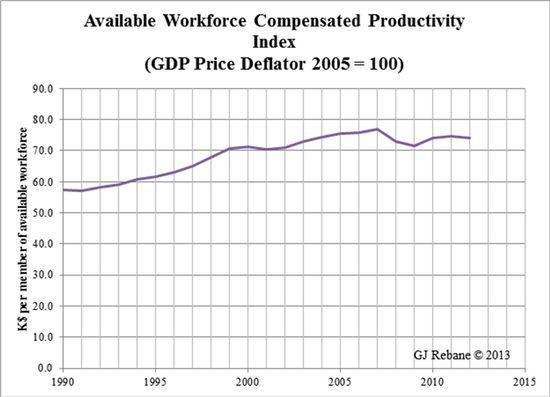
    Productivity of a nation’s workforce is an important metric in understanding its prospects for growth and its ability to compete globally.  The bottom line metric of workforce productivity has been to divide gross national product (GDP) by the number of workers involved in producing it.  But puzzling on it a bit reveals that there’s more to the story.  After all, we are talking about a nation’s ability to output product at some level of unit cost – note that I did not say ‘unit of labor cost’.

    Since the GDP of a country includes government spending, and since a big part of what government spends is in transfer payments that don’t directly support production (see figure in endnote), shouldn’t that somehow enter the productivity calculation?  Also, workforce members not participating, due to a number of reasons, are still sustained by the economy (to a large part by transfer payments), should they not be factored in since they remain as a ballast or deadweight in their unemployed condition?

    In short, if we were to compute a true productivity index for a nation in the units of productive GDP per each member of the workforce, whether employed or not, then we should compensate that index for these factors since they affect both growth and global competitiveness.  My effort to do that required searching for a lot of data that could be used commensurately.  The result is shown as the ‘Available Workforce Compensated Productivity Index’ (AWCPI) which uses the workforce as consisting of the total of employed and unemployed for any given year.  The GDP is compensated by subtracting out that year’s direct transfer payments, but leaving in any multiplier effect from such payments – i.e. a consumer spending his unemployment check on household expenses, entertainment, etc.

    AWCPI

    (more…)

  • George Rebane

    ObamaChange4America is being harmed beyond measure by its government.  It is no longer death by a thousand cuts – we have advanced to the slash and burn level of self destruction.  The Competitive Enterprise Institute in cooperation with the Weidenbaum Center has compiled these astounding stats from the feds’ own data.  Under the Obama administration –

    –    $1.752T is the FY2012 cost of regulatory compliance inflicted on the country’s private sector.  This is more than one tenth of the country’s entire GDP.
    –    In FY2012 Obama issued another $216B in regulatory costs.  This was actually an election year pullback which will be remedied in the remainder of his second term.
    –    In FY2013 the feds will spend $59B in regulatory enforcement.
    –    Regulatory agencies employ 283,600 people in full time staff positions.

    And according to the WH Office of Information and Regulatory Affairs (the outfit run by Cass Sunstein), during the Great Recession (aka Depression2) –

    –    Obama’s administration issued five times more regulations during his first three years than Bush2 in his eight years.
    –    The cost per regulation for Obama has been 3.5X the cost under President Clinton.

    And this is only a small part of the whole trail of tears onto which Washington has marched the country.  It is hard to accept that this self-administered pain and suffering during a time of economic hardship is being inflicted by a pro-America government vs a regime with another agenda.  Perhaps we err as we hopefully continue to view it as iatrogenics.


    (more…)

  • George Rebane

    Detroit is cueing up as the nation’s latest testimony to collective mismanagement.  It is truly the poster child for what happens when you mix capitalist hubris, progressive pap, unions (public and private), and politically correct ignorance with generous dollops of corruption.  The result is a city that is now on the last stages of life support, a city where the remnants of those who can are leaving, and leaving it to those who can’t or won’t.  Or as the WSJ puts it, Detroit is “a sprawling city with $14 billion in debt, a depleted tax base, a legacy of government corruption—and very little time left to avert financial collapse.”  Chapter 9 bankruptcy is in the offing.

    Few cities have had the geographical advantage and abundant gifts of commerce that blessed post-WW2 Detroit.  In 1950 its population was 1.5M, and today it has shrunk to 700K, as the productive and civilized are still taking their leave in droves.  The latest we hear is that the state of Michigan will take over, and run the city with an appointed ‘financial manager’.  Readers already know that Detroit has debt and unfunded liabilities hole too deep to climb out of (see ‘Hiroshima+66, Detroit+welfare’ and here).

    Chapt9filings2012
    Detroit is just the latest and most visible on the list of cities across the country going under.  (See nearby interactive map for the most recent jurisdictions filing Chapter 9.)  California, of course the leader in all things social and socialist, already sports a Chapter 9 club with Vallejo, Stockton, Mammoth Lakes, and San Bernardino as members.  And its crown jewel, the City of the Angels, is quietly fighting insolvency.  A look at the nature of LA’s fiscal countermeasures again gives lie to the leftwing denial that public service unions and their pension programs are not to blame for the nationwide scourge (here).  But there will be anything but crickets if LA has to declare insolvency.   I believe Sacramento will sacrifice everything except its socialist goals to keep that from happening.

    FederalStimulusAcross the country teetering giant Atlanta is also fighting to avoid following in the footsteps of another big southern jurisdiction, Jackson County.  It is considering the sale of major city infrastructure assets to keep the wolves from its door (here).  And so this is a small sampling and an update of what it looks like on the other side of the tipping point as the feds continue to use their fiscal proctoscope to stimulate the country’s jump off the real fiscal cliff.  As usual, the government always starts on the wrong end of the problem.

  • George Rebane

    [This is the transcript of my KVMR commentary broadcast on 1 March 2013.]

    It’s hard to think good thoughts about what is going on in Washington and the competency of our government.  We seem to have entered into an endless sequence of crises, questionable appointments, and scandals which literally have no end – they now stretch into the future as far as the eye can see, and then there are still more out there waiting that we can’t see.  As a political junkie even I am overwhelmed.

    We just concluded cabinet appointments that made it not because of the candidates’ sterling resumes – they are arguably awful – but simply because of party loyalty.  The guy for Secretary of Defense was at a loss to explain anything that was relevant to his office, and the Secretary of the Treasury candidate told the Senate that he didn’t really know what he did in private practice, why he got those big million dollar bonuses, and what experience recommends him for the job.  Nevertheless, these two are now the worthies one of whom will maintain our national security in the face of shrinking defense budgets, and the other one will be in charge of keeping China lending us money they will never see repaid.

    And the borrowing will go on forever because we will never bring our federal budget under control – all budgets and obligations call for every aspect of spending to increase indefinitely.  Washington’s claim of reducing spending is a very big fairy tale told repeatedly to a very large population of faithful morons.  The rule to spending cuts is simple – publicly plan to spend at some arbitrary and prodigious rate, then with much breast beating reduce the planned outlays to their usual budget busting levels, and then credit the difference to your having reduced spending – the sheeple will never know.  Meanwhile, the actual dollar amounts of spending just keep roaring upward year after year.

    (more…)

  • If you see fraud, and you don’t shout fraud, you are a fraud. – NN Taleb

    George Rebane

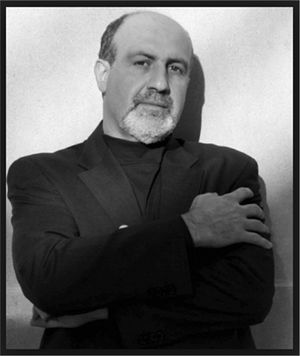
    TalebAmong other things Nassim Nicholas Taleb is a flâneur, mathematician, probabilist, systems thinker extraordinaire, philosopher, elitist, and most certainly a curmudgeon.  I ran into him years ago when doing some research in financial engineering.  He had just quit being a successful Wall Street trader, and got a job as a college professor exploring and disseminating (mostly his) ideas about “decision making under opacity.”  The more I read him, the more I wanted to be like him when I grew up – so I became his student.

    Readers may have heard about Taleb when they first ran into the now well-worn notion of a ‘black swan’ event (q.v. and here and here).  Besides numerous technical papers on things like low probability events and infrequent happenings, he has written three books for the intelligent reader – the man is also extremely well-read, well-traveled, speaks several languages, and does not readily suffer fools nor write for the thinking impaired.  Fooled by Randomness (2001) was his initial foray in which he introduced Black Swan to a wider audience.  Because the book also introduced realworld risk taking in a new and revealing light, it was immediately picked up by the investment and banking communities, and we began seeing ‘black swan’ in the popular press.

    His next book – surprisingly titled Black Swan (2007) – expanded on the topics of risk that now reached into public policy making, and embraced people familiar with behavioral economics.  Somewhere in there he caught the attention of Nobelist Daniel Kahneman, who along with Tversky RIP, founded behavioral economics, and documented the foibles and fables of human decision making in his recent Thinking, Fast and Slow (2012), a must read in its own right.

    And after letting a few more years pass and his popularity (notoriety?) grow, Taleb decided to gather his own near and far thinking into one volume that he purports as his summa, Antifragile – Things That Gain from Disorder (2012).  The book runs over 570 pages with diagrams and squiggly laden technical appendixes.  In the process of covering the extension of his ideas to what Taleb calls antifrigility, he takes the reader through a wonderful journey of western philosophy going back past the Greeks.  Heavy emphasis is shown to Mediterranean civilizations since Taleb is an immigrant from Christian Lebanon, and all things Levantine (including things Arabic) are firmly embedded in his double helix.  But the reader also learns about fine foods and wine available in various hideaways all over Europe, as he is regaled with the inner workings of complex systems that have been intelligent enough to adapt and even thrive in hostile environments – Man happens to be one of them.


    (more…)

  • George Rebane

    Contemplate your god or oblivion, for it will reveal that you will never experience mortality, and at least in that sense you are indeed immortal.

    Concert pianist Van Cliburn is dead at 78.  Cliburn won world fame in 1958 by taking first prize at the first International Tchaikovsky Piano Competition in Moscow at the height of the cold war, a competition designed to highlight Soviet culture and musical talent.  And he did it playing nothing less than Tchaikovsky’s Piano Concerto Number 1 (more here).  This was also a time when I was starting to mess around with the piano at idle moments.  I was blown away by his interpretation, one that has since become a world standard. 

    After Jo Ann and I started dating, his artistry remained a part of our lives for years afterward.  We were both classical music fans and shared a habit with many other UCLA couples of going up into the Bel-Air heights during evenings now and then to enjoy the city panorama.  The radio was tuned to KFAC, the LA classical music station, and as we settled in at 8pm the Gas Company Concert came on with the triumphant opening phrases of Tchaikovsky’s Number 1 – talk about motivational music.  Two hours later the program’s end was again announced, this time by the concerto’s second movement, the languid refrain from its Adagio – it was time to start getting things together to go down the hill and back into the real world.

    And so it went during our undergraduate years as Sputniks launched, Camelot came to Washington, and Cuba and Berlin vied for the touchpoint for WW3.  Throughout it all Van Cliburn played his masterful rendition every weekday night for Los Angeles audiences that also included some young couples on local mountain tops in cars with foggy windows.  Thanks for the memories Van – RIP.

    LeoCollage

    And yesterday we also buried Leo.  Leo was a cat to behold, given to us by friends as a frisky little ball of black fur nineteen years ago.  We lived on Saddle Peak Rd in the Santa Monica Mountains.  This was wild country where on the roads or in your driveway you could see pumas, bobcats, coyotes, raccoons, owls, eagles, hawks, deer, …, and rattlesnakes galore.  We always took in cats and had lost over 30 of them to local predators (mostly coyotes and owls) by the time Leo arrived.  Cats were our first line of defense against rattlers, territorial critters that eat the same things that cats do.  The idea was to limit their food supply to keep their population down (in ten years we reduced the annual rattler kill rate from seven to one), but the kitties paid a price for our living in God’s country by also becoming part of the food chain.

    (more…)

  • Only in America could the people who believe in balancing the budget and sticking by the country’s Constitution be labeled as “extremists”.

    George Rebane

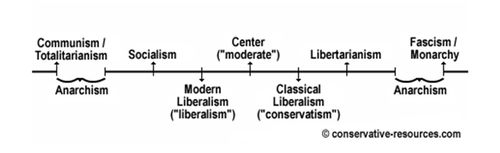
    Hereabouts and in more distinguished forums the governance debate continues as to which types belong to the Left or the Right.  The confusion from the Left’s academics seems to be with monarchy and fascism, and that stems from their use of the wrong set of coordinates that can productively frame the discussion.  In the minds of some pundits, the attributes of a given governance type are totally absent.  But when all is said and done, the modern progressives do accept a right/left view that is approximated in the figure below.
    IdeologicalSpectrum_progressiveWithout stopping to quibble about the specifics of what constitutes the ‘center’ or ‘moderate’, the single dimensional spectrum above does have some curious bookends.  The leftmost one ends in ‘communism/totalitarianism’, which state of affairs is reached after passing through a region where anarchism rules.  And the rightmost ends in ‘fascism/monarchy’ after also passing through anarchism.  The better read student here will immediately point out that the Left’s anarchism is not the same as that of the Right’s.  This is indeed correct, and I’ll have more to say about that below.  However, in this fractured view, regardless of each having traversed the swamp of anarchy, both sides terminate in totalitarian forms of governance under the absolute control of a great leader.

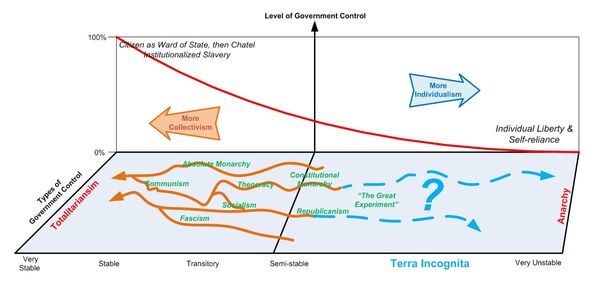
    A more accurate, useful, and historically exercised representation of ideologies and their supportive types of governance is given in the figure below (click to enlarge).  Here we use a representation common in the system sciences wherein one significant dimension/attribute is isolated as being perpendicular (orthogonal) to a plane that contains all the other dimensions/attributes.

    IdeologicalSpace
    For the discussion of ideologies and their supportive forms of governance, the dominant dimension shown in the figure is the level of government control of the land and the affairs of its people.  This ranges from a 100%, suffered under the absolute rule of a totalitarian dictator, to 0%, wherein anarchy is the order of the day and there are no visible institutions of state.  In the figure the variation in this level of control is shown by the thick red line in the plane (dimension) perpendicular to the field (multiple dimensions) of the types of government control, hence governance.

    Understanding this framework immediately clarifies the debate over what labeled ideology belongs where.  I have shown the various collectivistic labels distributed on generalized trajectories of governance as they proceed leftward (orange lines) in the direction of greater government control of wealth creation/distribution, property ownership, class memberships, and behaviors (liberties) permitted to the individual.

    (more…)

50 comments on Surviving healthcare better at home