

George Rebane
[This bi-weekly commentary aired tonight on KVMR FM89.5. Dr Hardin has been one of my lifelong teachers of social thought, the good fortune of which I had to run into him while still in my twenties. I highly recommend him to your attention; today his ideas are more important than ever. This piece is adapted from the SESF Numeracy Nuggets series.]
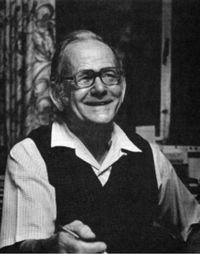 Garrett Hardin, the late professor emeritus at UC Santa Barbara, was an ecologist and world-class thinker. His long list of original ideas and writings pricked many sacred sentiments of the right and left. Hardin was concerned with population growth and the kinds of decisions required in a world with too many people – kind of like the decisions we are pondering here in Nevada County. ‘The Tragedy of the Commons’, first published in 1968, is his best-known legacy.
In one version, the concept is introduced in terms of ten farmers whose cows graze on a commons or public pasture. Each farmer has ten cows whose milk provides him with a major part of his income. The hundred cows fill the carrying capacity of the commons in that the grass is able to grow just fast enough to keep the 100 cows well fed. Then the spontaneous addition of one new cow by one farmer leads to a runaway addition of more cows as the other farmers also seek the added benefits of a larger herd. But soon all realize that they must keep adding cows just to maintain their shrinking income as their milk production plummets because the cows no longer have adequate food from the over-grazed commons.
This story illustrates the inevitable fate of any finite resource that 1) is not managed, and 2) is held as a commons (belonging to everyone and yet to no one). The first consumer to violate its carrying capacity gets an immediate but temporary incremental reward. But the sticky part is that then everyone must jump on the consumption bandwagon or they will lose their ‘fair share’, and then go on losing the more they hold back. What seals the fate of all valuable commons is that those who hold back, due to altruism or other sensibility, they quickly get punished. While it lasts, you have to join in, or you get nothing while watching the commons being destroyed. Such is our pragmatic public morality toward all commons.
Hardin taught that we are surrounded by many kinds of commons – the air we breathe, the river we drink from, the roads we drive on, the industry we sue, and even the cookie jar on the kitchen counter. Many years ago my wife Jo Ann, who baked a weeks’ worth of cookies every Sunday evening for the kids’ lunches, figured out why the big jar was empty when the kids went to school Wednesday morning. The jar was a commons. Dividing the cookies into plastic bags with names on them suddenly made the cookies last all week. We had eliminated the commons and substituted ownership and personal responsibility – what a concept! Perhaps in a future peace we’ll look at Hardin’s illuminating insights on how responsibility really works in a society.
Today the obvious fix to social problems is to place the shareable resource into a commons or public ownership, and then attempt its management it with whatever coercive means are needed to conserve the commons. This solution is a little tricky to apply with folks who have gotten used to the land of the free and the home of the brave. And most people who keep up with world news know that it’s near impossible to preserve any commons in autocracies (witness the late USSR) or in poor countries (witness most of Africa). At this point we might ask what commons have we set up here in Nevada County, and how will their fate affect the quality of our lives.
I’m George Rebane, and I expand these and other themes in my Union columns, and on georgerebane.com. The opinions here are mine and not necessarily shared by KVMR. Thank you for listening.


 rebanesruminations.com
Leave a comment