

George Rebane
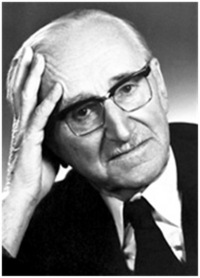 F.A. Hayek was one of the world’s foremost economists and a giant among the original thinkers of the 20th century. In this post I want to interest readers in his ideas and works with a short discussion of one of his small and often overlooked monograms – The Intellectuals and Socialism – published in 1949, the year I arrived on these shores.
From the monogram currently published by the Mercatus Center of George Washington University we read, “Friedrich A. Hayek, who won the Nobel Prize for Economic Science in 1974, is best known for the book the Road to Serfdom (1944), which has been widely translated. Receiving doctorates in law and economics from the University of Vienna, Hayek served on the faculties of the universities of London, Chicago, Freiburg, and Salzburg. (His major books may be seen here.) Hayek has attracted a growing body of scholarship, and in February 2000 a writer in The New Yorker observed that ‘it is hardly an exaggeration to refer to the twentieth century as the Hayek century.’”
One of the main lessons from the monogram is the reader’s ability to distinguish between the purveyors of ideas variously, and often carelessly, labeled as ‘theorists’, ‘experts’, and ‘intellectuals’. The first two are people who originate ideas and those who are actually able to implement ideas by applying their skills. However, it is the countless intellectuals with whom we should concern ourselves. They are overwhelmingly of the Left and populate our media, academe, institutions, and bureaucracies. Hayek defines them as follows.
“The term “intellectuals,” however, does not at once convey a true picture of the large class to which we refer, and the fact that we have no better name by which to describe what we have called the secondhand dealers in ideas is not the least of the reasons why their power is not understood. Even persons who use the word “intellectual” mainly as a term of abuse are still inclined to withhold it from many who undoubtedly perform that characteristic function. This is neither that of the original thinker nor that of the scholar or expert in a particular field of thought. The typical intellectual need be neither: he need not possess special knowledge of anything in particular, nor need he even be particularly intelligent, to perform his role as intermediary in the spreading of ideas. What qualifies him for his job is the wide range of subjects on which he can readily talk and write, and a position or habits through which he becomes acquainted with new ideas sooner than those to whom he addresses himself.” (emphasis mine)
The intellectuals are the distributors and champions of ideas formulated by the elites. They are drawn to the Left and socialism primarily because of its simplistic utopian vision of the future. This is opposed to the Right’s ideology having always emphasized individual liberty and its manifold benefits. In short, the Left’s intellectuals distribute simple easy-to-understand, high-level ideas to the masses, while those of the Right attempt to communicate their more complex ideas of, say, liberty, individual effort, and market capitalism on a person-to-person basis.
“Until one begins to list all the professions and activities which belong to the (intellectual) class, it is difficult to realize how numerous it is, how the scope for activities constantly increases in modern society, and how dependent on it we all have become. The class does not consist of only journalists, teachers, ministers, lecturers, publicists, radio commentators, writers of fiction, cartoonists, and artists all of whom may be masters of the technique of conveying ideas but are usually amateurs so far as the substance of what they convey is concerned. The class also includes many professional men and technicians, such as scientists and doctors, who through their habitual intercourse with the printed word become carriers of new ideas outside their own fields and who, because of their expert knowledge of their own subjects, are listened with respect on most others. There is little that the ordinary man of today learns about events or ideas except through the medium of this class; and outside our special fields of work we are in this respect almost all ordinary men, dependent for our information and instruction on those who make it their job to keep abreast of opinion. It is the intellectuals in this sense who decide what views and opinions are to reach us, which facts are important enough to be told to us, and in what form and from what angle they are to be presented. Whether we shall ever learn of the results of the work of the expert and the original thinker depends mainly on their decision.”
Socialism is a vile form of governance based on a siren-song ideology that entices the light thinkers to adopt it primarily because they don’t understand its dependence on the large scale morality of altruism which has never endured in human societies. When altruistic behaviors are abandoned, the government reverts to an autocracy which enforces self-sacrificing by the citizenry deemed necessary for the ‘common good’ by the ruling elites.
Hayek ends his monogram with a qualified hope, which, perhaps, dates his message written during the start of the post-war era of widespread relief, enthusiasm, revival, enterprise, and even joy felt around a newly post-colonial world. With the 1948 erection of the Iron Curtain in Europe, communism showed its true colors and gave pause to its advance in western countries and even in the Pacific periphery of Asia.
“The main lesson which the true liberal must learn from the success of the socialists is that it was their courage to be Utopian which gained them the support of the intellectuals and therefore an influence on public opinion which is daily making possible what only recently seemed utterly remote. Those who have concerned themselves exclusively with what seemed practicable in the existing state of opinion have constantly found that even this had rapidly become politically impossible as the result of changes in a public opinion which they have done nothing to guide. Unless we can make the philosophic foundations of a free society once more a living intellectual issue, and its implementation a task which challenges the ingenuity and imagination of our liveliest minds, the prospects of freedom are indeed dark. But if we can regain that belief in the power of ideas which was the mark of liberalism at its best, the battle is not lost. The intellectual revival of liberalism is already underway in many parts of the world. Will it be in time?” (emphasis mine)
Unfortunately, today it appears that the winds of global autocracy are strengthening, socialism is again in vogue with the under- and mis-educated younger generations whose votes today are bought by promises of munificent government largesse that will be paid for with other people’s money. Our new utopia will again be founded on an altruistic democracy as prescribed by the new woke dictums of diversity, equity, and inclusion that now have infected every institution in the land. Common ground between the Left and Right to reunite America is nowhere to be found.


 rebanesruminations.com

Leave a comment