

George Rebane
The ongoing Ukraine war is a complex affair with many dynamic factors that influence events and the state (attitudes/assessments) of the involved parties. These pages are home to a lively discussion and debate about the goings on in Ukraine and their worldwide impact. I’ve made an attempt to simplify and explicate my take on how the whole mish-mash comes together from what is known, claimed, and propagandized today. This assessment is reduced into an influence factors diagram shown below.
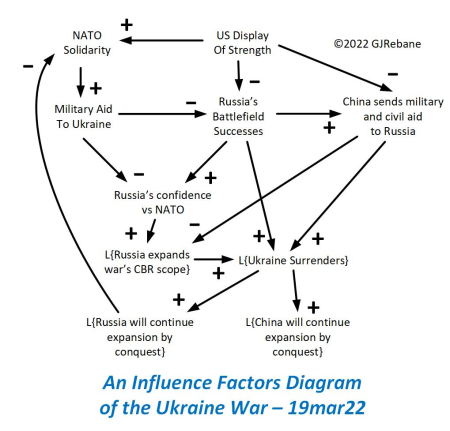 To understand the above IFD, I recommend a quick read of one or more tutorial pieces I posted some years ago (here, here, and here). The main thing to recall in looking at how the factors relate is that the connecting lines show the direction of influence by their arrowheads, and the plus (+) sign means that the influencer and influenced are in sync (i.e. as one goes up/down, so does the other), while the minus (-) sign means that they are out of sync (i.e. as one goes up/down, the other goes down/up). The factors labeled L{ } are likelihoods of the events in the curly brackets coming to pass.
IFDs usually contain ‘virtuous’ and ‘vicious’ cycles. A cycle is made by any directed path that returns to its selected point of origin. A cycle is usually taken as virtuous if the cycled feedback seeks to stabilize (self-correct) the involved factors, and is usually understood as vicious if the feedback causes a runaway state in one or more of involved factors. An easy way to identify such cycles is by counting the number of minus (-) signs in the cycle. Virtuous cycles have an odd number of minuses, while vicious cycles tally an even number of minuses. In the above IFD trace out some cycles starting with ‘US Display of Strength’.
Before you dismiss the IFD as just some idle technical doodling, you might consider that this tool (in its various formats) is used by the big kids as a starting point to discuss and communicate ALL complex processes about which critical decisions must be taken, and most certainly when it is required to formally ‘game the process’ using one of several simulation development environments – pricey software systems used in industry, by the military, and in statecraft. The IFD lets you see the big picture in its entirety and then drill down to whatever level of detail is required. It is the epitome graphic for communication in multi-party discussions of complex affairs. (BTW, people who can generate clear, complete, and concise IFDs for complex issues get paid big bucks.)


 rebanesruminations.com
Leave a comment