

George Rebane
Joseph Epstein’s column in 11dec20 WSJ (here) about Jill Biden’s doctorate started a national row that has even penetrated our country’s hinterlands and backwoods. The FLOTUS-elect likes to be called “Dr Biden”, and the compliant media has, well, complied to the extent that Dr Biden has become an ever-present, in-your-face item in today’s news. Most people (including Epstein) debating the use of that honorific in a salutation are innocent of the genesis of ‘doctor’ and ‘Dr’, so maybe a little background would help.
History records the first use of the upper-case honorific ‘Doctor’ in the 13th century at the dawning of universities in the west. (Actually, some universities, e.g. University of Bologna (1088), were founded earlier.) Doctor derives from the Latin docere (‘to teach’), and from the start Doctors were always teachers, and overwhelmingly teachers who taught what they themselves had discovered or developed. In other words, Doctor became the appellation of someone that society recognized as having expanded the body or shoreline of human knowledge. Students traveled across continents to sit with noted Doctors in order to imbibe what the learned teachers had discovered and taught. (more here and here)
And for the centuries that followed, to be recognized as Doctor required that you had contributed some new and useful knowledge to your civilization, and were willing to teach it to others, usually in an academic setting. In old-speak, to earn a doctorate the person had to demonstrate that he could ‘philosophize’ (in newspeak, to research things novel and unique). In fact, the term ‘science’ (Latin ‘scientia’ or knowledge) came into use only recently. Previously it was known as natural philosophy, and people practicing science were called natural philosophers. The main takeaway here is that for the centuries that followed, academies bestowed the academic degree of Doctor on a person who had accomplished a rigorous course of study, passed certain examinations, and contributed something new and unique to the body of human knowledge as acknowledged by a group of peers (other Doctors).
As the years wore on, the honorific Doctor was also adopted without much protest by those who just taught some notable esoteria at the university level. In a vain attempt to reserve the doctorate degree for knowledge discoverers, the universities invented the intermediate graduate degree of Master, the achievement of which allowed you to get a job as a lecturer (‘reader’) in academe. But the cat was out of the bag as more teachers started appending Doctor to their names.
This practice became a flood of confusion as medicine became a more formalized pursuit. We recall that for centuries the local physician was also the village barber/surgeon – a tradesman not worthy of academic recognition. But then certain physicians started their own programs of research into medicines, chemistry, physiology, and surgical techniques. And the nascent field was ripe for the pickings; all kinds of new things were discovered and made known through systematic study. These learned physicians became teachers at universities and were natural candidates for the Doctor appellation, because they had earned it according to the standing rules of academe and society in general. For example, Benjamin Franklin became Dr Franklin without the benefit of attending university. The honorific was spontaneously awarded him for a spate of discoveries and developments ranging from the electric nature of lighting to efficient design of space heating stoves. But the requirement for expanding the frontiers of knowledge survived until … .
Things began to change somewhere around the turn of the 19th century. Physicians in academe had by that time started schools of medicine, many of them connected to or as parts of established universities. And they wanted the graduates of their rigorous course of study and examinations to also be called Doctor. The academic establishment succumbed with a compromise. Since the newly accredited physicians had not qualified as knowledge discoverers (only practitioners), the new degree of Doctor of Medicine or MD was invented, and everyone was satisfied as long as they were labelled Dr in polite society. The knowledge discoverers then retained the expanded appellation of Doctor of Philosophy or PhD, and everyone seemed satisfied.
Well, that opened the flood gates. Since true scientists, Doctors with PhDs, were few and far between to farmers and city dwellers, their only experience with someone called Doctor was with local physicians who quickly began to be referred to as doctors, or simply ‘the doctor’ – and please note the important introduction of the lower case here. In the 19th century Doctor was cloned from an honorific to a noun, and its case-sensitive usage was forever confounded in the minds or ordinary folk. The main takeaway was that when someone heard ‘doctor’ or Dr Smith, they immediately fastened on to the notion of physician – a doctor was an MD, and that was that.
This practice in western societies collided with another well-established practice of our civilization – the use of honorifics to acknowledge an individual’s most important or highest accomplishment. Civilians having served and achieved notable military rank were forever referred to as Colonel/General/Major Smith or as ‘the colonel/general/major’. The same went for political, legal, and professional ranks. People having served as a senator/congressman or ambassador or secretary or minister or judge or … were from there on addressed with their capitalized honorific instead of Mr or Ms. And those accomplishments also did referential duty as ‘the senator, speaker, …’. In Europe, until the middle of the last century it was even de rigueur to label graduate engineers with the honorific ‘Dipl Ins’.
After WW2 a notable sea change occurred as thousands of returning GIs went to college on various ‘GI bills’. This wave coincided with the awakening of the civil rights movement in the 1950s. The new watchword was ‘equality’, which was supposed to be discovered, applied, and/or imposed in every sphere of human activity. We were quickly to become equal and homogeneous in and along every dimension of our beings, some even more equal than others.
As a result, in academe people started asking why everyone shouldn’t get a college degree, why everyone shouldn’t be beautiful, why everyone is not awarded a prize, why everyone should not pass with a high grade, etc. Recognizing some and not others was clear evidence of discrimination on the basis of whatever was real and or convenient – race, gender, religion, sexual orientation, …, and, of course, education. The last one was a bit dicey since traditionally and practically it had always involved merit and accomplishment, a clear differentiator among all humans. To ‘level the playing field’ meritocracy had to be rethought and corralled if necessary. To no one’s surprise, our educators have now progressed to the heights of woke where evaluating a student’s merit has been eliminated altogether.
To shorten this story, it was not long until colleges and universities began to invent majors and major fields in which everyone who fogs a mirror could succeed. Everyone was now qualified to be college educated, even though employers looked with gimlet eyes at the useless skillset with which many (most?) students were graduating. But more and more kept being admitted to colleges at all levels, and all abetted by government programs of countless colorations which allowed academe to keep hiking the tuitions and fees charged the subsidized students. And yes, one of the many benefits of the new higher educational landscape was a profusion of ‘doctorates’ in every imaginable field – write a paper, get a doctorate.
Most universities giving accredited PhD and ScD degrees continued to require the candidates to demonstrate the ability to conduct productive research that expanded our shoreline of knowledge. However, this requirement is a bit too subtle for main street, that made everyone’s doctorate equivalent as intended by our social engineers. Well, not quite. The average person does make a difference when it comes to physicians, dentists, veterinarians, and chiropractors – to them, these are the ‘real doctors’ worthy of a Dr in front of their names.
I have to admit that there is a bit of hubris among the ranks of PhDs. Those holding that kind of a ticket quietly look askance at all the other JDs, EdDs, DFA, … (here’s a more complete list), and that hubris is reinforced when it’s made known what was required get such ‘doctorates’ as compared with what they had to do to earn their PhD in, say, a STEM field. PhDs correctly view the medical practitioner doctors as sophisticated technicians. And all the other kinds of Drs are viewed more or less as a public relations bamboozle on the country’s less-read citizenry.
[Full disclosure, the author of this biased screed holds a dual-field (complex dynamic systems and computer science) PhD in engineering, preceded by a BS in Physics and a MSE in Control & Estimation. Additionally, I am a California Registered Professional Engineer in Control Systems.]
[Addendum] An interesting sidelight of the use of doctorates, especially by those with PhDs, is how the title/honorific ‘Professor’ fits in the academe’s pedagogical landscape. A professor is someone who specializes in the profession of a specific body of knowledge. In higher education it is also used in the title of academic rank – ‘Associate Professor’, ‘Adjunct Professor’, etc. Formally, to teach at the university level one does not need a doctorate, and therefore a college lecturer with that deficit can adopt the title/honorific ‘Professor’, and prominently display it on the door to his office and on the name-line of his business card. The interesting point here is that when someone is a college professor and also has a PhD, they never label themselves as Professor, even though others will properly use that honorific. The pedagogue with a PhD always has on his door ‘Dr Smith’, or ‘John Smith, PhD’, or both, but never a naked ‘Professor Smith’.
Often in humanities departments this convention is further extended by professors who have PhDs and those with other doctorates. The non-PhDs do not like to advertise their lesser doctorates in a hallway of office doors, and often use the appropriate professor title instead.
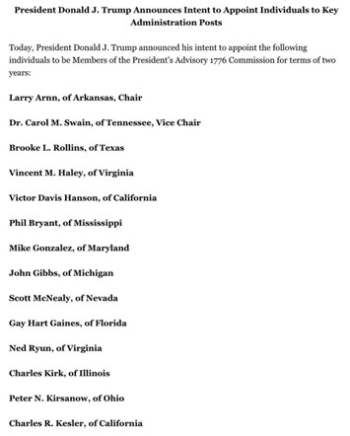
[Addendum2] The Republicans continue to speak softly and carry no stick. To counter the Left’s nationwide anti-American ‘1619 Project’, in its waning days the administration has launched something called the President’s Advisory 1776 Commission. I don’t know if this commission will have any legs under Biden, but its composition announced by the WH sure reveals the GOP’s squishy backbone when it comes to political correctness. In the graphic below, note that only Carol Swain is provided the Dr honorific. Dr Swain holds a PhD in political science and is black, so no blame no shame in identifying her correctly in such an assemblage. But half the other notables on the list also hold PhDs, but for some reason their accomplished honorifics have been omitted, as if to signal some kind of virtue in elevating a female and black above the crowd of overwhelmingly white, similarly educated males. And this is today’s GOP, our best hope and political opposition we have to oppose the approaching autocracy.


 rebanesruminations.com

Leave a comment