

George Rebane
Something is possible when it can happen with non-zero probability; something is probable when the chance of its happening will impact a decision.
One of our commenters pointed me to 270towin.com, a website that presents a map-based tool to predict the Electoral College (EC) votes which will determine our next president. They show how the states are going to vote given various pundit assessments and polling results. The site also lets you assign to each state whether and to what degree it will vote Republican or Democrat. The degrees shown for each party are – Safe, Likely, Leans, Tilt, and Toss-up. You can also add ‘Tilt’ to the spectrum. Assigning such degrees to each state allows the site’s visitor to come up with his own prognostication.
The problem with 270towin is that its algorithm to compute the total EC votes for each candidate is not revealed. To overcome this shortcoming and make the EC predictor more useful and transparent, I constructed a rigorous one in the spreadsheet form shown below (click on image to enlarge).
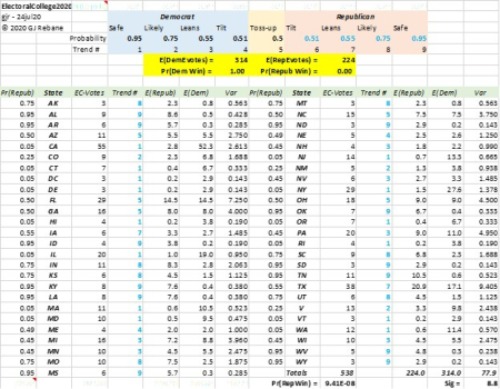
This has the trending categories shown along with their 1 thru 9 trend numbers that identify each one uniquely. As per convention, the blue numbers are to be input by the user, the black numbers are calculated by formulas (keep you mitts off of them). All the 538 EC votes are shown for the states and DC. Inputting your own trend numbers will recalculate the expected number of EC votes each side will get along with their underlying probability distribution. This permits some math to be applied to compute the actual probabilities of each side winning the EC vote – i.e. getting more than the needed 270 required to win.
And here’s the good part. In my model, the win probabilities that quantify each trend category are shown and can be changed by the user. Mine are 0.51, 0.55, … shown in blue under the Republican side and replicated in black on the Democrat side. If you don’t like my picks for each of the indicated trending categories, then substitute your own, and fill in the trend numbers for all the states and DC.
The model outputs are shown in the yellow block, and consist of the expected number of Dem and Repub votes along with the probabilities that the Dems and Repubs get at least the needed 270 votes to win. The trend numbers shown were the current ‘consensus’ assignments from 270towin, and with my assigned probabilities, a Democrat win is practically a certainty. I will put in my own trend numbers as time goes by, and so can you. You can download the spreadsheet here – Download ElectCollege2020
I will publish your assessments if you send me an image of the relevant cells as shown above – put your own name and date YYMMDD in the cell under the copyright notice. Have fun.
And despite today’s bad EC numbers, here is a little Lucky Strike Extra for all of you without TDS.


 rebanesruminations.com
Leave a comment