

George Rebane
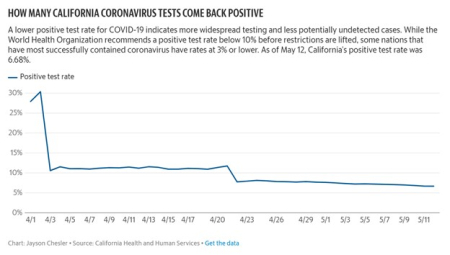 To again illustrate what we have been talking about the government’s basis for C19 policy decisions, the above graph and its annotation (from the 13may20 SacBee here) show raw test positive (TP) ratios over time, giving no hint of either the test’s reliability parameters, the tested sample (size and provenance), or knowledge that raw TP fractions are next to useless in low prevalence populations and need to be corrected to obtain actual population fractions to support policy decisions. If any of these people, starting with WHO personnel and working down to the state level, claim to have a relevant education to qualify them for their positions, they have every right to demand a full tuition refund from the school(s) they attended. Unfortunately, the beat goes on.
[update] Here’s another example of what NO ONE is telling the unquestioning public, and no one knows to ask (or even cares as witnessed by RR commenters). The graphic below shows two curves for a certain ‘infection test’ – the blue one is the probability of actually being currently infected with the C19 virus, given that your test came back positive; and the orange one gives the probability that you are free of the virus, given that your test came back negative. The test’s sensitivity, P(TP|V), and specificity, P(-TP|-V), are shown. Our prevalence (fraction of population currently infected) is at most 5% or 0.05. So if your test came back positive, the chance P(V|TP) that you actually had the disease is only 0.333 or one out of three. That means that it’s two out of three that you are not infected. However, at such a low prevalence if your test came back negative, the chance P(-V|-TP) that you don’t have the coronavirus is 0.9994, or almost certain that you are virus free. The problem now is what are you or anyone else going to do with those test results.
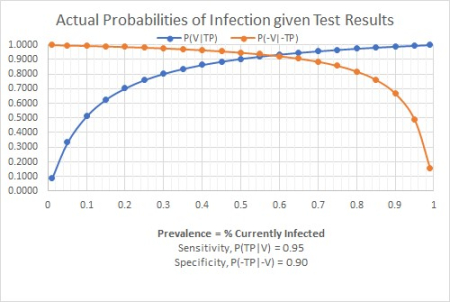
Well, if you tested positive you can always request to be tested again. Given that first positive, if the second test comes back positive again, your probability of having the virus jumps up to 0.826 or a little more than 9 out of 11. If the second test comes back negative, then your probability of being infected drops to 0.027, or about 1 out of 40. The question now is, what facilities will be available to do multiple testing on each individual so as to push the probability of infection or of no infection beyond some required threshold that determines what to do with the patient. The answer is ‘no one knows’ because no one has considered these questions amid the cries for testing and more testing – there is no guidance to the states, and apparently the states aren’t smart enough to determine and announce their own probabilities and response thresholds. Among all the shouting about testing, that’s the reality of how the pandemic is being handled by government healthcare ‘experts’.
[14may20 update] As we have been telling readers, lockdown is NOT a solution – short or longterm. ‘Stanford Antibody Studies Indicate No Safe Option for Eradicating COVID-19, Including Lockdown’.


 rebanesruminations.com
Leave a comment