

George Rebane
[A rewrite of this piece for broader audiences – ‘The big decision and the second wave’ – appeared in the 18apr20 online and print editions of The Union.]
As we start to turn the corner on the initial wave of C19 infections sweeping the land, people are already talking about the second wave and what it may look like after we carefully restart the economy. I did some noodling with Epidyne about what a second wave might look like as it takes another cut at us in California. Our state is thought to have had a large TBD fraction of people who already became immune last fall and early this year through asymptomatic infections. This is plausible from what we now know about the 2019 timeline of the Wuhan virus.
This assumption goes a long way to explaining why California’s infection, morbidity, and mortality numbers are so low, especially since we are one of the major Asia gateways into the US. The bottom line here is that we in our state already had developed a high level of herd immunity (q.v.) when the real C19 hit the country in early February of this year.
I ran a number of scenarios of a second wave using the latest CDC max reproduction rate of 2.6 which gets whittled down as herd immunity grows. And everyone now says that the Germans have calculated the most accurate death rate of 0.4% of the infected for developed country healthcare systems. Using these numbers on California’s 40M population, and letting the immunity fraction from the first wave vary from 0% (no one became immune) as an unrealistic bookend, to 50%, which most epidemiologists now think is closer to truth, I generated the infected population curves shown below.
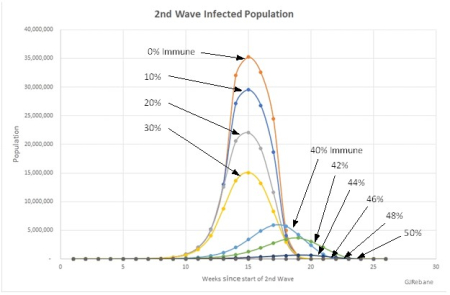
The Epidyne model (here) illustrates the highly non-linear nature of epidemic spread experienced in populations with various levels of herd immunity. We see the impact of the disease weakening as the percent immune increases in a fairly orderly way with little change in the second wave’s onset and its duration. This begins to markedly change as the immune percentage passes 30%. Then we see the curves flattening out with a delayed onset and a longer duration. Keep in mind that the infected cohort is made up of the asymptomatic, pre-symptomatic, and those requiring professional medical attention. The latter comprising of about 10% of the infected according to the latest figures. It is also from this cohort that we derive the mortality numbers.
The table below shows the maximum infected, the maximum hospital load, and the number deceased for the second wave as a function of the initial percent immune.

From the graph above we see that the duration of the wave for the lower immunities is about 2.5 months, and for immunities above 40% the epidemic’s onset is later, of lower intensity, and lasts about 3 to 3.5 months.
We must also note that the above numbers don’t reflect any imposition of a second statewide quarantine. Were we to take a more reasoned look at what kind of second wave we would have, I would agree with those who calculate that California’s immunity percentage would be very close to 50% coming out of the first wave that includes the cohort of pre-first wave immunities. Of course, if a second widespread quarantine is imposed that impacted proportionately the uninfected vulnerable and immune populations, then the intensity curves would all be lower and also more spread out.
Important in all this policy making is the ability to conduct immunity (antibody/antigen) testing on random samples from the state. I have extensively discussed testing previously (here and here), and also introduced readers to Epidyne (here). And when all is said and done on running these numbers, it sure looks like we should be ready soon to loosen the reins on our economy, and then not be too apprehensive about the so-called second wave – it will be quite manageable.
[update] So what all should policy makers actually consider as they wrestle with the decision of when and how to reopen the economy? Items definitely to include involve and understanding of the scenarios I have illustrated above regarding second wave infections. (We assume they have access to spread models at least as powerful as Epidyne.) But before that, one needs to take a measure of the situation in answering the question, what is and/or should be the immunity level in the target population I’m considering opening up. From above we saw that the immunity level should be somewhere north of 40% so that herd immunity can kick in and reduce the severity of the second wave after we have again started doing business in the land.
That decision will again involve another round of testing a random sample drawn from such a population. This time the test will be for the presence of immunizing antibodies/antigens, and these tests will also have their own levels reliability expressed in their sensitivities and specificities. More formally these are respectively the probabilities of test positive given the presence of the ‘antis’, here P+. and test positive when no ‘antis’ are present, here P–. I explained the whole process here, for those needing a review.
The remainder of this update has a couple of squigglies in it that makes it easier to read from this pdf – Download SecondWaveUpdate
[15apr20 update] The Epidyne second wave results shown above are now beginning to be described by prominent contagious disease experts and epidemiologists in interviews and columns that forebode ill if C19 returns to a population with a still WIP herd immunity. They are now doing some Monday morning quarterbacking on the governments’ policies of people quarantining, sequestering themselves at home, and social distancing on their infrequent forays to gather their necessaries (more here). Their arguments about “unintended consequences”, of course, make sense. All epidemics burn themselves out primarily through the beneficial action of herd immunity among the survivors of the disease (else they just kill everyone infected). But herd immunity is inhibited by premature and too comprehensive and longlasting quarantines. This means that once the people are ‘released’, any residual contagious agents will necessarily reinfect and start the disease cycle all over again. I have illustrated that with the Epidyne spread model, generating a number of epidemic return scenarios as a function of various levels of herd immunity being in place when society was opened up again.


 rebanesruminations.com
Leave a comment