

“Where are they?”, Enrico Fermi
George Rebane
Since my previous foray into Fermi’s famous query, I have had occasion to reconsider the numbers that I generated when first applying copernican arguments to the sound of silence experienced by the various Search for Extraterrestrial Intelligence efforts that started about the middle of the last century. My conclusion was that, the albeit the dismal results I introduced on my blog (here) to explain away the SETI experience, these were still too hopeful. This work definitely made me a graciously tolerated philistine among the dedicated throngs searching the heavens for evidence of ETI. Unfortunately, what I present in the sequel will only reinforce my reprobate status.
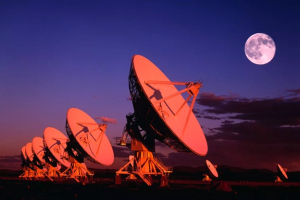 As a result of that first investigation I was nevertheless fortunate and honored to be invited to join the informal group of SETI researchers by Dr Andrew Siemion, director of the Berkeley SETI Research Center at UC Berkeley. Becoming more familiar with some of the ongoing efforts and literature generated by the hard-working stalwarts of that international cohort of professional astronomers, cosmologists, astro-physicists, …, I was motivated to return to the drawing board for another look at how we may explain the lack of success from so many ‘eyes’ pointed at the heavens for so many years, all collecting reams of data comprising mostly of inter-galactic and inter-stellar noise layered on the ubiquitous hiss of the cosmologic background, always there to remind us of our origins. And all this from a galaxy that has spawned hundreds of millions of ETI civilizations and, most likely by far, is still teeming with most of these. So why have we had no contact with them? This is the perplexing Fermi Paradox.
To answer that question, support for a copernican perspective and approach to SETI were presented in ‘A copernican answers Fermi’. (For other answers, read this.) To review some of the salient factors, we again consider that we live in an 13.5G year-old galaxy that formed along with billions of others in that epoch after the Big Bang of 13.8G years ago. The Milky Way (MW), containing north of 200 billion star systems, gave birth to our sun and its orbiting planets about 5G years ago. Today, by all counts, we see that the MW is an ordinary galaxy like billions of others, and our sun is a very ordinary G-type main-sequence (G2V) garden variety star. And its inventory of planets is of the type and with orbits replicated by eleven billion more exoplanets throughout the MW and countless other galaxies. In short, there is no a priori reason to believe that we are anything special in the universal scheme of things – ergo the copernican perspective.
Interested readers can download a copy of the follow-on study here – Download TN2002-1v200221 .


 rebanesruminations.com
Leave a comment