

George Rebane
[This is the addended transcript of my regular KVMR commentary broadcast on 6 November 2019.]
Income inequality in America has become a hot button issue. People in the street are being convinced daily that the inequality is somehow morally reprehensible since they are made to believe that the inequality comes from the rich stealing from the poor. And to nail this notion into people’s heads, we are told that the top fifth or quintile of households’ average earnings are 17 times more than the average of the bottom quintile. The problem with this number is that it is a blatantly false statistic.
But few people bother to inform themselves of the real factors that make up gross and net income. Gross income is the total of the cash you get in a year, and pay income taxes on. Net income is the actual amount you get to spend for what you need and want – that’s the amount that determines your quality of life.
Former senator Phil Gramm and Labor Bureau statistician John Early, both economists, have done an extensive analysis of the income inequality issue, and have published their findings in a recent piece titled ‘The Truth About Income Inequality’. Their conclusions are confirmed by the government’s own data. The information they have assembled supports a number of previous findings by various universities and institutions, findings which continue to be under-reported. (more here)
The popularly published information about America’s income inequality is developed by the US Census Bureau. The kindest assessment of their treatment of widely available income data is that it is faulty; a more sober examination might conclude that its reporting is tinged with partisanship. So let’s get to the specifics using the fewest necessary numbers, for which we know radio is not the best medium.
It’s the spendable cash where the rubber meets the road on such comparisons. The Census Bureau claims, and all media outlets dutifully echo, the 17-times multiple that the top quintile household average exceeds that of the bottom quintile. This number is quietly calculated by ignoring that the top quintile pays one third of all federal, state, and local taxes, in addition to the fact that they pay two thirds of all taxes. When we ignore this, we wind up substantially overstating inequality.
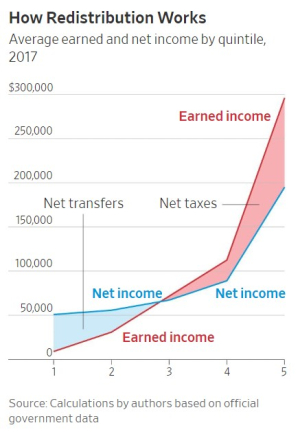 Then there’s the matter of the Census Bureau ignoring $1.9T of annual public transfer payments for such items like Medicare, Medicaid, food stamps, and over 90 more federal programs that issue checks. The point here is that such government transfer payments make up 89% of all income available to the bottom quintile of households, and more than half for the second quintile. So when we ignore the taxes of the upper quintile and the transfer payments to the lower quintile, the result is that the 17-multiplier overstates inequality by more than 300%. But when those realities are taken into account, the correct answer is 3.8. That is the ratio of the average net monetary resources available to the top quintile to the lowest quintile – let me repeat that, it is 3.8 not 17.
Another oft-quoted dog whistle number for our progressives is the 60:1 ratio of earnings of these two extreme quintiles that also excludes taxes and most transfers. However, when we take actual spendables into account to compare dollar amounts, then the average bottom quintile household income is almost $51,000. The average top quintile reduces to $195,000, so that’s where correct 3.8 multiplier comes from. (see nearby graph) Drs Gramm and Early conclude their report with – “Any debate about further redistribution of income needs to be tethered to these facts. America already redistributes enough income to compress the income difference between the top and bottom quintiles from 60 to 1 in earned income down to 3.8 to 1 in income received. If 3.8 to 1 is (still) too large an income differential, (then) those who favor more redistribution need to explain to the bottom 60% of income-earning households why they should keep working when they could get almost as much from riding in the wagon as they get now from pulling it.”
My name is Rebane, and I also expand on this and related themes on Rebane’s Ruminations where the transcript of this commentary is posted with relevant links, and where such issues are debated extensively. However, my views are not necessarily shared by KVMR. Thank you for listening.
[Addendum] Since RR’s launch, these pages have extolled the munificent benefits to humanity of capitalism and minimally regulated markets. This is motivated by my own long ‘world line’ which has given me the opportunity to see, experience, and study what the alternative forms of collectivism – communism, Nazism, fascism, socialism, … – have to offer. The bottom line is that collectivism in any and all of its forms ALWAYS leads to eventual autocracy. And the road to that destitute future is always painful, and one that requires state-induced sacrifices, which in its final miles turns utterly brutal. (‘To make an omelet, one must crack a few eggs.’)
The message to the hopeful naïfs in every population targeted by socialism/communism is that the state, in its wisdom, when sufficiently encompassing and powerful, will bring ‘social justice’ to the land by first declaring class warfare during which the wealth of ‘the greedy and idle rich’ will be redistributed to ‘the working class and poor’. As we have seen, with the Left’s control of public education, this becomes a powerful organizing message to those who have been carefully taught. These true believers are not even left with a language, let alone an accurate history, that supports critical thinking and/or criticism of the state. (The collectivist elites have been the true practitioners of Sapir-Whorf in education.)
Social science and history can only point to sustainable applications of socialism within small culturally cohesive populations that are mostly limited to family and tribe. Any larger collection of especially diverse people needs to be governed by either an autocracy, or in recent centuries by the alternative of nascent republicanism based on liberal principles of democracy, capitalism, open markets, entrepreneurship, and individual liberties. However, the latter quickly leads to inequalities in both opportunities and achievements, simply because people come with a wide variety of capabilities and interests. And sooner or later the resulting inequalities in people’s wealth and abilities to produce result in an unequal distribution of wealth that invites the power hungry and naïve to use our natural tendencies toward envy to embrace ideologies that promise them ‘more’ without asking more from them in return.
The great bamboozle of the French Revolution that promised “Liberté, égalité, fraternité!” lives on today in the minds and machinations of the Left, and is still the main ingredient of the Kool-Aid unquestioningly gulped by their minions and the new acolytes of their state religion. The only problem is that liberty, equality, and fraternity are existentially incompatible – liberty and equality sit on opposite ends of the see-saw, as do equality and fraternity. In any social order, equality can only be enforced by removing liberties, and enforced equality does anything but support fraternity, as has been demonstrated by every communist and strongly socialist regime.
The solution for those who have suffered under various forms of elite-run collectivism continues to be a hopeful return to more liberty, capitalism, and open markets. Then wealth can be created in amounts that lift even the poorest and least capable among a population. Another Frenchman, Frederic Bastiat, made that clear to us almost two hundred years ago which today is summarized in the so-called Bastiat Triangle of mutually supportive principles of security, liberty, and property. All three are needed for a sustainable beneficial social order; weaken any one of them and the other two also fall victim to the eventual collapse of the entire triangle.
Today the EU countries that drank most deeply from the socialist flagon are quietly attempting to return to governance supported by principles laid down by our Founders, Bastiat, and the Austrian school of economics. To better understand the siren song of socialism and its profound maladies, it is instructive to read (here) the historical journeys of Israel, India, and the UK as they implemented post-war socialist orders which ultimately had to be abandoned. Add to these journeys what other totalitarian countries, led by Red China, are now in the process of implementing within their borders. And then compare all this to how our leading Democrat candidates are promising to fundamentally transform America into a demonstrated tragic social order that has never worked.


 rebanesruminations.com
Leave a comment