

George Rebane
There are about 2,500 galaxies (not stars) in the picture below – each of even the smallest dots is a galaxy. Each such galaxy has about 300 billion stars, and each star has at least five planets. Today we can see over 2,000,000,000,000 = 2 trillion such galaxies. Fainter galaxies exist but don’t show in such photos. This means that we can visualize only a part of our universe which itself contains 3×10^23 (a 3 with 23 zeros following it) planets. Of these, at least 1% are in the ‘Goldilocks’ zone from their sun. This suggests that there are about 3×10^21 planets that could potentially have an environment that supports life as we know it. (There are undoubtedly other forms of life about which we are ignorant.) In our own galaxy there are about 11 billion of such planets.
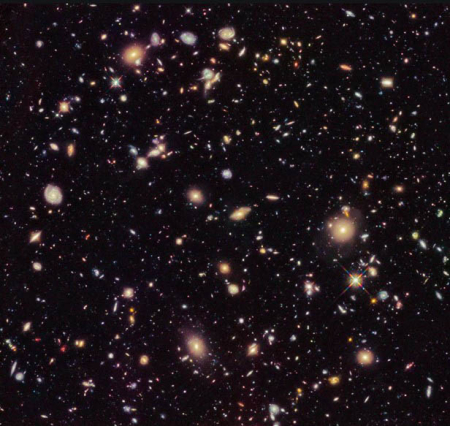
To further illustrate the vastness of our visible universe, consider that the above photo is a magnification of what our telescopes see when looking at a part of the entire sky surrounding Earth that is less than 1/33 of (or more than 33 times smaller than) the size of the period at the end of this sentence when held out at your arm’s length. This means if you printed a page with a period (from Times New Roman size 12) on it, and made a hole with a very sharp needle through and exactly the size of the period, then holding it out at your arm’s length you would be able to ‘see’ over 84,000 galaxies through that pinprick, no matter in which direction you looked in the night sky. Of course, your eye would have to have the magnifying power of a big telescope (like the Hubble) to resolve all those galaxies as shown in the above photo. Perhaps this understanding would allow us to better contemplate the size of our visible universe and consider all the extra-terrestrial civilizations that have already existed, are now in existence, and will come to be in the interminable future.
The background to this meditation was posted as ‘A copernican answers Fermi’, and later I’ll have more to say about the portents of all this. (more here)


 rebanesruminations.com
Leave a comment