

George Rebane
Since the Democratic Party’s great Leftward Lurch, it is now publicly and unabashedly America’s new socialist party, notwithstanding start-up wannabes like the newly formed Progressive Party USA. The Left’s problem today is how they must carefully wend their way through a potential political minefield in how they describe their brand of collectivism – i.e. socialism – in a way that doesn’t blow up the narrative they have been carefully nurturing since the days of FDR.
As we witness in these pages and from the years-long national dialogue, the Left has always maintained that while they embrace the socialism of a Marxist-Leninist provenance, the extreme Right, in its turn, embraces the fascism of Hitler and Mussolini. And therefore, to all good modern leftwingers, fascism is not now and never has been a form of socialism – fascism is instead the form of totalitarianism that comprises the hidden agenda of the Right and is the other bookend of their simplistic political spectrum. This is both factually and historically false as we’ll cover in a moment. But given the difficulties our Left has had in selling socialism to Americans, they have always desperately needed an ideological bogeyman or monster that they could erect and portray to the lightly read, and against which they could favorably compare the nostrums and shibboleths celebrating their brave new world. Enter ‘fascism’, the avowed enemy and monstrous ideology that we fought and vanquished in WW2, and, according to the Left, the rebirth of which once more threatens the world if the Right comes to power and has its way with us. (And hence the current rationale for the Left’s sanctioned “incivility” in the streets until they regain power.)
So, for at least the last 75 years, the Left’s narrative has drawn its substance and raison d’etre from characterizing itself as the defender of the common man against what they invent for public consumption as the rapacious Right of the greedy capitalists. These are the people whose only aim is to exploit and then enslave the masses under an autocratic cum totalitarian governance that forcefully exploits them as the labor engines to create wealth, which is then shunted into the coffers of the … (wait for it), the ‘fascist elites’. Unfortunately for the Left, history has shown all this occurring only after collectivists have come to power.
America’s Right has continued to characterize itself as promoting the ideology of individual enterprise, free markets, private property, liberty, distributed governance through minimalist governments/jurisdictions, and an originalist (‘textualist’) interpretation of the Constitution (see Addendum). This interpretation embraces inevitable change through constitutional ways and means prescribed and practiced throughout our history. In short, an ideology that is a total antithesis of the collectivists’ worship of society organized under and administered through the strata of (altruistic) central planners and controllers within an expansive and ever-expanding government. Today the Left marches toward globalization under banners emblazoned with ‘democracy’, and the full and selectively suppressed knowledge that, practiced in the large, democracy quickly consumes itself as it morphs into one of the particularly egregious forms of totalitarianism.
Economist and academic Douglas Hotz-Eakin – president of the American Action Forum, formerly with Syracuse University, and past head of the Congressional Budget Office – in a recent interview described socialism as coming in “two basic flavors”. The first is a form of governance in which the government owns and directs all means of production and distribution – let’s reference it as Type1. This form eschews private property as the source of all social evils, and finds its consummate expression in Marxist-Leninist communism. The second form of socialism is where, for the most part, the means of production and distribution are left in the hands of a favored private sector. However, government still is the central planner that assumes the dominant role of directing what is produced when, and how it will be distributed – let’s reference this as Type2. This is socialism’s fascistic form which was implemented by the pre-WW2 ultra-nationalistic governments of Germany, Italy, and Imperial Japan under which individual freedoms and enterprise were abolished by government diktat.
The historical roots of fascism are important to review, especially since the Left has made their instruction in western schools a thing of the past. Konrad Heiden, German historian, journalist, academic, and briefly a Nazi Party member, was the first to introduce American audiences to Adolph Hitler and the origins of Germany’s National Socialist (Nazi) Party. In his landmark Der Fuehrer (1944) published by Houghton-Mifflin in the throes of WW2 (and picked up by the US Book-of-the-Month Club), Heiden gives an exhaustively detailed biography of Hitler, and the history of the Nazi Party – from its founding and rise until they came to rule Germany in 1934.
(Heiden was also the first to announce Hitler’s ‘Final Solution’ to the world in 1938, writing – “To drive 600,000 people by robbery into hunger, by hunger into desperation, by desperation into wild outbreaks, and by such outbreaks into the waiting knife — such is the coolly calculated plan. Mass murder is the goal, a massacre such as history has not seen – certainly not since Tamerlane and Mithridates. We can only venture guesses as to the technical forms these mass executions are to take.”)
The sordid history of fascistic socialism began with Benito Mussolini in 1919. Historian, journalist, and author Nicholas Burgess Farrell’s recent comprehensive biography of the Italian dictator – Mussolini: A New Life (2003) – notes from the start that today “fascism means a word that has become an all-purpose term of abuse for something people, mainly liberals, do not like: i.e., something ‘far right’. … What I discovered is that fascism is not far right at all. In fact, it is an alternative far-left revolutionary movement.”
‘Fascism, Real and Imagined’ (Chronicles, Sep 2018), describes how Mussolini’s love affair with communism that started before WW1 when he was “the leading light in Italy of international socialism (communism) who ditched that to invent national socialism (fascism) 100 years ago in 1919.” For that deviation Mussolini was kicked out by the communists, started fascism, and vanquished the Italian communists in due course.
In 1932 Mussolini co-authored The Doctrine of Fascism that laid out the doctrine and principles of fascism. There it is made clear that “fascism regarded the state as the solution, not the problem”, and that robustly “separates it from the Anglo-American, or Anglo-Saxon, conservative and libertarian ‘bourgeois’ right for whom the opposite is the case. … In fact, fascism has much more in common with communism than either has with capitalism or democracy. This is why – for instance – the Times regularly defined Soviet communism in the 1930’s as “fascist”, and why the 1939 Nazi-Soviet Molotov-Ribbentrop Pact was a far more natural alliance than the subsequent alliance between Roosevelt, Churchill, and Stalin.”
During the same post-WW1 years (1919-1923) when both USSR/Russia and Germany were having their own form of civil wars, Hitler became enamored with the way Lenin had marshaled the Russian masses to smite the established aristocracy and bourgeoisie, and then take complete control of those who had done the party’s bidding. Heiden reports the efforts Hitler made in communicating with German communists with the purpose of forming a unified coalition to take over the country and free it from the heel of Versailles to form a new Germany in command of its own destiny and not the dictates of Allies to whom their beloved fatherland had been betrayed.
However, things didn’t work out because German communists were taking their marching orders from Moscow to demand that the new Nazis be folded into the German Communist Party, and that the emphasis then would be to support the international spread of communism through the implantation of fresh party cells into countries that were ripe for revolution. Hitler would have none of it because he and his cohort were focused on restructuring Germany into the Type2 (described above) socialist country, cleansing it from undesirable ethnic elements blamed for betraying Germany during the war and siding with the Allies to implement the Versailles Treaty. This included the maintenance of the economically devastating naval blockade after the cessation of hostilities which made it impossible for Germany to pay the reparations that even the Allies (save France) considered usurious. Hitler now had the perfect political and economic environment for launching a nationalist party against the demonstrated ‘communist/Jewish traitors’.
By the mid-1920s Hitler already realized that he and his henchmen were building the German version of what Mussolini was bringing about in Italy – the Type2 socialism known as fascism.
To add to this smorgasbord of labels, today we have an added semantic conundrum around the concept of ‘populism’ which the Left has made a Siamese twin of fascism, and with great effect imposed on those ignorant of the real history of fascism. According to Farrell, what unites all populist parties of the Left (including fascism) and Right “is a passionate determination to defend the nation, its culture and way of life, from today’s political, economic, and cultural imperialist and their institutions, such as the EU, Goldman Sachs, CNN, and the BBC.”
However, British and American populisms are different from the continental European forms for a very basic reason. “Anglo-Saxon law is based on liberty; European law on rights. In Britain, for example, you are free (or were, until Britain joined the E.U.) to do something unless the state has passed a law that stops you. In Europe, you are not free to do anything until the state has granted you the right to do it.” Moreover, most populisms with which we are familiar are not racist, “unless you define their determination to put a stop to mass immigration and multicultural imperialism as racist. And if anyone is antisemitic, it’s the far Left who despise Israel.”
Years ago, in ‘Ideologies and Governance – a structured look’ (here), I attempted to communicate a more realistic ideological spectrum in a multi-dimensional graphic from that clearly shows the true difference between collectivist ideologies (socialist, communist, fascist, theistic, …) and their antitheses, the basis of which is summarized by the Bastiat Triangle of Rights (here). These were presaged and structured by our Founders in the Constitution which has become our common American heritage. And all this is a history that the Left has buried, and is doing everything it can to keep buried (more here and here) so as to falsely portray fascism, socialism’s own bastard sibling, as the Right’s target ideology for organizing counter-globalist societies to embrace populistic forms of autocratic nationalism.
[Addendum] Constitutional interpretation is a much debated subject. A commenter brought up his understanding of my use of the such interpretations. According to my readings, I view some of the main interpretations within the following taxonomy (my own preference is shown in green).
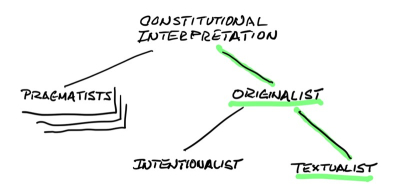
A set of definitions that go with this are –
Originalist – An originalist is a person who believes that the meaning of the constitution does not change or evolve over time, but rather that the meaning of the text is both fixed and knowable. An originalist believes that the fixed meaning of the text should be the sole guide for a judge when applying or interpreting a constitutional provision.
Textualist – A textualist is an originalist who gives primary weight to the text and structure of the Constitution. The text means what it would have been understood to mean by an ordinary person at the time it was written. Textualists often are skeptical of the ability of judges to determine collective “intent.” Justice Antonin Scalia was a textualist.
Intentionalist – An intentionalist is an originalist who gives primary weight to the intentions of framers, members of proposing bodies, and ratifiers. Judge Robert Bork was an intentionalist.
Pragmatists – Non-originalist who give substantial weight to judicial precedent or the consequences of alternative (also ideology based) interpretations, so as to sometimes favor a decision “wrong” on originalist terms because it promotes stability or in some other way promotes the public good.
(more here)


 rebanesruminations.com
Leave a comment