

George Rebane
Robert Kagan is a historian and political scientist with an endowed fellowship at the Brookings Institute. He perches a bit left of center from where he has been a foreign policy adviser to both Republican and Democratic presidents. Dinesh D’Souza is a conservative political commentator, author, and filmmaker formerly associated with the Heritage Foundation, who continues as a lightning rod for critiques of rightwing ideology. Not so surprisingly, these two intellectuals share many insights into America’s post-war role in the world and the state of the world were America to “retreat” from this role.
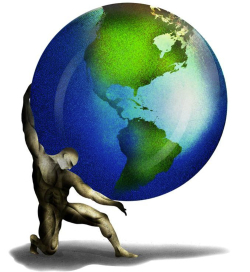 Of D’Souza’s many books, his America: Imagine a World Without Her (2014) contains assessments that tie closely with Kagan’s sentiments as expanded in a major essay ‘The Cost of American Retreat’ in the 8sep18 WSJ. (Essay based on Kagan’s latest book, The Jungle Grows Back: America and our Imperiled World, that comes out later this month.) My commentary on this highlights that the Rebane Doctrine on foreign policy espoused here over the years also ties closely with what these essayists have gleaned from their studies and experience. I believe that, in these times, the tenets from both bear repeating emphatically and often. (Graphic by Brian Stauffer)
Kagan points out how the period of liberalism under the hegemonic umbrella of the United States has given rise to a most unusual epoch of human history. During this epoch “liberal ideals triumphed because, for the first time, they had power behind them.” And all this, because “a new player arose on the international scene: the United States. It possessed a unique and advantageous geography, a large, productive population, unprecedented economic and military power, a national ideology based on liberal principles, and a willingness, after the war, to use its power to establish and sustain a global order roughly consistent with those principles. … That order – with its mutually reinforcing security, economic and political components – has created a geographical and geopolitical space in which liberalism has taken root, spread and evolved. But it was always artificial and tenuous, challenged from within and without by natural forces – the always potent antiliberal aspects of human nature and the competitive and anarchic tendencies of geopolitics.”
This global state of affairs was also in line with what Henry Kissinger described in his World Order (2014). But all of us who have witnessed this golden age of liberalism know that “like a garden, it can last only so long as it is tended and protected. Today, the U.S. seems bent on relinquishing its duties in pushing back the jungle.” And there’s the rub. For some decades now, America’s Left has been a proponent of removing America as the world’s white hat hegemon. And recently loud libertarian voices on the Right have signed on to that policy with their own brand of isolationism. To be sure, the goals for America are diametrically opposite in these views – the Left simply wants America gone, melded into some form of centrally-controlled global governance; the isolationists on the Right want America to remain a strong sovereign nation-state, but not involved in being the free world’s geostrategic sheriff that continues to maintain an orderly and secure environment in which its allies have been able to grow and prosper.
Kagan goes to some length to make the case that the first 25 years after WW2 were truly idyllic for the free world. It was a time when “normal geopolitical competition all but ceased. Nations within the order, in Western Europe and East Asia, didn’t compete with each for military superiority, form strategic alliances against one another or claim spheres of influence. Since no balance of power was necessary to preserve the peace among them, as it always had been in the past, they could shift substantial resources and energy from military to economic and social purposes.”
Things began to unravel a bit when America strained through its civil reorientation of the late 1960s and into the 70s. Within nations basking in the comfort (“free riding”) provided by the United States, the Left again began to stir, wisely and surreptitiously taking greater control of schools and media infrastructures. They started turning out millions who were taught a different history of wars, commerce, and colonialism, and the seeds of western self-hate were planted. Criticism of America arose and slowly started turning into hatred. However, during this time “American hegemony was never so intolerable as to drive other members out. On the contrary, nations (still) banged on the door to come in. Participants in the order, then and now, have shared the implicit understanding that however flawed the American-led liberal world order might be, the realistic alternatives would almost certainly be far worse.”
But the fabric of political belief in American hegemony has now continued to weaken to the point that we in the west have forgotten the state of affairs and it harbingers that gave rise to the great conflicts of the 20th century. We grouse about today’s international tensions and horrible wars that seem interminable, while forgetting what real wars and disasters in world affairs were like. We don’t recall that “it was in the West that fascism and communism arose, and it is in the West that democracy is at risk once again.” Kagan recounts for us the real disasters that occurred in each of the quarter centuries that ended in the last mid-century, and reminds us that we are again donning the blinders of the 1930s.
The emerging consensus today is that the U.S. has been doing too much. But what if we have been doing too little? We wanted to believe that the course of history was taking us away from the war, tyranny and destruction of the first half of the 20th century, but it may be taking us back toward them, absent some prodigious effort on our part to prevent such regression. Those who call themselves realists today suggest that we can do less in the world and get more out of it. It is a lovely fiction. Our real choice is between maintaining the liberal world order, with all its moral and material costs, or letting it collapse and preparing for the catastrophes that are likely to follow. … Nothing is determined, not the triumph of liberalism or its defeat. As we have seen these past 70 years, tremendous human progress and human betterment are possible even in a dangerous world. To know that the jungle will always be there is not to despair of keeping it at bay, as we have done more or less successfully for decades. But make no mistake: The liberal order is as precarious as it is precious. It needs constant tending lest the jungle grow back and engulf us all.


 rebanesruminations.com
Leave a comment