

“Any sufficiently advanced technology is indistinguishable from magic.” – A.C. Clarke’s Third Law
George Rebane
Last month we were encamped with two other couples at Hat Creek in northern California. It was a delightful trip – the weather was fine, the food, drink, and the friends superb. Actually, we’re all experienced “road warriors” having traveled much with each other over the last years. This was our second trip to the Hat Creek RV Park which is located far away from cities and towns in the middle of a broad and very ancient volcanic caldera with walls reaching up several hundred feet. Hat Creek is a quiet place with few people, but because it is located in a bowl, it is also quiet in the electromagnetic (EM) sense which is important to radio astronomers and people searching the galaxy for evidence of extra-terrestrial intelligence (ETI).
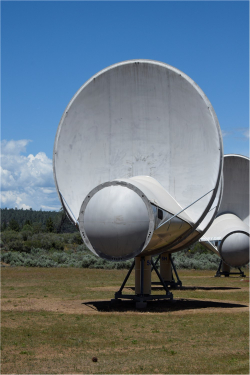 For that reason, the Hat Creek caldera is home to the Allen Telescope Array (ATA) that was built for the Search for Extra-Terrestrial Intelligence (SETI) Institute to support their ETI search program. We men, of course, had to go visit the observatory since it was only about 1.5 miles from the RV park. We drove over, went into the facility, talked to the staff, walked into the array of dishes, saw the data gathering and control equipment, and watched the obligatory video extolling the virtues of the radio observatory and its mission. Then we took a lot of pictures, one of which you see here is a close up of one of dishes.
We were told that the ATA currently serves the radio astronomy needs of both the SETI Institute located in Menlo Park, and the Stanford Research Institute in Palo Alto. The array signal feeds go directly to those locations for further analysis, and from there the surveillance directions for the array are transmitted.
After returning from our visit, my little feverish mind started recalling all the things I’ve been reading and thinking over the years about ETIs and the galaxy with multitudes of post-Singularity super-intelligences. And the constant points that I always had to revisit was Drake’s formula for estimating the number of intelligent civilizations in the galaxy, and Fermi’s ‘Where are they?’ or ‘Where is everybody?’
Physicist Enrico Fermi’s question is even more poignant today than it was over sixty years ago when he first posed it to John von Neumann. Because to date we have spent a lot of money and brainpower pointing sensitive radio telescopes at the sky, and we have heard nothing but radio noise – no sign of intelligent transmissions. So, is there really anybody out there, or are we really alone? What can explain the silence?
Years ago as a nascent physicist, I learned that there could be several other means than radio waves with which to conduct inter-stellar communications, and as a teenage sci-fi geek and junior cosmologist, I was already convinced that Earth and the solar system were not unique in our galaxy or, for that matter, in the universe. It baffled me how anyone could think that in its formation from cosmic dust, our sun would be the only star to be born with a system of planets orbiting it. To my mind, given what was known about the genesis of stars, a star without planets would have been the exception, and lo, that is how it has turned out with what we know today about stars and exo-planets. So there had to be another reason for the silence.
As we all learned more during the Cold War and from other scientific studies, there are many ways that an inhabited planet could ‘blink out’ and become an orbiting derelict, no longer home to intelligent life. Books have been written about the diverse endings that civilizations may suffer. Of course, the more salutary kind of blink outs would involve the purposive evolution, or transit if you will, of bio-intelligent species into super-intelligence that would begin with each civilization encountering its Singularity. The bio-life would then recede as its super-intelligent successor became the dominant lifeform residing on some more convenient material stratum (not necessarily silicon).
From what I and others, those who have adopted that view of post-Singularity life, have gleaned is that the interval between starting EM transmissions and encountering Singularity would generously take about two of our centuries, 200 years. It would take much less time for a civilization to destroy itself as we ourselves have ascertained on Earth. So it seems to me that using 200 years as the nominal duration of EM transmissions before blink out is a reasonable number with which to define spreading EM annuli of 200 lightyears (ly) thickness emanating from planets with civilizations having destroyed themselves or successfully evolved to intelligence.
Adding some more numbers describing the age of our universe, our galaxy, our solar system, and all the distances that characterize our Milky Way galaxy, along with the speed of light, and it appeared that there was enough information for a bit of noodling that might yield some useful distributions that describe what our radio telescopes could encounter as they looked for ETI. The long and short of it was that I had some time and recent motivation to sit down, push some squigglies, develop a simulation model or two, and code them up. When I ran the simulations the very plausible answer explaining away SETI’s experience and answering Fermi’s question stared me in the face. I won’t give away the punch line here, but if you’re interested in the answer and a short description of the journey there, please download the little paper that describes the whole thing – Download A Copernican Answers FermiV21nov18


 rebanesruminations.com
Leave a comment