

George Rebane
No matter what he actually said in that White House meeting on immigration policy, President Trump has again focused a policy discussion on a crux of the matter instead of continuing the same ol’ same ol’ circling of the barn. I don’t want to debate whether he actually said “shithole country” as the press is attributing, but I hope he did if it gets us off the dime in deciding who should be let in to serve America’s interests as a sovereign and sustainable nation-state.
Because this is a family-oriented blog (hah!), and in the ensuing discussion we will want to continue using that colorful descriptor without gratuitously sprinkling dirty words all over these pages, I will use the three-letter acronym SHC in the sequel for both expedience and, perhaps, collateral decorum. Nevertheless, the meaning of that appellation will be made and should remain clear.
Instead of working on a more polished commentary, I decided to quickly anchor my contribution to the topic in a structured list of propositions that I believe are also embraced more or less by other conservetarians. If they are also Bayesians like me, then their beliefs of the following will range from near zero (impossible) to near unity (certain), and in the process never saying never for either extreme.
Before sallying forth, what Trump really meant to say instead of SHC is ‘third world country’ as pointed out by a reader under the recent ‘Scattershots’, who also provided a link to the UN’s list of third world countries (here). However, on closer inspection ‘third world country’ does not quite capture the more specific and richer concept of a SHC since not all third world countries are SHCs and some, even European, second world countries (e.g. Belarus and Albania) are SHCs. Onward to the propositions in no particular order –
- No broadly based social benefits can be maintained by a nation without strong economic growth.
- Low or stagnant economic growth leads to unrest and authoritarian cum tyrannical governance (always instigated ‘for the common good’).
- While case-by-case implementation of public policies is desirable, no country has the resources to sustainably provide that. Therefore, laws regulations, codes are crafted and enforced on the basis of aggregate descriptors of the governed cohorts.
- There is no historical evidence that desirable and transplantable social orders can survive within stagnant economies (i.e. such benevolent stasisms are popular in fairy tales and myths).
- America was founded primarily on the extension and spread of western culture. When formerly we welcomed immigrants, it was understood that the arriving “wretched refuse” departed from the “teeming shores” of Europe. No one then wanted to throw open our doors to Asians, Africans, Latinos, or even the swarthy people of the Mideast and Arab countries.
- Therefore, race (i.e. physical appearance) was the easy aggregate descriptor used to define and expediently sort out the desirables from the undesirables.
- Sentient life (i.e. critters that can remember and form pictures of likely futures) exhibits Bayesian behaviors. They decide things on the basis of prior experience (personal and learned knowledge) and aggregated evidence (e.g. in the form of summarizations and/or learned stereotypes).
- Individual freedoms within a cohort or community are always a tradeoff within some acceptable level of security, given the level of perceived danger. Corollary – freedom and security are zero-sum benefits within a social order.
- A culture is identifiable as a collection of beliefs and behavioral norms held dear and valued by a given population. Beliefs include a common ontology and shared view of the past (history). Behaviors include language, dress, social practices (commercial, familial, entertainment, …). The overarching purpose is to live in a selectively supportive society that allows members to reliably predict each other’s behaviors. Different cultures have adopted different tradeoffs between individual freedoms and social security. Cultures should be viewed as implementations of collectively held social insurance for a secure and predictable future, whose premiums paid by the beneficiaries are the publicly visible cultural norms they practice.
- SHCs are countries that inhabit the repressive, ignorant, stagnant, and economically poor end of the spectrum of nations. Most SHCs can be found among what are commonly identified as third world countries, with some seen as second world countries.
- People tend to help the poor and needy, not so much with the expectation to eliminate poverty and need, but to confirm ourselves as participating members of a benevolent social order that will also nurture us should our fortunes fail. In short, more of that social security insurance.
- Nature abhors universal definitions of ‘good’ (i.e. utility). All utilities (measures of ‘good’) are in some fashion localized, and the more localized, the more achievable. In the natural order, local achievements network naturally to create greater and mutually supportive communities of commonly held good (i.e. supporting the increase of a more comprehensive utility).
- Enforced multi-culturalism does not work. Peaceful cultures compete and naturally evolve through mutually beneficial intercourse. In war stronger cultures destroy, deform, and/or disperse weaker cultures.
- No successful country has ever intentionally attracted or established lasting counter-cultures within its domain. Successful immigration has always involved importation of industrious and assimilating foreigners. (Possible exception: Peter the Great inviting Germans to bring west European culture to the Russian countryside, develop commerce, and manage agricultural estates. However, the norm is more like the attitudes Mexico, Switzerland, and Saudi Arabia have toward immigration.)
- Humans, individually and as members of established groups, are measurably different. In short, we can forensically identify unique individuals and groups.
- A litmus test for SHC qualification is that its citizens overwhelmingly want to emigrate.
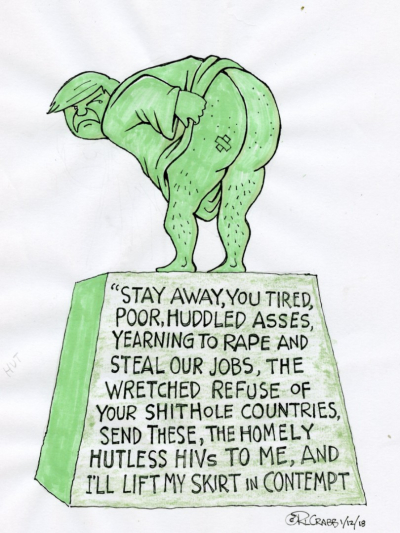
[13jan18 update] Not much on immigration debate has come from the Left, and that specifically includes the local Left as witnessed by the comment stream below. Now one of their leading lights – our political cartoonist RL Bob Crabb – has entered the fray with his contribution. In other more measured offerings Mr Crabb laments on the polarization and quality of debate in the land, seeking always to promote himself as the voice of bipartisan and dispassionate reason astride the mindless froth that issues from both sides of the proverbial road. I suppose in his tally, offerings like the one below are not included. Another commenting reader in an exuberant expression of joyous approval of Mr Crabb has appended “Nailed it!!!” Such is the nature of our national dialogue.


 rebanesruminations.com
Leave a comment