
Rebane's Ruminations
December 2017
S M T W T F S
 12
3456789
10111213141516
17181920212223
24252627282930
31  

ARCHIVES


OUR LINKS


YubaNet
White House Blog
Watts Up With That?
The Union
Sierra Thread
RL “Bob” Crabb
Barry Pruett Blog

George Rebane

This little puzzle recently came to my attention.  A ring of radius R is tossed randomly onto a large grid of unit squares as shown below.  The toss will score only if the ring intersects two or three squares โ€“ rings 1 and 2 will score.  If the ring intersects only one or more than three squares, it will not score โ€“ rings 3 and 4 will not score.  What radius ring will maximize the probability of scoring โ€“ i.e. compute the radius and the maximum probability?
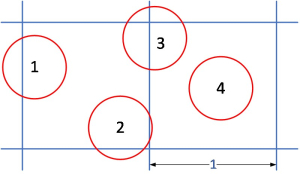
CircleGridProblem

Being able to solve ‘puzzles’ such as this is a skill fundamental to solving several large classes of problems in science and engineering.  And coming up with just the approach to its solution is a critical thinking skill that should make non-techies proud.  TechTest season is again upon us, and I gave this problem to one of the very busy students I have been mentoring.  He saw the challenge immediately, went home but couldnโ€™t put it down, and had the correct answer back to me before sunset.  I thought some of our RR readers might also want to take a crack at it, or give it to their bright offspring ๐Ÿ˜‰

[30dec17 update]  Thanks to Mr Don Carrera of Irwin, PA for his detailed workout of the problemโ€™s solution.  In subsequent private communications I promised to make available to readers both his solution and mine in PDF formats.  Mr Carrera has also demonstrated that his solution and mine produce identical numerical results.  Here are the downloads for Mr Carrera’s solution, and my solution.

Posted in ,

9 responses to “A Little Puzzle (updated 30dec17)”

  1. Gregory Avatar
    Gregory

    I can solve it, George… but since you already know the answer I doubt there’s a pot of gold waiting for me if I work it down to the end, and my kid is busy working problems that are paying his bills. ๐Ÿ™‚

    Like

  2. George Rebane Avatar

    Gregory 507pm – The puzzle came without an answer, so the only thing that I and my mentee got out of it was just the sheer joy of solving it (as is often the case). The solution set for R in [0, 0.5] is pretty straightforward. It gets more interesting in the (0.5, Rmax] domain.

    Like

  3. Don Carrera (Irwin PA) Avatar
    Don Carrera (Irwin PA)

    Answer to your problem: best Ring Radius = 0.28 to give Max Probability=56%; Rmax = 0.5858
    For R<= 0.5: score area = [0.25 – ฯ€r^2/4 -(0.5-r)^2]
    I used 6 drawings (in EXCEL) to illustrate various values of R = 0+; 0.2; 0.5; 0.5858. Needed a very detailed drawing for R>0.5 for understanding what is happening. My drawings used gold color for the scoring area for R<0.5, and green for R>0.5
    To calculate values for R>0.5 required creating a kite shape in the unit square/circle combination; then calculating the lengths of the 3 sides of a half-kite; then using Heron’s formula to find the area of the half-kite; doubling this area to find the area of the whole kite; then subtract the area of the sector of the circle.
    ……….Score
    Radius..Area…Prob.
    0, 0, 0.0%
    0.05, 0.0455, 18.2%
    0.10, 0.0821, 32.9%
    0.15, 0.1098, 43.9%
    0.20, 0.1286, 51.4%
    0.25, 0.1384, 55.4%
    0.26, 0.1393, 55.7%
    0.27, 0.1398, 55.9%
    0.28, 0.1400, 56.0%
    0.29, 0.1398, 55.9%
    0.30, 0.1393, 55.7%
    0.35, 0.1313, 52.5%
    0.40, 0.1143, 45.7%
    0.45, 0.0885, 35.4%
    0.50, 0.05365, 21.5%
    0.5258, 0.0242, 9.7%
    0.5508, 0.0079, 3.2%
    0.5758, 0.0007, 0.3%
    0.5858, 0.0000, 0.0%
    Since the Snipping Tool doesn’t copy onto this area, understanding the formulas below will be tough without seeing the drawing.
    A pix is really worth 1000+ words sometimes.
    For finding values R>= 0.5 to 0.5858 Rmax took some work.
    Area of kite (ABCD)- area of circle sector (BCD) = green scoring area
    CE = 1-R
    ED = x = sqrt (2R-1)
    DA = 1 – x – R
    AC = (sqrt (2))/2 – [(R-0.5)sqrt(2)]
    CD = BC = R
    Use Heron’s formula for area of triangle ACD (half the kite):
    s = [(DA + AC + CD)/2]
    then AREA = sqrt [s
    (s-DA)(s-AC) (s-CD)]
    So green area = 2AREA – (f/360piR^2)
    where f = 90-2q; q = arccos [(1-R)/R].
    q=angle of base triangle inside the circle; f = small angle of kite from the center of the circle with radius R.
    ..R,…..CE,…..ED=x,….DA,…….AC,……….CD,………s,
    0.500, 0.500, 0.000, 0.500, 0.707106781, 0.500, 0.853553391,
    0.525, 0.475, 0.224, 0.251, 0.671751442, 0.525, 0.724072322,
    0.550, 0.450, 0.316, 0.134, 0.636396103, 0.550, 0.660084169,
    0.575, 0.425, 0.387, 0.038, 0.601040764, 0.575, 0.606871215,
    0.5858, 0.4142, 0.414, 0.000, 0.5857814, 0.5858, 0.585779619,
    AREA,…..q,……f,….f/360
    piR^2,…..green,….Prob.,
    0.1250, 00.00, 90.00, 0.196349541, 0.05365045, 21.5%,
    0.0597, 25.21, 39.58, 0.095206996, 0.02420477, 9.7%,
    0.0301, 35.10, 19.81, 0.052285136, 0.00791236, 3.2%,
    0.0080, 42.34, 5.31, 0.015334482, 0.000688726, 0.3%,
    0.0000, 45.00, 0.00, -5.03737E-06, 1.00758E-05, 0.0%
    (f/360
    pi*R^2) is the formula for the sector drawn in the circle.
    Merry Christmas!

    Like

  4. Don Bessee Avatar
    Don Bessee

    Well done sir and a Merry Christmas to you too! ๐Ÿ˜‰

    Like

  5. George Rebane Avatar

    DonC 607pm – Excellent Mr Carrera. A simple way to solve for R in [0,0.5] is to attack the quarter square in which the forbidden areas are the quarter circle of radius R in the outside corner and the quarter square measuring (1-2R)/2 on the inside corner. Taking the derivative wrt R of the remaining area quickly gives the optimal R = 2/(pi + 4) and Pmax = 4/(pi + 4). Good work on ferreting our the probs for R in (0.5, Rmax] where Rmax is seen to be the circle centered on the square’s diagonal, passing through one corner, and tangent to the two opposite sides from that corner. This requires that Rmax + Rmax*cos(pi/4) = 1 which yields the correct Rmax = 0.5858. And you’re, of course, right about making the whole explication simpler with appropriate graphics. Merry Christmas!

    Like

  6. Don Carrera (Irwin PA) Avatar
    Don Carrera (Irwin PA)

    George,
    I’m a retired EE, and I’ve been volunteering one day a week for the last 9 years in a local Middle School, in their math & science classes. I am currently reviewing some math work with three 6th graders. I’ve already covered Carl Friedrich Gauss’s way to add an infinite number of integers, and how to prove the Pythagorean Theorem. It’s within their grasp, and they’ve used that info to solve several problems.
    But I will show them what to learn from this problem. Not what you think though. Sad to say, I spent 30 minutes wondering why using a ‘modified’ Pythagorean theorem (a^2 + b^2 = c) did not work. Fortunately, I only wasted a half hour before the idiot part of my brain went to sleep, and I found the missing “c^2”. And it wasn’t a fatal error. So good fortune all around.
    Yes, I set the problem up the same way you described, with a smaller quarter-square. And used calculus to find the max value. But what’s the fun in that? I emphasize to the kids that there is usually more than one way solve a problem – sometimes clever, sometimes not. So for middle schoolers, using geometry, trig & algebra can often times be more understandable.
    Don C.

    Like

  7. George Rebane Avatar

    DonC 628am – I too was taught that there is more than one way to climb a mountain.

    Like

  8. George Rebane Avatar

    DonC 628am – Upon closer inspection, our answers for R in (0.5, Rmax] differ a bit. Could you email me your graphic so I can append it to this post, and I will also do the same for my solution in that range. You can reach me at gjrebane@gmail.com. Thanks.

    Like

  9. George Rebane Avatar

    re my 135pm – In a subsequent communication Mr Carrera demonstrated that in fact his solution and mine produce identical numerical results. My error for not picking this up in the first place.

    Like

Leave a comment