

George Rebane
The titled essay (here) by Princeton historian Dr Stephen Kotkin provides an important critical review of the system of governance under which many still live and many more actively promote. Under autocratic governments socialism’s logical terminus has been communism, as the attempt to fix socialism’s indigenous failures is always through ratcheting up the reach of central planning and control. In America today, socialism is taught in our schools as being high in the desiderata of alternatives for organizing societies.
Kotkin presents the historical record of how “in the 100 years since Lenin’s coup in Russia, the ideology devoted to abolishing markets and private property has left a long, murderous trail of destruction.” Here Kotkin’s only detectable error is his gross underestimation of the length of that “murderous trail”. Although he does cite China’s Great Leap Forward, which killed over 30 million, he abbreviates the total to the previously documented 65 million that were intentionally killed by communist governments (cf Death by Government, 1994), but fails to include Mao’s Cultural Revolution (1966–76) in which he killed an additional 100 – 120M Chinese citizens through starvation, working to death, and executions. Every Chinese family today can cite the number of relatives they lost in that holocaust. Progressive historians have either been silent about that loss of life or revised it drastically downward; some as low as only 1.5M dead.
For communism, as for socialism, capitalism has been the common enemy. “Karl Marx, who saw class struggle as the great engine of history, what he called feudalism would give way to capitalism, which would be replaced in turn by socialism and, finally, the distant utopia of communism.” This anti-capitalist class struggle continues in full swing, promoted at all levels today in the West by progressives.
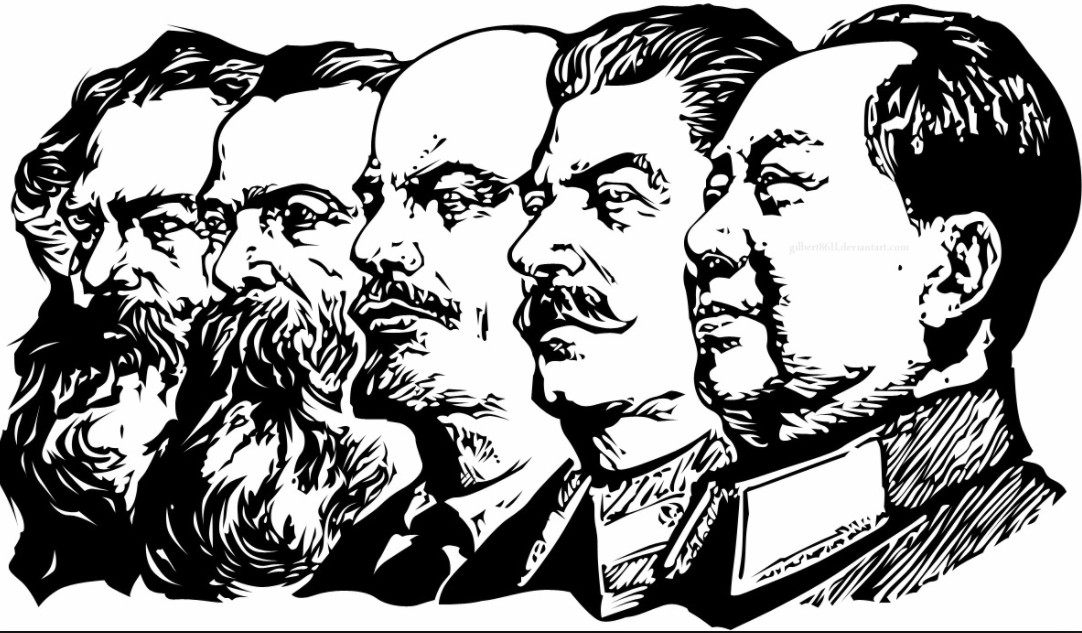
Marx & Engels in their 1848 Communist Manifesto declared that their theory “may be summed up in the single sentence: Abolition of private property.” Today the visible catchment for this is the longstanding UN Agenda 21 initiative (pdf here) which strives for that and related goals through a variety of constructive legal and regulatory stratagems. (see also RR’s Agenda 21 category of commentaries.) All of this is strongly denied by our Left, for which such a denial may serve as a reliable litmus test of their ideology.
The failure of communism wherever it has been tried has demonstrated “that to implement Marxist ideals is to betray them. Marx’s demand to ‘abolish private property’ was a clarion call to action—and an inexorable path to the creation of an oppressive, unchecked state.” And during the post-WW2 era communist governments sprouted with an alarming regularity, most as the radical means to throw off the yoke of Western colonialism. Recently, as the West successfully halted the spread of this disease, we have seen some communist countries attempt a rapprochement with heavily regulated forms of market economies. This, according to Kotkin, was when a “few socialists began to recognize that there could be no freedom without markets and private property. When they made their peace with the existence of capitalism, hoping to regulate rather than to abolish it, they initially elicited denunciations as apostates. Over time, more socialists embraced the welfare state, or the market economy with redistribution. But the siren call to transcend capitalism persists among some on the left.”
Actually that siren call has now been institutionalized in the West’s education systems, entertainment industries, and, of course, the news media. Today the Millennials, our "dumbest generation", lead in America’s renewed love of collectivism and communism (more here and here). Almost two out of three Americans support Marx’s fundamental social paradigm – “From each according to his abilities, to each according to his needs.”
Kotkin does not concern himself with (recognize?) the specific advances toward socialism cum communism that the Left has achieved, and continues to work toward in developed western countries. He only alludes to it in his conclusion – “Communism’s bloody century has come to an end, and we can only celebrate its passing. But troubling aspects of its legacy endure.” With major “redoubts” in Russia and China, Kotkin grudgingly accedes that the communist revolution is not yet “spent”.
Addendum – On this Bolshevik centenary I ran across another essay recounting the maelstrom of misery that communism has brought to the 20th century. The essay ‘100 Years of Communism – 100 Million Dead’ by David Satter is a bit more realistic in its body count and includes a few more salient details and important citations. In it Satter writes –
“Although the Bolsheviks called for the abolition of private property, their real goal was spiritual: to translate Marxist- Leninist ideology into reality. For the first time, a state was created that was based explicitly on atheism and claimed infallibility. This was totally incompatible with Western civilization, which presumes the existence of a higher power over and above society and the state. … The Bolshevik coup had two consequences. In countries where communism came to hold sway, it hollowed out society’s moral core, degrading the individual and turning him into a cog in the machinery of the state. Communists committed murder on such a scale as to all but eliminate the value of life and to destroy the individual conscience in survivors.”
Importantly, Satter points out that as the influence of communism spread it also had a deeper and more insidious effect. “In the West, communism inverted society’s understanding of the source of its values, creating political confusion that persists to this day.” To see an illustration of this, we note the disastrous mentality that has settled in our universities which recalls the prelude to the Bolshevik revolution observed by Russian religious philosopher Nikolai Berdyaev, who 1909 wrote, “our educated youth cannot admit the independent significance of scholarship, philosophy, enlightenment and universities. To this day, they subordinate them to the interests of politics, parties, movements and circles.” Does that have a familiar ring to it on 21st century American campuses?


 rebanesruminations.com
Leave a comment