

George Rebane
In the figure below we present a grid representing the two-dimensional space over a defined range of governance, and a range of collectivistic social orders. The governance (G) range encompasses a continuum starting with anarchy at G = 0, and progressing all the way to one world global government at G = 10. The collectivistic (C) range starts with comprehensive privatization at C = 0 where nothing is owned collectively – everything is private property to be disposed of as its owner wills. At the other extreme of the collectivistic range is communism at C = 10 in which the collective owns everything and private property has disappeared.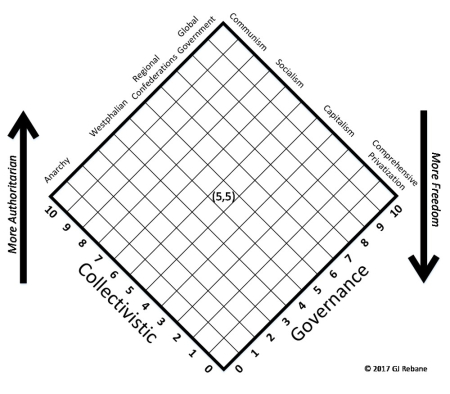
In the G-dimension we start with a Mad Max world of anarchy, there is no higher authority to enforce any codes of conduct or contract law. Peace and tranquility in such a region can only obtain through comprehensive altruism in which it is the individual who has and implements his notions of the common good. Or, of course, the opposite where raw might is right.
From there we move to versions of the Westphalian order (q.v.) in which various territories have regional sovereignty based on various forms of shared attributes such as race, ethnicity, language, common history, … . Westphalianism per se can encompass more structured forms of governance that are restricted to within the boundaries of mutually recognized and respected sovereign nation-states that agree to maintain existing borders and not interfere in the internal affairs of their neighbor states.
More encompassing forms of governance can subsume larger land areas in which formerly independent jurisdictions join in various forms of confederation to achieve, say, economic and/or security benefits. The European Union is an example of such a regional confederation of states. From there we come to an overarching global government that achieves the one-world objective of seeking peace, harmony, and sharing among all the earth’s peoples. The United Nations considers itself as prepared to assume this role under the aegis of its Agenda 21 protocols.
The intermediate stages of collectivism include various forms of proto-capitalism where sufficient contract law exists and is honored so as to permit establishing enterprises of shared ownership that seek profit through collective action. Capitalism can progress into more formal forms in which it depends on an overarching government to enforce contract law and lay down regulations that create various economic environments favorable to this or that sector of industry and commerce. The ultimate format of capitalistic collectivism morphs into corporatism in which government and corporations work hand-in-glove to guarantee both conducive environments for sustaining each.
It is a relatively short step from corporatism to socialism in its various forms that engender “social ownership and democratic control” of various means of production and the (re)distribution of wealth. As such collective ownership and control becomes more comprehensive, we arrive at communism in which everything is jointly owned and all decisions are made democratically by the collective (or a small troupe of professional elites who discharge their duties to promote the common good).
It is clear from the looking at the G-C grid that proceeding upwards takes one into more organized and authoritarian social orders, and proceeding downward promotes more individual freedoms and brings us to worlds that are least organized and predictable. And please note that not all places (coordinates) on this chart are necessarily stable, and one could argue that there may be some that are not even achievable.
So where are you on the G-C grid, what are your desired coordinates and where do you think is the US and/or any other country in the world? My own preference is to live near a (G,C) = (4,3) environment, and according to my lights America is now transiting through (5,6) on its way to (7,8) arriving there well before 2040. Of course, if the Singularity arrives before that date, then all bets are off. (See also the Nolan Chart here.)


 rebanesruminations.com
Leave a comment