

George Rebane
The news media, including Fox News, are confounding the latest buzz about the SecDef and the President being at odds about the Iran agreement. Trump has called the Iran deal “the worst ever” for the US, while Mattis along with the JCoS chair testified that Iran appears to be living up to the agreement. To the pea-brains who pass for journalists these days, this is a stand-off in the making within the administration. No one seems to understand that the two assessments are totally independent. Yes, Virginia, it is possible for the Iranians to be living up to the letter of the worst agreement ever that Obama negotiated with Iran.
With all the latest histrionics about ‘gun violence’ and ‘police brutality’ witnessed at entertainment venues across the land, it is clear from just the raw data about gun deaths that neither the blacks nor the Democrats believe that ‘Black Lives Matter’. Given the stats from longstanding Dem-controlled urban areas, it is clear that no such concerns exist about the overwhelming proportion of black-on-black murders committed there every month, year after year, numbers that also overwhelm the carnage in Las Vegas. But all those whites killed by a white man, now there’s “a disaster that must not be wasted” to give government control over more of our lives.
Control over our lives is governed by regulations that actually implement laws passed by elected legislatures; regulations that more often than not overextend what was intended in law. Here is the latest from the Mercatus Center of George Mason University on ‘Regulatory Accumulation: The Problem and Solutions’. Note the vertical scale of the graph below.
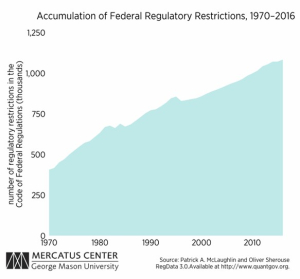 Regulations are created one by one. By design, each new regulation contains obligations or prohibitions—regulatory restrictions that policymakers hope will deliver benefits that justify their costs. Over time, however, the buildup of more and more regulatory restrictions distorts and deters the business investments that drive innovation and economic growth. These dynamic effects of regulatory accumulation can hinder economic growth considerably, on top of the many other consequences often associated with regulations, such as higher unemployment, higher prices, and lower wages, particularly for low-income households
Here is a quick look at the “gobbledygook” in which the nation’s gerrymandering problem is now mired and argued in the SCOTUS (more here). According to my lights, the solution to gerrymandering seems to me an easy one. Set an upper threshold on the ratio of area to perimeter of the district to be gerrymandered to such a value that keeps the defined regions reasonably compact. The ratio would have to be defined in terms of a specific unit of length (e.g. mile, meter, kilometer, furlong, …) since the ratio or fraction of area divided by perimeter will be in units of length given that perimeter is a length and area is in length squared. So if we pick ‘mile’ as the unit of length, we can set a lower threshold like, say, ‘2 miles’. For a rectangle that means that L*W/(2*L+2*W) must more than or equal to T = 2 miles. This will keep everyone from coming up with these thin tangled regions with very wiggly boundaries. The geometers among you will realize that the most compact region is a circle with its area/perimeter = radius/2.


Leave a comment