

George Rebane
When George Westinghouse patented his railway ‘fail-safe’ airbrakes in 1869, that new technology inaugurated a century of what came to be called featherbedding for the railroad industry as unions successfully fought the railroads to continue employing unneeded workers. Prior to airbrakes on each railroad car, the speed of trains on down grades were controlled by brakemen manually setting each car’s brakes and then releasing them. This was demonstrably the most dangerous job on a train since it required the brakemen to run up and down the length of the moving train equipped with narrow wooden gangways on the roofs of freight cars, jumping from car to car night and day in all kinds of weather. Thousands of brakemen died during the 1800s until all trains were equipped with the Westinghouse brakes. Today we still have railroad ‘brakemen’ doing other things, but that’s another story. (more here)
The important notion to understand here is that after remotely operated airbrakes were installed, railroads were still forced to hire brakemen whose new make-work tasks allowed them to also while away their work hours ‘featherbedding’ in the obligatory caboose (crew’s sleeping quarters) at the end of each train. Due to successful lobbying of the federal and various state legislatures by the unions, laws were passed to enforce specified crew sizes and compositions, and, of course, union memberships. This continues to this day.
And now the public, including some prominent leaders in science (e.g. Stephen Hawking), are becoming aware of the wide spectrum of things smart machines can already do, and some of their future potential in the workplace. They are belatedly discovering things known and demonstrated by computer professionals for more than thirty years. Many of them now realize the shake-up of society that large scale systemic unemployment will bring. However, many more see the advent of intelligent machines as nothing other than the latest iteration of Westinghouse’s air brakes, and their non-impact on unemployment. (more here and here)
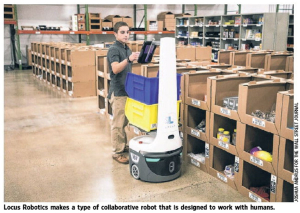 These worthies are telling people not to worry because 1) smart machines will create more jobs than they will displace, and/or 2) smart machines will be taught to work alongside humans to make their jobs easier while increasing productivity and therefore the workers’ pay. The first proposition is flat wrong on its face. And a moment’s thought reveals that the second is only a temporary palliative promoted by corporations for political reasons. In articles like ‘A Robot can be Warehouse Worker’s Best Friend’, we can at best just smile at the ignorance of the writer who has little knowledge of either the technology and/or what motivates the business tradeoffs between labor and capital. There we read –
“The worker doesn’t have to look for the product, the robot tells them exactly where it is,” said Bruce Welty, chairman and co-founder of Locus Robotics Corp., which makes the robots. Once the order is complete, the robot carries it over to a packing table, then returns to the aisles with another assignment. Read that as ‘another assignment for the human’; and the human’s job? Act as the pair of grasping arms (manipulanda) to pick up a part from the shelf where and when the robot instructs him to do so.
In the early 1980s with the advent of the laser disc and personal computers, we were already able to design smart machines to diagnose and repair complex systems and equipments. The human operator did not have to have deep knowledge of the thing he was supposed to repair; all he had to do was follow the computer’s directions in hooking up test equipment as directed and reporting its outputs to the computer. The machine then told and showed the human what tools to use to do what things that would then effect the repair. For us in the business of making such interactive multi-media maintenance systems, the human’s role was as a compliant set of sensors and manipulanda whose use the smart machine directed. And that is exactly how today’s smart machines will continue using humans to do ever more menial and cognitively simple things with his ‘best friend’ the computer.
And tomorrow, as the machine grows ever more perceptive sensors and finely dexterous manipulanda, management will take a look at the dollar cost, regulatory hassles, and reliability of the human worker and tell the human to leave his ‘best friend’ behind and take a hike. We used to call that being stabbed in the back by your buddy.
In private industry such progressive replacements will become more and more routine in the next years. The only workforce that will then remain secure in their jobs will be government workers whose existential on-the-job incompetence and sloth are protected by carefully structured regulations ensconced behind bureaucratic walls manned by beholdened politicians. These ‘workers’ are the already established featherbedders in our society, and they all take that condition of employment as their constitutional right (more here). (And these are the same kind of people destined to manage America’s ‘single payer’ healthcare system.)
But I don’t think the story will stop there in these pre-Singularity years. There is virtually no limit to the onerous extent that new regulations will be used to force employers to effectively become government welfare agencies, hiring workers to be the functional equivalents of featherbedders in order for their companies to be allowed to use their smart machines for profit. In that brave new economy corporatism will thrive and soar, along with income and wealth disparities.
[5aug17 update] My friend, commenter, and longtime reader Scott Obermuller raises an important point in his strong 5:47PM assertion below – “… no automation will ever replace my current occupation as husband of my dear wife and the grandfather of 2 wonderful kids.”
I don’t want to contend Scott’s established role within his great American family whom the Rebanes admire, but I would like to raise a related notion – humans’ readiness if not eagerness to anthropomorphize. Humans have long been known to ascribe human like qualities, attributes, and even functions to non-human critters and things. Things as obviously unhuman (sometimes inhuman) as automobiles. Men especially have been known to get very attached to their long-owned vehicles which they often come to treat as animate with even having commensurate personalities to boot.
Today we already have sophisticated robots that can hold a fairly deep conversation within a given topic domain. The twin technologies of physical robotics and machine intelligence have already produced early versions of in-home helpers that respond to elderly retirees in Japan. And even more ‘life like’ speech-understanding and talking helpers are showing up in the workplace. In the process more and more people are accepting such machines as fellow beings in their daily round (consider your developing relationship with Amazon’s Alexa or one of her cohorts). We seem to find it easier to work with critters that we can elevate to some semblance of our level of life. In short, anthropomorphizing works.
My own experience with such anthropomorphizing is extensive and began with my white 1963 VW bug which I bought brand new in Darmstadt, Germany for $1,300. That was our family car while I was stationed there, and the one we had shipped back to LA when we returned to the land of the round door knobs. And it was the little car that initially took us and two small children on camping trips in the high Sierra, and was my reliable daily transportation on LA’s freeways as I shuttled between work and grad school during years that seemed filled with unending energy, and room to always fit in yet one more project or attend another family or business or school command performance.
 That little bug was always there, doing its job, uncomplaining even when sometimes I skipped a scheduled oil & lube job on it. I was the first in my social network to fatten up its steering wheel to what today is standard fare by sewing on layers of Naugahyde, replaced the plastic knob on the shift lever with a custom contoured handgrip I carved out of an oak coffee table leg bought from Akron (remember those stores), and installed a set of new seat covers that Jo Ann sewed out of heavy duck when the original seats covers began to fray. More things were done under the hood and for the bug’s suspension to improve handling. But then after ten years of constant and reliable companionship it came time to buy a bigger and more powerful station wagon for our growing family – it was time to sell our little bug. I put a sign on it, and within a day or so had a couple of guys come take a look at it, and then quickly make me offers on what was an obviously loved and cared for vehicle.
When the buyer showed up with the check, I handed him the pink slip and keys, and, with eyes beginning to glaze, walked him out to our driveway. Tears flowed freely as I stood alone and watched him drive away with ‘my’ beloved bug. When I went back in the house, one look from Jo Ann told me that she understood what had just happened. And I would not be surprised if you, dear reader, have also had a similar experience.


 rebanesruminations.com

Leave a comment