

George Rebane
The US adopting the dreadful Paris Accords is the hot topic now. The accord is a voluntary agreement to further cut carbon emissions by the participating countries. The major emitters get a pass, with the other developed countries having not even met their past commitments. And everyone is hollering about President Trump not signing up America to be the only patsy in the group.
[update] ‘Trump Quits Climate Deal He Says Is Unfair To US Workers’
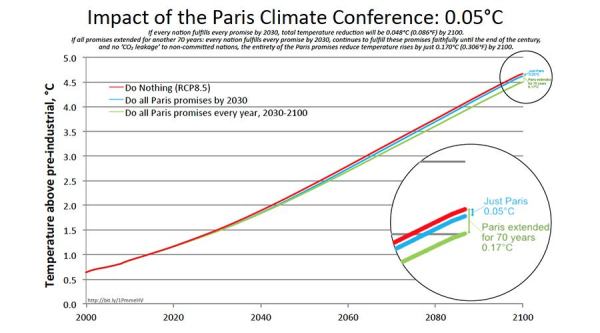
More specifically, China will not have to do anything until 2030 if then, and India will continue increasing its CO2 emissions to 3X current levels in the interval. And all that is OK with everyone else. But the US, which has actually cut its CO2 emissions thanks to private industry fracking natural gas to substitute for coal, it is we who are suddenly the bad guys for not jumping with both feet into an economically devastating commitment that will literally have no effect on anything to do with climate (see nearby figure).
As grist for the nation’s innumerate and ignorant, Senator Chuck Schumer (Democrat, of course) is leading a team of far-left liberals touting the UN line that the US is forsaking the creation of gazillions of ‘green jobs’ by not signing up to Paris. This is the same ‘debate is over’ crowd that forsook climate science years ago and adopted global warming as the perfect political tailwind to usher us into our new one-world future. But using the already debunked green jobs gambit really plays a trick on the nation’s light readers.
French economist and philosopher Frederic Bastiat (whom RR readers have met many times) wrote That Which is Seen and That Which is Not Seen in 1850, the year California entered the Union. In its first chapter he dispelled the then already established economic myth that the shopkeeper’s broken window was not all that bad for the local economy. The logic went that since the shopkeeper now had to pay the glazier a fee to fix the window, this allowed the glazier to continue to spend his fee with butcher, baker, and candlestick maker, who in turn spent their … well, you get the picture. The bottom line was that the broken window, while an unintended expense for the shopkeeper, was really an economic boon for the community – in short, destruction results in profit.
The natural question that here begs an answer is ‘If we want to stimulate the economy, then why not simply break more windows along with other acts of destruction which will employ a legion of repairmen and start a fiscal cascade to the benefit of all?’
But that is only what is seen. As Bastiat teaches, what is not seen are the alternative uses for the monies spent to fix things back to how they already were in the past. It is spending (investment) in the enterprising and new that really grows the economy, producing more jobs and increasing everyone’s quality of life. This is a concept foreign to progressive minds.
Schumer et al want to deploy a significant segment of our workforce in the attempt to produce or replicate (read ‘fix’) our energy production infrastructure – an infrastructure that already exists, functions exceedingly well, and is naturally transforming itself with new technologies to become ever more efficient, economical, and environmentally benign. There is no real need to take money out of a productive economy and redeploy it to ‘fix’ what is not broken, and doing that will inevitably deprive the uses of those monies for new enterprises that will really benefit us all. This is the sum and substance of the eternal debate between the Left and the Right.
Are They Really that Ignorant? Department: In the same vein we encounter similar items that illustrate the acumen of our leftwing neighbors. Since its discovery during the Obama years, the intellectual deficit of today’s so-called millennials is now firmly established. This is proving to be an embarrassment to our Left since a large fraction of them lean in that direction and vote Democrat. A standard response is to lambast anyone who cites the evidence for such a deficit. In fact one local leftwing loonie has even suggested that recognizing such a deficit makes one unfit to participate in educating our youth.
The logic for this knee-jerk may actually work because the millennials are like any other generation, save their having had to suffer wholesale the educational constriction inflicted by a unionized merit-deprived public school system, that is doubled down by a far-left professoriat within the ivied walls as it then puts the finishing touches on their thinking.
To corroborate this, Warren Stephens addresses ‘Why Do the Young Reject Capitalism?’ while “at the same time, they celebrate entrepreneurship and free enterprise. It is a curious disconnect.” In the piece he cites last year’s Harvard survey and study (here) showing that “more than half of respondents between 18 and 29 do not support capitalism, the free-market system that underpins our economy. An astonishing one-third said they support socialism.” Critical thinking today is a skill forsaken because it is not taught.
And finally we come to the bottom of the liberal barrel with an example from an offering in the 1jun17 Union by a Mr Richardt Stormgaard (here). This proud leftwing scholar takes to task a past column by Ms Cindy Hren in which she explained to readers that the United States is a (democratic) republic as opposed to a democracy. Mr Stormgaard will have none of this and opens with a strong assertion that we are indeed a democracy because that is what many people think. But the substantiation of his argument quickly goes off the rails when he somehow connects Ms Hren’s explanation as evidence of “the extraordinary journey undertaken by the once honorable Republican Party to the extremist right.” (yes, that is a quote) This off-topic tirade continues until another attempt at lucidity fails when he suddenly announces that it was really the Heritage Foundation in 1973 that introduced the error describing our governance when they “concocted the notion that since the U.S. Constitution specifically had not named democracy as its form of government (no society at that point in history had) U.S. democracy in fact is not valid and most of our history massive unconstitutional overreach (sic). The label chosen for the new U.S. was a republic.” Profound ignorance on parade.
The rest of us learned the difference between a democracy and a republic as intended by the Founders, for which the most famous confirmation comes down to us in the exchange between Mrs Powell and Benjamin Franklin emerging from the 1787 Constitutional Convention. “Well, Doctor, what have we got, a republic or a monarchy?” With no hesitation whatsoever, Franklin responded, “A republic, if you can keep it.”
Given today’s schools and the likes of Mr Stormgaard, it is no longer clear that we can keep it.



Leave a comment