

George Rebane
 Corporatism is the classical scourge of capitalism wherein privately held corporations, either alone or within associations, join with government to create business environments (e.g. markets) that reduce their risks from competition, natural anomalies, and economic turbulence through enactment and enforcement (by the government gun) of favorable laws, regulations, codes, fees, etc that serve to guarantee their survival and profits. Although not limited to large corporations, corporatism inevitably becomes their executed strategy as their marginally managed size makes them vulnerable to more nimble competition at home and abroad.
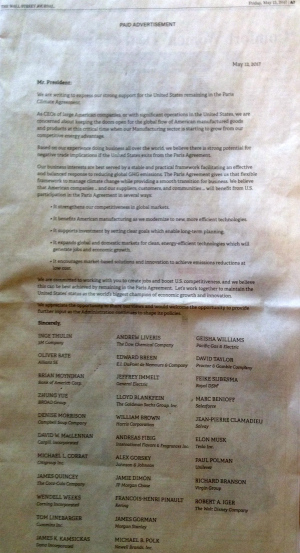
The nearby photo (apologies for the quality; it was quickly taken with my phone; inc.com didn’t do much better, but doesn’t connect the dots) is of a paid ad in the 12may17 WSJ containing an open letter to President Trump from the grim array of large corporation signatories beseeching him to keep the US in the recent Paris accords that presume to combat preventable manmade global warming. When we read the bulleted reasons for why it is in our interest to remain bound to those accords, it should become clear that these arguments are meant to convince and comfort the nation’s light thinkers. All of them are specious in the sense that they outline actions and business practices which the corporations could undertake on their own without any need for the Paris accords.
But a deeper consideration reveals that these ‘benefits’ to the undersigned, paid for by the consumers, will only accrue and make sense if they are executed within government mandates fashioned to mangle markets so that the big guys are afforded a sufficiently deep and wide regulatory moat behind which they can risk such compliance investments that would make no sense within freer markets. For example, “(Enforcing the accords on everyone) benefits American manufacturing as we modernize to new, more efficient technologies.”
Well then, if our manufacturing will truly be ‘benefitted’ by modernization and integration of “more efficient technologies”, then why not do it regardless of the Paris accords and enjoy the rewards? And therein lies the lie, because the benefits will accrue to the undersigned ONLY if expensive constraints are imposed which their (smaller and/or more efficient) competitors can ill afford.
The same line of revelatory reasoning can be applied to each of the other seemingly salutary “several ways” claimed in the letter. The overarching rationale for these cumbersome corporate giants to support the anticipated fruits of the Paris Agreement is to increase their own survivability and competitive advantage in a rapidly evolving global economy in which they face stark limits to growth and profits without government as their enforcement partner. Such a broad appeal to light thinking represents the finest practice of compelling camouflaged corporatism.


 rebanesruminations.com
Leave a comment