

George Rebane
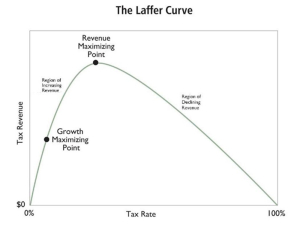 President Trump’s tax reform proposals have reignited debate over the curve made famous by economist Art Laffer. The nearby figure illustrates its most popular version, although as a more thorough discussion reveals (here), there are more sophisticated versions that reveal the variation of the state’s tax revenues as a function of increasing taxes on economic parameters such as labor and (monetary) capital. We remember that Laffer’s end points are accepted by all, save perhaps by the most rabid Left. If the government doesn’t tax or taxes very little, it gets no or low revenues; if the government takes almost all or all the wealth that you earn/create, it also gets very little or zero since then you will cease wealth producing activities. It’s the middle ground of tax rates where the debate should concentrate, since obviously the government does levy a considerable tax on us, and in return does take in a ton of money.
The Left’s most recent volleys against the Laffer Curve are based on the notion of their eternally (infernally?) received wisdom summarized in the proposition that ‘lowering taxes never pays for itself’. This implies that the only way to ‘pay for’ extracting lower than current tribute from the population is to eliminate a concomitant amount of government spending (a thinly disguised reference to the wealth transfer ‘entitlements’ for people who get more than they give).
Let’s think about what this proposition asks us to believe. First, it implies that our current tax structure or rates are miraculously already at the ‘Revenue Maximizing Point’ in the figure. Any reduction of these rates will cause us to ‘slide backward’ on the curve and yield lower revenues. Second, and more remarkably, it requires us to believe that regardless of where we are on the mid-region of the curve, raising taxes always yields more government revenues. The latter additionally appeals to the Left’s carved-in-stone shibboleth that tax rates have no significant effect on economic activity.
Both beliefs are empty of supporting evidence. The first assumes a hubristic Ptolemaic stance that is totally unreasonable given the difficulty in determining the RMP for a complex economy. The second belief is insane on its face – always raising taxes to gain more revenue must needs collapse somewhere along the way since arriving at wholesale confiscation of earned wealth ultimately stops its creation. The above cited piece in Forbes does a good job of explaining the matter to the intelligent reader.
Team Trump’s economic advisers correctly take the more humble Copernican view that we are located nowhere special on the ‘Laffer hump’, most certainly we don’t know our exact location regarding the RMP. But given the existentially high taxes we have been paying, and the historically anemic performance of our economy since the bottom of the Great Recession, it is reasonable to attribute a higher likelihood to the idea that we are to the right of the RMP. This advises that reducing taxes will indeed generate more government revenue by stimulating added economic activity that will generate more taxable wealth that in turn will increase revenues even at the then lower tax rates as part of a reformed overall tax structure. At this point it is at least worth a try.
The stasist and statist Left, of course, will have none of this. Why? Because it will be another widely visible contradiction that gives lie to their long-held model of human behavior – from an ideological perspective it will serve to reveal their man behind the curtain. And that’s a no-no, regardless of how their ill-informed minions must fare under an ever-bloating leviathan.


 rebanesruminations.com
Leave a comment