

George Rebane
While our Left, especially of the academic bent, assiduously works to stunt the English language – e.g. reduce/mangle the information carrying capacity of words – our technologists have been very busy expanding the language and introducing new words into English and other tongues. This battle is both important and its outcome is not yet determined, although for most people the Left’s determination to limit speech and thought along Orwellian newspeak lines seems to be taking hold with their constituents recently from union schools now being tutored by even more radical mentors in our institutions of higher learning.
In the last century we discovered a strong determinant that limits thought is a person’s language(s). An individual has a hard time thinking thoughts (e.g. formulating concepts and storing them) that his language does not support. More formally, the structure and breadth of a speaker’s language determines his perception and categorization of experience. This phenomenon is known as the Sapir-Whorf hypothesis which we have reviewed here before.
While words like ‘discriminate’, ‘immigrant’, ‘hero’, ‘prejudice’, ‘stereotype’, ‘racist’, ‘climate change’, ‘misogynist’, … have been mangled beyond meaning, other words like ‘meme’, ‘network’, ‘hashtag’, ‘feedback’, ‘in-the-loop’, ‘online’, ‘email’, ‘variance’, ‘steady state’, ‘causation’, ‘transient’, ‘algorithm’, … have worked their way into everyday usage as our individual ontologies have expanded to keep pace with the times. (Ontology? Please stand by.)
I recall it was as late as the 1990s when I used ‘algorithm’ in a meeting made up mostly of MBAs and lawyers, I was accused of lapsing into unnecessary and incomprehensible technical jargon. When at the turn of the millennium things got so obviously complex with the spread of the internet and ecommerce, the lack of ‘algorithm’ in our lexicon just screamed for its adoption, so I responded by writing the one-pager most longtime readers have seen (here). Today we can’t open a newspaper without running into ‘algorithm’ numerous times. Nevertheless, today’s innumerates continue giving grief to those from STEM fields who can describe complex systems, processes, and events with a word new to their ears – they’d rather take comfort in repeating ‘a small stealthy predator with claws given to hunting rodents’ when simply saying ‘cat’ would serve.
Nevertheless, in this vein, the language of the well-read layman continues to expand as technology and science infiltrate and push our horizons inward, outward, and all around. I am guilty of using words without explanation that are common to my lexicon and literature (e.g. see ‘ontology’ here and here). I figure if the reader is interested in the thought presented, then his looking up the unknown word online is both easy and expanding (in the Sapir-Whorf manner). And if my reader doesn’t care, then neither do I; for I proudly trail in the shadows of my betters such as Buckley, Carroll, Tolkien, and Dennett.
Daniel Dennett is an internationally celebrated cognitive scientist, writer, and also happens to be my favorite atheist. A number of his books decorate our shelves, and in his latest – From Bacteria to Bach and Back: The Evolution of Minds (2017) – he slips in the confession that he wants to introduce ‘ontology’ into our everyday tongue. In this piece, I call his ‘ontology’ and raise him a ‘deictic’.
As the good professor explains –
Ontology comes from the Greek word for thing. In philosophy, it refers to the set of ‘things’ a person believes to exist, or the set of things defined by, or assumed by, some theory. What’s in your ontology? Do you believe in ghosts? Then ghosts are in your ontology, along with tables and chairs and songs and vacations, and snow, and all the rest. It has proved more than convenient to extend the term ‘ontology’ beyond this primary meaning and use it for the set of ‘things’ that an animal can recognize and behave appropriately with regard to (whether or not animals can properly be said to have beliefs) and – more recently – the set ‘things’ a computer program has to be able to deal with to do its job (whether or not it can properly be said to have beliefs).

So basically, your ontology is your universe of items, ideas, notions, beliefs, objects, history, and all that lends order to your perceptions of what is. And when we consider this ‘order’ or structure, if you will, that itself delivers itself differently to many of us. Some of us like to have an ontological structure where each thing has a known and accepted relationship to at least one other thing in our ontology, more often than not, it often enjoys relationships to several or many things. When we think or ponder, we figuratively climb like a spider over the web that connects our things, often discovering more direct paths or relationships (‘new way of looking at it’), and sometimes finding out that an old relationship needs to be severed, it was erroneous and won’t work anymore.
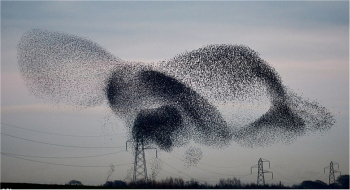 And here we come to the notion of deictic referencing. In a deictically connected and managed system or network or organization or ontology, every subunit is constantly querying or determining its relationships with other subunits, asking ‘where are you in relation to where I am now?’ And then it uses the answers to decide (algorithmically?) what it should do next (technically, what state it should enter next). Nature is deictic in that, even in its most complex forms, it operates deictically without requiring an omniscient master controller to keep things working. Demonstrations of deictic behaviors can be seen in the aerobatics of a flock of starlings or the precise convolutions of an entire school of sardines.
 Science expands human knowledge in this manner by maintaining and expanding its ontology deictically. Every new idea and advance is connected to and based on what is already established truth. And when some scientist’s leap of imagination creates a promising island off the shoreline of accepted knowledge, then we get real busy trying to build a causeway and join the new island to the rest of what we know. In other words scientists (and presumably other sane people) insist on expanding their ontologies deictically, or they abandon the island as another barren rock that bore no fruit. But even then that deictic of failure survives to inform us of what worked and what didn’t.
Humans have now become smart enough to understand the technical underpinnings of how deictic structures simplify and enhance cooperation between different parts of even the most complex systems ranging from a microscopic folding protein, to an entire ecosystem, an economy and beyond. From another perspective, we now understand why deictic systems and ontologies are computable – every part takes care of itself (works its algorithm) by having only ‘local’ knowledge of what its neighbors are doing. Such local environments may grow, but they always tend to prune themselves, sometimes catastrophically, when things become too complexified. Nowhere in the natural scheme of things do we find a big omniscient kahuna keeping an eye on everything and telling every part what to do now and next.
Well, that’s not entirely true. The biggest contradiction to this can be found all around us in how humans conduct their affairs. For millennia there have been certain humans and their supportive cohorts who have sought to be the big controllers, educating their minions by means fair and foul to discount all other relationships save that of subservience and compliance to the center of power – i.e. minimizing the deictic wherever it is found. They used to be known as kings and conquerors, and some still are. But today most are found in leviathan organisms known as the state, run by hubristic minions who confidently drape themselves with imaginary powers to plan and control while bestowing various forms of misery upon the rest.
So, how deictic is your ontology?


 rebanesruminations.com
Leave a comment