

George Rebane
Recently the new SecTreas Steve Mnuchin was quoted (here) to claim that the acceleration of technology, specifically the advent of smart machines, would have no or minimal effect on US employment. The overwhelming evidence that inundates us daily (e.g. recently here and here) leads one to conclude exactly the opposite. Warning of the rampant increase of systemic unemployment has been a clarion cry in these pages since RR was launched over a decade ago. The number of potential workers who are out of the workforce is now around 90 million, 20 million more than I predicted today’s number to be about ten years ago.
The factors that significantly impact our systemic unemployment are AI (or accelerating technology), immigration, and education. Contrary to Mnuchin’s mind-numbing conclusion, smart machines that are into everything from medical diagnoses, flipping hamburgers, to scientific research are extending the reach of some workers while permanently evicting larger numbers of them from the workplace. One of the prime reasons our onshore businesses have a hard time growing is finding qualified workers – people with enough smarts and proper skill sets who are willing to work for a very uneven spread of paychecks and benefits that the realworld delivers.
And our dumbed down union dominated public education system is the guilty party in this equation that continues to deliver less for students while demanding more from taxpayers. Today we have sunk below the problem of incompetent teachers to the utter loss of classroom control that is dictated by our own federal government. A recent update (21mar17 WSJ) of this part of our educational tragedy is provided by Manhattan Institute Fellow Jason Riley in his ‘An Obama Decree Continues to Make Public Schools Lawless’.
Riley makes the case that “to improve education, allow teachers to administer discipline regardless of race.” Most recently (2012) Obama’s Dept of Education made that even harder by releasing “a national study showing that black students are suspended from school at a higher rate than whites, and the findings fueled a predictable debate over whether school discipline policies are racist. Two years later, the department sent a letter to school districts warning them to do something about the disparity—in effect, to stop suspending so many disruptive black students or risk becoming the subject of a federal civil-rights investigation—and the results have been just as predictable.” The remainder of Riley’s piece gives a summary of some of these disastrous stats about which the leftwing lamestream media is predictably silent.
The bottom line here is that our most disadvantaged students – blacks and Hispanics – are the most disruptive, and now purposely so since they know that short of ‘drawing blood’ they cannot be touched by the anyone in the system. The resulting mayhem not only inhibits prominent classes of our poor and ignorant from benefitting from civilized society, but also denies our society the number and quality of workers needed to continue generating the distributed wealth we need to maintain our quality of life. However, the policy plays perfectly into the hand of those seeking to maintain the nation’s plantation mentality of dependence and allegiance. Perfidy perfected.
These pages have continued to update readers on the advances in AI and robotics. The field has recently witnessed a sea change in development and adoption of its derivative technologies by the marketplace. Much has been written here and elsewhere about such AI advances and by this time even the modestly read have been exposed to some wonders of ‘deep learning’. A particularly useful summary is ‘Why Deep Learning Matters and What’s Next for AI’ from Algorithmia. What I’d like the reader to now connect is the state of our education and AI with possibly today’s most demagogued issue that impacts the United States and concerns western civilization – the mass migration of people from poor and unassimilating (unassimilatable?) cultures that is collected under the horribly inappropriate and intentionally confounding label ‘immigration’.
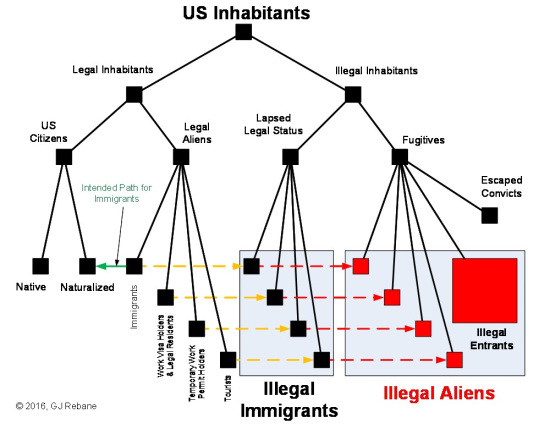
America’s immigration policy is not in shambles as reported. However, our policies to deal with illegal entrants and fugitive illegal aliens is America’s existential disaster. Not only does this have a major impact on our systemic unemployment, but its social problems have been cynically and successfully framed by the Left in such a way that a reasoned national debate to seek solutions is now next to impossible. Today the problem has finally drawn the attention of our intellectuals and public policy experts leading to a spate of books, papers, and articles. One of these – from Mark Krikorian of the Center for Immigration Studies – is a particularly informative piece entitled ‘The Real Immigration Debate: Whom to Let In and Why’.
I was particularly drawn to this piece because of its distinguished provenance, and that it underlines the Rebane Doctrine repeatedly argued in these pages. The cherry on the cake is Mr Krikorian’s systems approach to reasonable and reasonably accessible solutions that starts with defining our country’s immigration utility function. He begins by noting that “today’s bitter divides focus too narrowly on enforcement. All sides need to be clearer about what immigration policy is meant to achieve.”
Once you get by enforcement, the real question that should be addressed is ‘why limit immigration at all?’ and that requires a clear definition of our goals and preferences. The ‘limit argument’ centers on the notion of protection from a spectrum of maladies ranging from, say, terrorism to “protection for less-skilled workers, protection for the social safety net, and protection for the civic and cultural foundations of American society.”
Polls show that a good part of the earth’s population (700M, Gallup, 2009) would like to leave their native lands with America as their top destination. 43M foreign born (including me) are already living here, with 1.5M new arrivals (most legal) annually. 4M are on immigration waiting lists. But, of course, those patiently waiting immigrants don’t quite complete the ‘immigration’ picture which is more comprehensively presented in the following graphic depicting the source and make-up of US inhabitants.
Kerkorian correctly cites that Americans are most concerned about the impact of foreigners on jobs and workers. The details of the economic effects of immigration are contained in the 2016 National Academy of Sciences study. The bottom line is not exactly what the Left has been telling us. The study concludes that the “net benefit is derived from lowering the wages of Americans who compete with immigrants by about $500 billion. Businesses, in turn, benefit to the tune of about $550 billion, resulting in the $50 billion immigration surplus. In effect, immigration functions as a program of redistribution, shifting wealth from labor to capital.”
An ancillary conclusion is that the promoted shibboleth that” native-born workers don’t compete with immigrants because the two groups are in different occupations—‘jobs Americans won’t do’ is the shorthand term—is generally false.”
Among the many findings corroborated in the report is Milton Friedman’s argument that “you can’t have both relatively open immigration and a generous welfare state.” The obvious reason is large-scale immigration “attracts large numbers of less-skilled workers, who will only be able to earn low wages. These low wages mean, in turn, that they would pay little in taxes but are eligible for many means-tested government benefits.” Today over 51% of households headed by immigrants use at least one means-tested welfare program.
The bottom line of the NAS economic effects study “found immigrants to be a net fiscal drain” when all the costs are considered – including “the balance between services used and taxes paid by immigrants and their dependent children – with the loss as large as $299 billion a year.”
Kerkorian’s article spells out the inevitable conclusion that most informed people have known for a long time now. “There is no avoiding the reality that admitting large numbers of poor people into the U.S. inevitably creates costs for taxpayers. As with the effect of immigration on the labor market, no specific policy follows from these facts, but they clearly show the impact of decisions about immigration limits.”
And here we have not even considered the factors involving unassimilating alien cultures that seek to retain/impose their imported native values and mores. Not much reflection is required to see the distinct future for America when we continue to support policies that annually deliver millions of sub-par workers while maintaining porous borders – the unemployed, unemployable, and then inevitably the poor and ignorant will demand a strong state headed by the man on a white horse to lead us all.
[update] H/T to reader.
[1apr17 update] I was at loggerheads as to under which commentary to post this update on the very strategic response that big businesses are making to job-killing AI in the public forum. GE’s CEO Jeff Immelt is covered in all the outlets assuring everyone that he “doesn’t think robots will kill jobs in the near future.” OK, we do note the inclusion of ‘near’ in his pronouncements. But when he makes his case, then it is clear that he believes he is talking to the lesser lights in our country. Consider his public thoughts about “automation and the future of work” as parsed for us in the following points on Axios.com.
- He thinks fears of robot-driven joblessness are overblown, even as he invests billions in automation:”This notion of the war of the robots happening in the short term, that’s more of a Silicon Valley vision than the real world.”
- Robots are making Americans richer: Businesses can only pay workers more if they become more productive, and automation allows humans to focus on more valuable tasks.
- It’s not just technology, but politics that drive automation: “The question of the last election was, ‘how do you create $25 per hour jobs?” Immelt argues. In a global economy, jobs that don’t require trained workers to leverage the power of computers and automation simply won’t pay that well.
- All business will be in the education business: Immelt says that GE and firms like it must do more to train workers to rise above tasks that robots can do, “not because we’re bleeding hearts, but because we’re good at it.”
A short perusal of the above reveals a gross contradiction. On #1, overblown or not, the war for jobs between robots (AI) and humans is being overwhelmingly won by smart machines. The labor department and census data bears that out, as do the numbers of growing systemic unemployment and workforce participation percentages.
What he doesn’t reveal in #2 is that tomorrow fewer humans will be able to and needed to operate smart machines. And even fewer than those will be able to “focus on more valuable tasks.” But he is right in that that ‘them that can will become much richer than them that can’t’. Can everyone now hum a few bars from the Ode to Guaranteed National Income?
And the tautological #3 flies right in the face of #1.
Finally, #4 panders to the unthinking, painting a picture of socially sensitive corporations happily devoting all necessary resources to “train (unemployed) workers to rise above tasks that robots can do”, and then giving them good high-paying jobs. Smart machines will continue doing ever more complex jobs, and the tasks that they can already do will never again be done by human workers.
Tomorrow the situation will be direr for those who cannot benefit from the promised training. Recall that half the population has two-digit IQs, and the required smarts threshold is already advancing in the three-digit domain. Now is the time to review the story of ‘John Henry, the steel drivin’ man’ (here and here).
What Immelt and other corporatist leaders will be telling us in the coming months and years is a comforting pabulum designed to keep the social peace for as long as possible, while they automate and lay off more workers and expand into new business units and enterprises in which labor costs are absolutely minimized. During this time wage inequalities cannot do anything but rise, and there will be calls to tax the bejeezus out of profits and high earners. The result will be socialism on steroids that gives rise to equal opportunity misery, or a two-tiered world in which the rich and productive will insulate themselves against the poor and ignorant.
We have spelled out mitigating and ameliorating alternatives in these pages that greatly depend on a reformed educational system and a wealth transfer process that involves everything from guaranteed national income to the establishment of non-profit service corporations. But our political ability to realize and implement such solutions (palliatives?) in time is not guaranteed, most certainly not in the current political milieu where socialism continues to be society’s siren song. (See also ‘The Depth of Dumbth’)


 rebanesruminations.com
Leave a comment