

George Rebane
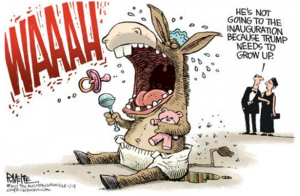 Black congressman and civil rights icon John Lewis hasn’t done much if anything for black folks since he joined the legislative gravy train in Washington, so maintains Jason Riley, senior fellow at the Manhattan Institute (here). What Lewis has done lately is become leader of the de facto Democrat Party’s drive to delegitimize Donald Trump’s election as the nation’s 45th president. Such a concerted nationwide initiative is a potentially destabilizing first in the modern history of our country.
But what Mr Riley makes us aware of (here) is that Congressman Lewis is nothing more than another well promoted black leader who has successfully demagogued his Atlanta constituents as have so many others in Congress whose home districts, all under decades of black Democrat control, continue to languish economically and educationally. These political leaders have gained enormously from keeping their charges in a plantation mentality – poor and ignorant – and they are not about to let go of their oh so sweet sinecures.
In response to Lewis’ charge of his “illegitimate” election, Trump’s recent tweet clearly pointed out Lewis’ record as a lawmaker. And with his civil rights heroism historically secure, the question that still stands is –
… what do Mr. Lewis’s mostly black constituents in Atlanta have to show for his time in Washington representing them? Atlanta has one of the widest gaps in the country between high- and low-income households, according to the Brookings Institution. A 2015 report by the Annie E. Casey Foundation found that although Atlanta “is considered an economic powerhouse and ‘black mecca,’ its wealth and promise don’t extend to many of its residents, particularly those of color, who struggle to make ends meet, get family-supporting jobs and access quality education.” The study found that incomes for Atlanta’s white residents were more than triple those of blacks; the high school graduation rate was 57% for blacks and 84% for whites; and black unemployment in Atlanta was 22%, versus a city average of 13% and a white rate of 6%.
Atlanta also hasn’t avoided the surge in violent crime that has hit other major cities in recent years. Last summer the mayor announced the creation of a task force to reduce gun violence, and in November the Atlanta Journal-Constitution reported that the city had been named “one of America’s top 25 murder capitals, according to the latest data from the FBI’s Uniform Crime Report.”
And to the point that John Lewis is part of what may be termed the nation’s black leadership plague, Jason Riley observes that –
Mr. Lewis’s poor record is not unique among black politicians with large black constituencies. Atlanta has had black Democratic mayors pushing liberal policies for decades, and blacks have been well-represented as city councilmen and in the top echelons of the police department and school system. Much the same is true of other major cities with large black populations—Baltimore, Cleveland, Philadelphia, Washington—which are lagging economically, notwithstanding black political clout from Congress down to the local school board. This is what Republicans mean when they say black voters have been getting little in return for their steadfast loyalty to Democrats.


 rebanesruminations.com
Leave a comment