

George Rebane
It appears that enough dust has settled around Ms Senum’s unfortunate remarks about the nation’s police departments that we can bring closure to the factors involved in the considerable support she has received for her (now clarified) sentiments. My own support of her position was published in the 13jul16 Union and in these pages which garnered an extensive comment stream (here).
The revealing part of public attitudes became quickly apparent during the NC City Council meeting where public comment against Ms Senum was a bit in excess of two to one. At the meeting and in the media her antagonists almost uniformly demanded her apology and removal from public life. Not only that, but these folks expected the NCCC accede to their demands forthwith. The fact that the overwhelming part of them had no say in the matter beyond exercising their First Amendment rights did not occur to them, and upon reflection can still be seen to represent a broader national understanding of how policies should be made and implemented in the country’s thousands of electoral jurisdictions.
In this commentary I would like to expand on this audacious national misunderstanding, and clarify the various aspects about elected officials voicing and representing unpopular sentiments. What appears to confuse people are factors associated with such events that are independent of each other, and which should also be treated as such. These are –
- The legal expressability of an unpopular sentiment,
- Public expression of the unpopular sentiment by an elected official,
- The sharing of the sentiment by the official’s constituency,
- The right of constituents holding unpopular sentiments to be represented,
- The legal aspects of the official’s tenure in office – who/what is required to unseat,
Legal expressability: This is covered primarily by the First Amendment right of free speech, unless specifically proscribed by a public code of conduct for the elected office. All educated people know that the First Amendment does not guarantee the right for all possible instances of free speech.
Public expression by elected official: First, let’s all be clear that an elected official cannot effectively parse their speech into personal and public categories. All of their speech reflects on their duties and how they are perceived to execute their office. And all protestations to the contrary serve only to weaken the subsequent effectiveness of the elected official. After all, they were elected in great part for their displayed character and values which were taken by their constituents to be the ‘real person’ who would represent them.
Constituents’ shared sentiments: Until and unless the official’s constituents, publicly and in the aggregate, disagree and/or reject the official’s stated sentiment, it is reasonable to assume that silence presumes acceptance. Here it is important to consider the plurality of the aggregate (numbers matter), and that such disagreement does not automatically imply or dictate the official be unseated.
Representation of unpopular sentiments: In a free country, and still in America, sentiments which one cohort of franchised citizens embrace may be totally reprehensible to and rejected by another, perhaps the majority, cohort. Nevertheless, all such sentiments in every electoral jurisdiction have the right to representation in their governing bodies as enabled by the jurisdiction’s applicable election laws. In America there are no extra-legal provisions by which people from other jurisdictions may peremptorily have the offending official removed.
Who/what is required to unseat: The only provisions that exist for the removal of an official are those spelled out in the applicable laws and in any additional ‘code of conduct’ codicils to which the official is a signatory. Absent these, the official is tenured and secure in his seat, and may vacate it only through volition or reasons of health.
To make these points as unambiguous as possible, we appeal to the following graphic. Here we consider a universe of distinct jurisdictions within the context of the above represented by the blue squares assembled into the large rectangle. We isolate one of these jurisdictions that is colored green, and is surrounded by the gray cross-hatched jurisdictions.
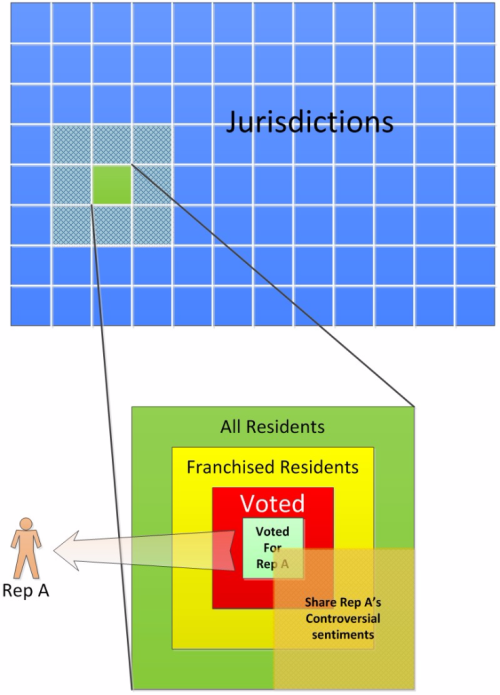
In the lower part of the figure we expand and examine the green jurisdiction which has elected ‘Representative A’. From all the jurisdiction’s residents (the entire green square) we have a (yellow) subset that is franchised to vote. Of the franchised residents we have a further subset (red) that could have voted for ‘Rep A’ and did cast their votes. And finally, of all these voters there is the last subset (in light blue) of people who actually voted ‘Rep A’ into office as indicated by the arrow.
‘Rep A’ now goes public with a controversial sentiment that may or not be shared by any given green resident. But absent an exhaustive survey, and given no contrary evidence, we may presume that there exists a subset of ‘green residents’ that also embrace the controversial sentiment. This subset is shown by the tan square that overlaps each of the previous subsets to some extent. Most importantly, this indicates that there are people who voted and voted for ‘Rep A’ that share the sentiment and subsequently have that elected official appropriately represent them while holding that sentiment.
Given the five factors expanded above, who in the shown universe of jurisdictions have the right to remove ‘Rep A’, the official that offends them, and which people in that same universe have only their First Amendment rights with respect to ‘Rep A’? We may easily agree that no resident of the blue jurisdictions has any such rights beyond their right to free speech. And that same stricture is in place for the neighboring jurisdictions in cross-hatched gray. These neighbors cannot gratuitously reach across into another jurisdiction and effect the disposition of that jurisdiction’s elected officials. This might well give rise to blood in the gutters, and rightly so.
So we are left with the residents of the green square from which ‘Rep A’ was elected. Now the question becomes a bit more complex. If there is to be formal action to remove the representative, should it be limited to only franchised residents (yellow square) some of whom did not vote? Or perhaps only to those who voted (red square) whether or not for ‘Rep A’? Or should it be further restricted to those who actually elected ‘Rep A’ warts and all?
Surely somewhere inside that yellow square is the answer. I’m not certain as to what it is exactly, but I do believe that any formal action to unseat taken by all those who could have voted for ‘Rep A’ (and did or didn’t) make up the largest cohort of green jurisdiction residents who should be able to jointly and legally determine the political fate of ‘Rep A’.
Back to Reinette Senum: Sadly I report that this kind of analysis has eluded many of the loud voices responding to Ms Senum not only in our county and these parts, but also across the nation. In the correspondence regarding my article I received kudos and also extensive criticism of my position from a learned correspondent who argues that Ms Senum’s remarks have evoked an a fortiori public mandate for her removal, one that Nevada County and specifically Ms Senum’s colleagues on the City Council of Nevada City cannot ignore without rending the fabric of our society. Additionally, I was accused of delaying Ms Senum’s needed contrition and voluntary withdrawal. Upon reflection methinks that such exhortations (hyperventilations?) are beyond the pale both legally and also practically in the prudent exercise of our ‘live and let live’ liberties.
Finally, since everything is now decidedly quiet on the western (Nevada County) front, Councilwoman Reinette Senum should continue to devote her energies to serving the city she loves. Her silent majority has spoken.
[28jul16 update] In this morning’s Union we have a Mr Andy Burton, no less a member of the newpaper’s editorial board, delivering yet another misbegotten swipe at Councilwoman Reinette Senum (here). He attempts to demonstrate that Ms Senum did violate Nevada City’s code of conduct for the City Council and cites chapter and verse. What results is an embarrassing demonstration of poor reading skills, or is it reasoning skills? Mr Burton cites the code’s Article 3 which states –
“The professional and personal conduct of members must be above reproach and avoid even the appearance of impropriety. Members shall refrain from abusive conduct, personal charges or verbal attacks upon the character or motives of other members of the Council and Planning Commission; the staff or the public.”
He claims that this directly addresses Ms Senum’s sins, when everyone who knows what the lady said clearly sees that the code covered none of her Facebook remarks. Yet Mr Burton goes on to accuse the City Council of being “irresponsible and (failing) to understand the responsibilities of elected officials” in not ejecting or censuring Ms Senum. Even further from the man’s intellectually illuminated area are the notions that Ms Senum most likely represents Nevada City constituents who share her perceptions about the nation’s police departments, and that these constituents also deserve a voice in city government.
[3aug16 update] Since the dust began to settle on the Reinette Senum statement, a number of people have written The Union in support of the Nevada City councilwoman. These letters corroborate the original RR commentary first offered on the matter, and have gone on to give examples of what was graphically illustrated in the follow-on above. Today we read another one from a Mr Tom Ferrer who in his ‘Hang in there Reinette’ letter writes –
Reinette hasn’t brought shame on Nevada City. She has voiced what many people think. Innocent people are being killed. If one person supports her in writing, then there are 10 more who do so but do not speak up. Ditto for any petition supporting her.
What we should note is that, yes, many of Ms Senum’s constituents do indeed share her original sentiments and for them she is their lawful and legitimate representative.
[8aug16 update] Reinette’s little dust devil just keeps spinning as it pits her supporters against her detractors. This morning’s Union had an Other Voices by a Mr Phil Zink who demonstrates that neither thinking nor writing can be included as his strong suits. He takes me to task by name constructing and quoting statements that I never made, spread over a screed that demonstrates he understood nothing of what I wrote – e.g. have no idea from where he got Mr Rebane’s “constituent bubble” that he cites twice.
Not knowing the definition of constituent (“a person who authorizes another to act in his or her behalf, as a voter in a district represented by an elected official”) he goes on to defend hills not assaulted by me. I would like to conclude that his emotions concerning Ms Senum’s statement have clouded his reason, but upon a careful reread I find that the cloud obscures nothing. However, I do recommend a close study of the above post, if for nothing else than discovering what I did not say.
[12aug16 update] I responded to Mr Zink’s column (see 8aug16 update) with a letter that was published in the 12aug16 Union here. It is reprinted below.
***
Mr Phil Zink’s recent Other Voices continues the argument that people other than Ms Reinette Senum’s constituents have a right, beyond exercising their voices and wallets, to determine her political future. Ignoring her received support, he seems to miss that Ms Senum may well and most likely does represent the attitudes of some Nevada City residents, especially those who voted for her. In formulating our counsel concerning Ms Senum, we should understand that
- The legal expressability of an unpopular sentiment,
- Public expression of the unpopular sentiment by an elected official,
- The sharing of the sentiment by the official’s constituency,
- The right of constituents holding unpopular sentiments to be represented,
- The legal aspects of an official’s tenure in office – who/what is required to unseat,
are independent factors that bear on the matter. To muddle these factors only confounds the public debate, and highlights our Founders’ longstanding concern about America’s Great Experiment to demonstrate that people are capable of governing themselves. I have gone into some detail about this issue on Rebane’s Ruminations.


 rebanesruminations.com
Leave a comment