

George Rebane
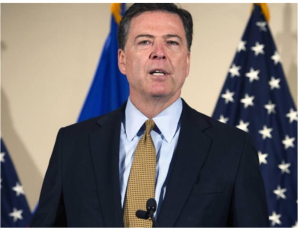
This morning we heard FBI Director James Comey announce that the bureau’s exhaustive investigation found no reason to bring criminal charges against Hillary Clinton regarding the goings on with her private email servers when she was Secretary of State.
His conclusion was based on two factors –
- Lack of intent to harm the country. “Although we did not find clear evidence that Secretary Clinton or her colleagues intended to violate laws governing the handling of classified information, there is evidence that they were extremely careless in their handling of very sensitive, highly classified information,”
- Assessing the success of a subsequent prosecution were she indicted; to wit, “no reasonable prosecutor would bring such a case.”
 Anyone who has ever held high security clearances with the responsibility to safeguard classified materials, and also the responsibility to classify previously unclassified materials knows that intent to violate the laws governing such handlings makes no exception for the perpetrator’s intentions. (cf Federal Penal Code, Title 18, Sec 794(f)(g) ) It is the existential behaviors and their portent for harm that determine guilt or innocence. Without doubt Hillary’s position as SecState assigned her those responsibilities, apparently without having to be accountable for failing to carry them out. When I was in government service, holding such high clearances in and out of the military, any careless, let alone “extremely careless”, handling of classified materials would have instantly resulted in the loss of my clearances and a criminal indictment. Were this to have happened while I was on active duty, I would have spent my life in Leavenworth no matter what my intentions had been.
And when did it become a material factor for a criminal investigative agency to base its findings on its own apprehension of what every one of the population of the country’s “reasonable prosecutors” would do were the conclusion to recommend indictment? In this case that decision is specifically reserved for the DoJ of which AG Lynch in her recent half-hearted retreat still retained her right to make the final decision to indict or not. Comey’s precipitous conclusion and rationale relieved Team Obama of having to bear the corruption-laden political brunt of exonerating Hillary. Comey conveniently chose to fall on that sword himself.
According to my lights it is beyond ludicrous to conclude that “no reasonable prosecutor” could be found to prosecute Hillary based just on the evidence that has been released to, and surreptitiously withheld from, the public. The most likely case is that there would be tens of reasonable prosecutors across the country who would step up to make the case that Hillary is guilty of a long list of serious infractions that include impeding the investigation.
Finally, we are being asked to believe that the sequence of recent events had no impact on the investigation’s outcome and its timely announcement this morning. We are asked to believe that all parties and departments for the first time in federal government history behaved with solid insularity between jurisdictions, with hundreds of agents, bureaucrats, and officials remaining mum about their individual goings on.
Exit questions: How would Hillary’s announced trip with President Obama on Air Force One to campaign in North Carolina have had to be handled if Comey had recommended indictment? Without certain knowledge of Comey’s compliance as a team player, who would have had the meetings, scheduled the events, and made the public statements we have witnessed in the last week? Is it really over?


 rebanesruminations.com
Leave a comment