

George Rebane
We in the IT development industry became aware over thirty years ago that the coming technology revolution would destroy more human jobs than create new ones. Things would be different, very different. No one believed us, least of all government types and those in the social sciences. They all had their eyes in the rear view mirror.
That awareness became a reality in the late 1980s when when research made large gains in machine intelligence – Bayes nets, neural nets, robotics, fuzzy logic, causality, … – that quickly began to be integrated into various industries ranging from defense, through manufacturing and services, to medicine and finance. While all this was happening our central planners were still firmly focused looking backward in their attempts to look ahead; no one in the public policy arena was looking through the windshield.
The early harbinger of the yet to come was and still is systemic unemployment – workforce age people in and out of the job market unwilling and/or unable to economically sustain themselves. What to do about it eludes our governing elites to this day – half of them don’t recognize the problem, the other half would rather not talk about it. Ten years ago I ran some numbers and predicted that by 2020 the US would harbor around 70M systemically unemployed – even though no one believed me, I was wrong. Technology accelerated at rates that even amazed me; five years ago I upped my prediction to 90M as reflected in these pages. I was wrong again because today we have already reached that 90M figure, and now people (excluding locals and liberals) are beginning to take notice.
The fraction of people required to create any given amount of wealth in America is shrinking along with the numbers who are able to do so. The fraction that is permanently out of the free labor markets is growing by leaps and bounds as workers’ skills become ‘redundant’ and hordes of the under-educated leave our schools every year.
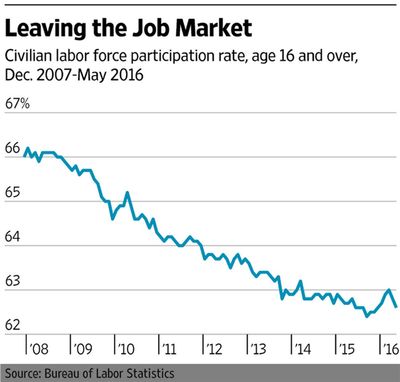
In recent years the greater impediment to an economy that can still create jobs has been our federal government operated by a dismally ignorant and hubristic administration, one that history will judge harshly given that our government will not proscribe such historians as today it displays every intention of doing. Despite desperate paeans of propaganda that cover the countryside, our economy’s so-called “expansion” has been mismanaged to an extent unexperienced that, according to government statistics, has left today’s diminished aggregate workforce with incomes lower than at the 2009 depth of the ‘Great Recession’. In the meanwhile our Potemkin economy is heralded daily by progressives citing the faux unemployment figures made possible only by huge numbers of Americans leaving the workforce (see nearby plot). Going hand-in-hand are equally misleading job creation numbers presented to hold up their end of this great National Lie – e.g. created jobs are mostly part-time requiring low skills, with manufacturing and even the number of IT jobs contracting. More here and here.
So what to do? The only solution, discussed here for years, is the redistribution of wealth from those who can to those who can’t or won’t. In recent years a new approach to this notion has gotten a lot of traction among conservatives, libertarians, and capitalists in general. (Only the collectivists keep beating their long dead horse solution that calls for just taxing the bejeezus out of ‘the wealthy’.)
In our again prescient discussion of this issue, I was surprised this morning to see a major essay addressing guaranteed national income (GNI) in the 4jun16 WSJ. The piece by celebrated socio-economist and political scientist Dr Charles Murray (much covered in RR) presents yet the latest detailed argument to replace the current desultory and destructive welfare system with what Murray labels universal basic income (UBI). As reported here and elsewhere, the Swiss and Finns are seriously considering various forms of GNI, but without necessarily doing away with their other extensive social safety nets. Murray argues that his UBI would work only if it replaces the entire gamut of government transfer programs, and it would fail miserably if it became yet another add-on bureaucracy to redistribute the country’s wealth (more here).
In his essay, Murray covers a bit of the history of America’s private institutions ministering to the poor and destitute, institutions that were crowded out by the federal government beginning during the Great Depression. This has not provided the uniform benefit to the nation’s impoverished for all the reasons long debated, and summarized by Murray’s own conclusion that “government agencies are the worst of all mechanisms for dealing with human needs. They are necessarily bound by rules applied uniformly to people who have the same problems on paper but who will respond differently to different forms of help.” He then makes the point that “whether religious or secular, nongovernmental organizations are inherently better able to tailor their services to local conditions and individual cases.”
A year ago Cato launched a serious national discussion of GNI in its May 2015 ‘The Pros and Cons of a Guaranteed National Income’ (Policy Analysis #773) by senior fellow Michael Tanner. In this extensive analysis Tanner concludes with a cautionary note advising us to proceed with a crawl/walk/run approach –
As strong as the argument in favor of a guaranteed income may be, there are simply too many unanswered questions to rush forward with any such plan. Opponents of the welfare state have long criticized its supporters for believing that even good intentions justified failed programs. In considering some form of a universal basic income, we should avoid falling into the same trap.Instead we should pursue incremental steps: consolidate existing welfare programs, move from in-kind to cash benefits, increase transparency, and gather additional data. This would allow us to reap some of the gains from a universal income without the costs or risks.
The bottom line here is that our current economic order is going to end through a combination of existential forces – political, globalization, and technical. In the political arena there is the ever-present surge of populist socialism to implement ‘from those according to their ability, to those according to their need’. Globalization is not going away, no matter the campaign frothings of Sanders and Trump – ‘if trade does not cross borders, armies will’. And all the while accelerating technology is relentlessly delivering on its promise to bit by piece replace man in the affairs of Man during these pre-Singularity years, until that time when Man will hopefully be presented with the choice to ‘climb aboard’ or face extinction.
[update] When it rains it pours. My 4jun16 issue of The Economist arrived in the mail today, and you guessed it – two major pieces on GNI that are worth your time. For those not familiar with ‘the world’s oldest newspaper’, The Economist is a globally respected publication that considers all aspects of human affairs. It is famous for editorializing in all of its articles, and its political leaning appears a bit left of center which many in Great Britain consider rightwing. Here and here are the links.


 rebanesruminations.com
Leave a comment