

George Rebane
The importance of every social issue derives only from the numbers which underpin it. Without understanding the numbers, our response is limited to unfounded and misplaced emotions.
A major RR tenet has been the importance of numbers in the discussion/development of public policy, and the need for a numerate population to maintain our republic. I’ve posted versions of the above tagline many times in these pages. Now it seems that our local newspaper has given a nod to numbers when discussing the county’s new efforts to update its MJ ordinance.
As all local RR readers know, we will be asked to vote on Measure W in June (full text here). W essentially limits the growing of MJ for only medicinal purposes and in qualifying indoor grows – no outdoor grows are permitted in the county.
In the 1apr16 Union our Sheriff Keith Royal writes an Other Voices column (here) explaining the county’s rationale for advocating a YES vote on W. On the front page the newspaper also features a major report on MJ that contains some relevant numbers (here). The reasons for opposing MJ grows and consumption categorize as follows – public nuisance, crime, environmental degradation, health & safety, habituation (gateway drug), and no clear financial benefit to permitting jurisdictions.
My own position on MJ, both MMJ and RMJ, is a matter of record on these pages. Given our country’s disastrous history combatting drug use as a criminal act, I favor controlled legalization of drugs using the template of alcohol and tobacco regulations and laws as starting points. I am sure that the final form of such drug use laws and regulations will differ from such starting points, but we have to start somewhere so that we may gain experience in order to enact reasonable and effective modifications. The process will probably be longer than shorter, but according to my lights this beats continuing the decades long and tragic game of cops and robbers.
The key is to make illegal drug trafficking an unprofitable business as quickly as possible, and to install a flexible jurisprudence in which various approaches to legalization and controlled use can be tried and tested. My understanding of the voter initiative process under which Measure W falls is summarized by ‘whatever the public votes in, the public must again vote to modify or abolish’. In short, regulating through the initiative process is an expensive and cumbersome enterprise. The natural alternative is to effect the same controls through county ordinances enacted by the Board of Supervisors, ordinances that can be subsequently modified with much less cost and delay.
I share Sheriff Royal’s outlined concerns and have no reason to reject his arguments or the Union’s report of the numbers involved. Although the pro-MMJ argument is yet to be addressed to my satisfaction because there is no reasonable explanation given as to how the complex medicinal products can be produced in quantity and quality to satisfy the county’s presumed very large MMJ demand. The numbers are not available.
Also, the ‘leakage’ from purported MMJ grows to satisfy RMJ demand remains a mystery. Such leakage does occur now and will go on as long as large local outdoor grows continue production. The proponents of this status quo argue that there is a very large (cash) component of the county’s economy tied to the local illegal RMJ industry, and that curtailing it will be disastrous to local merchants. Again, no numbers.
All such shortcomings in the current MJ situation should be addressed through BoS ordinances instead of on stone tablets from the mountain that Measure W will create. Other than the current BoS wishing to tie the hands of future supervisors, I see no reason why the language of W cannot simply be made into the new MMJ ordinance by the present Board. Maybe that should be the question clarified before the 7 June election.
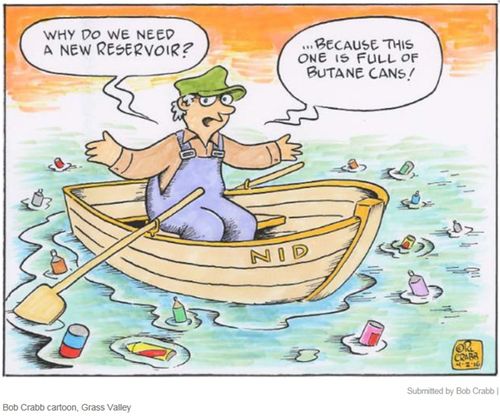
[update] When I saw Bob Crabb’s cartoon in this morning’s (2apr16) Union, I knew I had to filch it and include it with this post. Thanks Bob for another outstanding contribution to Nevada County thinkers.
[5apr16 update] Re PaulE's 949pm & BradC's 729am below – Excellent comments/questions by Messrs Emery and Croul. I’ll take a stab at responding within the context of developed Rebane Doctrine and with the objective of coherently, if not also reasonably, expanding it. I hope that readers will view my thoughts with their usual critical eye, and that they will contribute their own corrections and/or variations.
PaulE’s constitutional question. The ‘business of government’ has expanded considerably in the last two centuries beyond that contemplated by the Founders. Prodded by corporatists and progressives, it now enters and manages commerce and our private lives to an ever greater extent. Today more than half the country (IMHO, the ignorant half) demands an even larger and more intrusive (or ‘involved’) government. The bottom line here is that the cats are already out of the bag, and now we argue with each other as to which ones we need to chase and reincarcerate. The constitutionality question underlying any issue, whether about MJ, EPA, trades licensing, central banking, …, can only be discussed with people who admit this state of affairs. I presume Messrs Emery and Croul are among those.
The short answer from a strict constructionist or ‘originalist’ perspective is that our government has no business telling people what they can grow as long as it does not directly impact the QoL of their neighbors. And yes, this itself raises many questions – what’s ‘directly impact’? Is it something that is obvious to a 5-year-old, or so nuanced that only discerning minds can sort it out. In the latter case the buoyant criterion for intervention becomes ‘He who pays the Piper calls the tune.’ And if we ask government to ‘play the tune’, then we seldom get to call the tune that we must inevitably fund. Corrupt politicians paid off by special interests intervene.
The only approach to a solution is to minimize the role/size of government, and again appeal to a more common and cohesive culture to police our mutual behaviors through common values, language, customs, and traditions into which we inculcate our young. The alternatives are states like the USSR, Yugoslavia, China, … where the liberally applied government gun makes people hew to an ideologically-defined, state-imposed ‘culture’ no matter how ersatz it is to any of its multi-cultural population. The harbingers of this solution applied are more than ample in America.
So no, the Founders’ government has no business telling us what to grow, but the Founders’ society also expected things to sort out locally among people with common beliefs and values. Today we are beyond the tipping point. And specifically where I want government to intervene is alien to you, and vice versa. Looking for consistency in this hodge-podge is a fool’s errand and our lawyers’ paradise.
BradC’s point, “I do not see why Nevada County farmers/growers should not be allowed to grow more than their "fair share" of MMJ (or RMJ once legal) if there is a demand for it outside the area.” For the record, I have not advocated any limits to the county’s MJ grows that are compatible with eliminating the nuisance and environmental concerns. I continue to believe that as soon as RMJ consumption and production is legalized in CA, we will find ways to control and tax it so that people will have all they want of it at a price that also keeps Leviathan happy.
But to do that, according to my lights, will require much more efficient ways of growing and distributing the weed. This is where I see ‘big tobacco’ (for lack of a better term) moving in and efficiently growing multiple crops annually in large indoor green/warehouses, located also in Nevada County. The quality product issuing from such CA enterprises will drive the private large outdoor grows out of business for a number of practical and regulatory reasons. Even the mom and pops with their backyard and garage operations would be hard pressed to satisfy their cravings more cheaply. But I’m sure that some small time operators will remain, especially if Leviathan gets too greedy on the taxes. Bottom line is that there is so much that we still don’t know about widespread legal use of MJ in society, especially in our society. But taking the wraps off slowly and staying flexible will let us put MJ on the shelf along with tobacco and alcohol as another ‘legal sin’ that is conditionally accepted by Americans.


Leave a Reply