
Rebane's Ruminations
January 2016
S M T W T F S
 12
3456789
10111213141516
17181920212223
24252627282930
31  

ARCHIVES


OUR LINKS


YubaNet
White House Blog
Watts Up With That?
The Union
Sierra Thread
RL “Bob” Crabb
Barry Pruett Blog

George Rebane

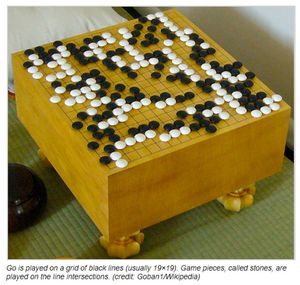
GoA couple of days ago Google’s parent Alphabet (actually its DeepMind division) announced that their AlphaGo deep-learned software system has mastered the ancient Chinese board game Go.  This is a very big deal during these pre-Singularity years and marks a milestone toward intellectual peerage with humans.  AlphaGo is not just a souped-up version of Deep Blue that defeated chess champion Kasparov.

The number of possible moves in Go is trans-astronomically bigger than those in chess for which the next good move can be discovered by generating an expanding search tree of possible future move sequences.  In Go such search trees are literally not possible to either construct or ‘grow’ in any useful manner.  The alternative approach is to mimic the human brain in its ability to assess the current situation through abstracting board patterns, and then derive the best move by evolving more possible future patterns from alternate courses of action.  That in essence is what we do when we play Go, and more importantly, attack myriads of other problems in our daily round.  (more here and here)

Alphabet intends to productize and promote various versions of AlphaGo into a number of markets which require high levels of performance within large data and complex image environments.  For example, most experts foresee that skilled and experienced physicians and medical practitioners who interpret diagnostic imagery (MRI, CAT, X-ray, sonograms, …) will quickly be surpassed by the new machines.  Similar results are expected in fields such as finance, genomics, athletics, complex design, decision making and planning, and so on.  The portents here are that large cadres of very highly educated and experienced workers will become increasingly redundant as customers demand state-of-art performance at lowest cost, and companies compete to satisfy such demands.

Given the recent turn of our socio-political expectations, it will not be long until some politicians will argue that it is a human right for everyone to obtain such ‘best practices’ goods and services.  But before we go sailing off into that future fraught with unknowns, there are other voices rising to be heard.  The 28jan16 WSJ reports that an emerging cadre of ‘experts’ is now considering how to put the brakes on AI developments.

The advance, published in the journal Nature, impressed artificial-intelligence experts and revived a debate about whether limits should be placed on computer programs that gain humanlike abilities to learn by themselves.

In any event,  DeepMind CEO Demis Hannabis is “thinking very carefully about how to ethically use and responsibly deploy” the technology. When DeepMind was acquired in 2014, its founders required Google to agree not to use the technology for military purposes. Google has created an ethics committee to ensure such benefits “accrue to the many, not the few,” he added.

I urge you to evaluate these sentiments in light of the countless enterprises worldwide which are developing, advancing, and racing to market the latest concepts in AI.  Putting on the brakes?! – talk about pissing into the wind.

[30jan16 update] Robots will devastate third world jobs; robots will replace most white collar jobs; robots will do all future manufacturing; robotic vehicles will replace all transport jobs; … .  The Financial Times reports that “The Rise of the Robots Threatens the Poor”; and studies from prestigious universities are now coming in telling us that the robotic “revolution could leave up to 35% of all workers in the UK, and 47% of those in the US, at risk of being displaced by technology over the next 20 years, according to Oxford University research”.  (also google ‘robots, job loss’)

RR has been a little alarm bell for the last decade relating news and prognostications in these pre-Singularity years about the growth of systemic unemployment due to accelerating technology. Now finally there emerge some louder voices repeating this message, but still not getting it quite right.  Meanwhile, the socialists among us are proposing policies which will guarantee a future world of tyranny much as foreseen by Orwell in the 1940s – recall that tyranny is the most stable form of governance against which ‘democracy by the dumb’ doesn’t stand a chance.  And technology-augmented tyranny is a rock stable slam dunk.

I believe the probability is close to one (certainty) that today we are irredeemably beyond the tipping point. There remain few approaches – e.g. the Non-Profit Service Corporation schema – to implement the required redistribution of wealth which may preserve the Bastiat Triangle of Rights.  However, all of them require an overwhelmingly educated and enlightened citizenry to pull off.  Instead, we are overrun with collectivists and central planners whose interests lie in fomenting class warfare between various manufactured cohorts of ignorant yet compliant voters with scant intellectual assets to figure out where they are being led.  (Today we remain in a government induced Depression2 with a hokey unemployment numbers and GDP growth rates last seen during Depression1.  See also PriceWaterhouse study on millennials.)

A delayed advent of Singularity that could give rise to a transhuman world is looking less like the saving grace that it once did.


Posted in , , , ,

11 responses to “AI masters Go – time to apply brakes? (updated 30jan16)”

  1. Russ Steele Avatar
    Russ Steele

    I am currently reading The Future of the Professions: How Technology Will Transform the Work of Human Experts by Richard Susskind and Daniel Susskind
    According an Amazon Summary:
    This book predicts the decline of todays professions and describes the people and systems that will replace them. In an Internet society, according to Richard Susskind and Daniel Susskind, we will neither need nor want doctors, teachers, accountants, architects, the clergy, consultants, lawyers, and many others, to work as they did in the 20th century. The Future of the Professions explains how increasingly capable systems – from telepresence to artificial intelligence – will bring fundamental change in the way that the practical expertise of specialists is made available in society. The authors challenge the grand bargain – the arrangement that grants various monopolies to todays professionals. They argue that our current professions are antiquated, opaque and no longer affordable, and that the expertise of the best is enjoyed only by a few. In their place, they propose six new models for producing and distributing expertise in society. The book raises important practical and moral questions. In an era when machines can out-perform human beings at most tasks, what are the prospects for employment, who should own and control online expertise, and what tasks should be reserved exclusively for people? Based on the authors in-depth research of more than ten professions, and illustrated by numerous examples from each, this is the first book to assess and question the relevance of the professions in the 21st century.
    After reading The Future of Professions, it is clear who might be trying to slow down the development of AI, the professions that will soon be replaced by lower cost more effective AI driven services.

    Like

  2. Russ Steele Avatar
    Russ Steele

    Brookings is a left leaning organization, some say progressive, and It has taken a look at the robots and jobs issue with some suggested solutions. A left-leaning point of view which I hope will promote some discussion of this issue.
    Brookings Center for Technology Innovations: What happens if robots take the jobs? The impact of emerging technologies on employment and public policy. By Darrell M. West
    West proposes striking economic changes in order to restructure how our society delivers on the social contract, such as:
    • Separating the dispersion of health care, disability, and pension benefits outside of employment, offering workers with limited skills social benefits on a universal basis.
    • Mandating a basic income guarantee for a reasonable standard of living to combat persistent unemployment or underemployment posed by the automation economy.
    • Revamping the Earned Income Tax Credit (EITC) to allow the benefit to support households in the grips of high unemployment.
    • Providing activity accounts for lifetime learning and job retraining to motivate the workforce to keep pace with innovation.
    • Offering incentives for volunteerism—beneficial for many people who in the future may not be able to provide for their families through regular employment but may still wish enrich their communities.
    • Encouraging corporate profit sharing to spread the benefits of improved productivity to the broader workforce.
    • Reforming the education curriculum to reflect the high premium STEM skills will offer employees in the future.
    • Expanding arts and culture for leisure time, ensuring that reduction in work will not eliminate chances for cultural pursuits.
    “There needs to be ways for people to live fulfilling lives even if society needs relatively few workers,” West writes. Taking steps now in anticipation of the exciting new future that awaits will help people adapt to new economic realities. [My emphasis]
    The full paper can be downloaded here:
    http://www.brookings.edu/research/papers/2015/10/26-robots-emerging-technologies-public-policy-west
    As you can see, this is not just a left or right issue, it is a technology driven issues that will impact both sides of the political spectrum. It would be wise if both sides were to work on a mutually acceptable solution. As George pointed out, we are passed the technology tipping point, and it is time for public policy to catch up and address the jobs issue.
    What are readers views on the Brookings proposed solutions?

    Like

  3. Scott Obermuller Avatar

    from Russ at 1:21 – “It would be wise if both sides were to work on a mutually acceptable solution.”
    That is a correct statement, but when was the last time that happened?
    For my entire life, this country has gone steadily to the left. Every single ‘solution’ to all sorts of social and political problems have involved less personal freedom and more governmental control. There isn’t going to be any sort of compromise beyond the speed at which we sink the ship.
    I’m used to it and have adopted an attitude of understanding that it is the normal drift of human nature that most all citizens want to be rid of the burdens associated with freedom and liberty.
    And there seems to be a plentiful supply of little Caesars to lead the rest around by fiat and edict.
    Also – “There needs to be ways for people to live fulfilling lives even if society needs relatively few workers,” West writes.
    I sense a new ‘human right’ for the politicians to brew up.
    Good luck engineering that one.
    This is the great part of being raised to be responsible for myself and wanting to be around others of the same ilk. I have a fulfilling life what ever the circumstances or employment choices are because I am not turning my life over to the govt to provide me with anything beyond my enumerated rights as spelled out in the Constitution. Those that expect the govt to provide them with a ‘fulfilling life’ will be sorely disappointed. Ask the babushkas sweeping the streets in Moscow about their ‘fulfilling lives’.
    Robotic machines do not ‘take’ jobs from anyone.
    Humans tend to get increasingly expensive with all of their new rights and privileges at the same time that AI and technology combine to provide a higher quality of service at a decreasing cost. It is simply a matter of operating a service or manufacturing process in the most efficient manner.
    This does give rise to the conundrum of making it easier to manufacture goods for fewer people that need or can afford those same goods. Simplistically, we can ask: Who needs a car to drive to work if there is no work?
    As to those light thinkers that believe the govt can provide the solution – ha! When has the govt ever provided a solution to such an issue? This will just be another opportunity for leviathan to flex its muscles and increase its reach into our lives.
    Count on it.

    Like

  4. Russ Steele Avatar

    Scott @ 09:40 am
    A thoughtful reply. Job killing AI is going to take more forms than manufacturing. All professions that rely on specialized knowledge will be challenged as AI driven devices provide more accurate and less costly information, advice and guidance. The Internet provides a plethora of information, the proposition is that AI will validate this information and turn it into advice and trustworthy guidance. This is what we expect from today’s professionals. Professionals that are now being challenged by the AI computational machine with competition accelerating as capability grows and public acceptance increases. This acceptance will most likely take place on generational boundaries.

    Like

  5. jon smith Avatar
    jon smith

    AI is not something that is going to be black one day and suddenly white the next. We have been incrementally edging into the world of AI over the past half decade or so. Genome sequencing is now done with a logical interface that is not human dependent. The best answers are “guessed” (heuristics) and pursued or discarded by the whim of computers. Facial recognition, speech prediction, Siri, and intelligent agents are certainly not examples of true AI but we have adapted to them very, very quickly. The step into AI will be the simple logical progression of current technology and most non techies will never know the difference. Yes jobs will be lost, but others will be gained. Ten years ago I had to hire humans to translate foreign correspondence into English. Today anyone with a laptop can communicate in hundreds of languages. The distopia of humans not having to work and to enjoy limitless free time due to to machines has been around since Henry Ford. Humans are historically pretty good at figuring out to create more work for themselves. I am not afraid.

    Like

  6. Scott Obermuller Avatar

    “This acceptance will most likely take place on generational boundaries.”
    Yup – kids who grow up immersed in a rapidly changing tech environment have no knowledge of anything else and the younger the person is – the more likely they will adapt to the newer ways of doing business.
    It’s going to be interesting to see how all of this plays out.
    How will the different countries and societies react to a future in which there are massive percentages of citizens who won’t have or care to cultivate a means of gainful employment?

    Like

  7. Bonnie McGuire Avatar

    We used to mill lumber for almost anything made from wood on our portable sawmill. We learned many things from our clients. For instance, valuable nutmeg tree used to make”Go” game boards. It’s a popular Chinese Chess game of tactics you might enjoy knowing more about since some think it might work as a dehumanizing global strategy….
    http://en.wikipedia.org/wiki/Go_(board_game)

    Like

  8. George Rebane Avatar

    re JonS – Is this another piece of evidence why progressive policies are so destructive to the economy and workers – they just don’t believe all the data coming in on systemic unemployment and national dumbth. They, as always, are stuck in yesterday – today is like Henry Ford’s day – demonstrating the cynicism of their self-adorned label as being ‘progressive’.

    Like

  9. jon smith Avatar
    jon smith

    The unemployed masses of today are not unemployed because of technology and the internet. They are largely unemployed because they make just about as much staying home eating burritos and collecting welfare than if they spent 40 hours/week gainfully employed. There is no longer any stigma to being on the dole, and fact, if you are dumb enough to flip burgers, your unemployed friend will let you know how dumb you are. You will get ZERO argument out of me that this is the root cause and rampant socialism is to blame. I don’t blame Siri for today’s unemployment or general unintelligence quotient (UQ), and in 5 years I’m not going to blame AI.

    Like

  10. George Rebane Avatar

    BonnieM 138pm – You may have missed it, but this post is about the milestone of AI mastering the game of Go (see photo) 😉

    Like

Leave a comment