

George Rebane
[Brian Hamilton, editor of The Union, emailed me that this piece was bit too long for their Other Voices columns, and invited me to shorten it. I felt that a better alternative to abbreviation was to write them a letter-to-editor that cited Mr Paul Berger’s dismissal of my previous OV column, and which also pointed to this post – look for it in The Union. Thanks for your interest.]
The Preventable Global Warming (PGW) season is here again with another spate of conferences, new laws and regulations, media events, and VIP visits, all happening in short order to reignite public apprehension that man’s neglect will soon cause a worldwide catastrophe. To prevent the calamity, timely intervention in human activities on a massive scale is now required. However, some considerable number of people remains skeptical of the PGW arguments and its prescribed remedies. The public debate about PGW today reaches from the highest levels of government down the lowest grassroots as witnessed here in our little community.
PGW is an extremely complex issue both in the technical and political sense, and made more so by the several confusing interchangeable names we use and don’t differentiate – climate change, global warming, anthropogenic global warming (AGW), … . In this limited space I’ll try to shine a little light on some of the particulars. First, every reputable skeptic acknowledges that climate change is always going on, and during the last couple of centuries the earth has again warmed. Over longer timespans the earth has been much warmer (think Greenland) and much colder.
The current warming trend that appears to have halted coincides with human CO2-producing activities, and the most recent measurable increase in the atmosphere’s CO2 level. However now there is also disturbing evidence that global warming will turn into global cooling. But here I want to review the components necessary to understand what earth’s climate was, and what is used to predict its future. The top line is that this enterprise requires skill sets that reach far beyond what the layman thinks belong to a ‘climatologist’.
First, there is no such thing as ‘earth’s temperature’ (ET), there is no place we can stick a thermometer to get a reading. ET is a number calculated from a formula with many parts and many inputs. Moreover, there are many ET formulas using different inputs and published by different agencies. And historical ETs are even more complex since they require proxy observations like tree rings and ice cores which are then algorithmically combined to produce a temperature for the planet. Almost all of these are generated by specialists who are definitely not climatologists.
All of these formulas, algorithms, and proxy datasets are combined by estimation theorists to produce probability distributions from which publishable numbers are distilled. And you can be sure that many different ET histories have and continue to be computed. There is so much more here, but we must continue. The layman is just presented with one wiggly line and told that is THE unquestionable record of ETs. For a scientist who knows what data records had to be computed and cobbled together to get such a wiggly line, this is beyond funny.
And then we come to the general circulation computer models (GCMs) used to predict ETs a century from now. These are enormous software programs with many parts that require contributions from many different kinds of scientists and engineers, each submitting their own sets of equations that must be assembled into a computable architecture and programmed. This again requires people with diverse skill sets – e.g. finite element modeling from materials science – that go far beyond what is taught in climatology, let alone what a climatologist is able to practice during his career. The construction, exercise, testing, and validation of a GCM is really an exercise in the systems sciences and software engineering. Again, all this is unknown to the lay public that believes it’s only the work of ‘climate scientists’.
Returning to the public debate, we must then consider arcane matters such as how much do CO2 and other greenhouse gases affect the transmission of heat through the atmosphere, and how much of that is contributed by man. But finally, we have to come to grips with the whole preventable part of PGW because that’s where politics, economics, national sovereignty, human rights, etc collide.
The sticky part here is that in its make-up our universe doesn’t support long term predictions, especially of how chaotic systems like earth’s climate will perform over future decades. This we learn, not from climatologists, but physicists and systems scientists. You can’t simply crank those GCM equations into future epochs and expect to get reliable results. But if your use for PGW is to promote a political agenda, then reliability takes a back seat to accommodating results made simple to understand and marketable to voters who are overwhelmingly innumerate and innocent of any of the pieces that make the case for PGW.
To the ignorant multitudes the politicians and their true believer acolytes sell PGW through ‘consensus science’, possibly the weakest and historically the most unreasonable basis for scientific truth. And when material evidence is presented to counter PGW, the first response from the technologically naive acolytes is to dismiss such messages, especially if they are delivered by scientists and engineers having resumes unanointed with ‘climate’.
The part that eludes these defenders of the faith is that in science and engineering ALL the building blocks of a system or theory must work correctly to make the whole work. It is like a chain, one weak link sinks the whole thing. Therefore, any of the many non-consensus specialists worldwide, like those of us who understand what the GCM is and must do, and how their specialty parts must perform to contribute to the whole, any one of these is a credible referee to condemn the entire enterprise by pointing out how their link will not serve its intended purpose.
The real burden of the true believer is that he must be certain that EVERY part of the PGW theory has been correctly formulated, integrated and works as intended. No UN ‘consensus scientist’ has claimed to have done that, nor is even capable of such feat. More importantly, many of the contributing IPCC specialists have registered serious caveats about how their contributions have been used to predict the far future as the GCMs’ simulated ET numbers respond to various public policy prophylactics.
The greater problem for the lay true believers, like the worthies who write in these pages, is that they don’t have the education, training, experience, or know-how to even correctly assess, let alone denigrate, the qualifications of those who critique the questionable underpinnings of what today is sold to us as Preventable Global Warming.
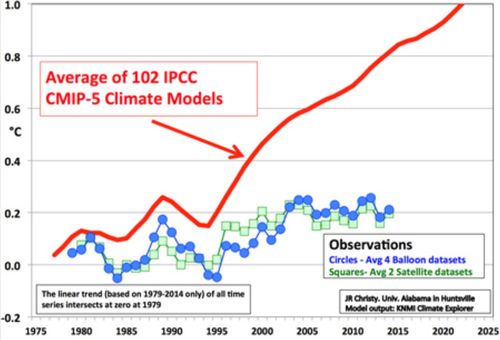
[Addendum] Russ Steele, fellow blogger, RR reader, and colleague in the local PGW society, sent me the following measured vs GCM predicted temperature graphic. It perfectly illustrates the points made in the body of this post. Many thanks.
In the sequel you will find an edited version of my more saltier contribution to the comment stream of ‘The Left’s Climate Scientists on Parade’. The explication goes into some detail about earth’s temperature (ET) about which I have found profound ignorance among the ranks of true believers in PGW. Similar expansions will appear about regressing data and the numerical instability of GCMs which I will illustrate by designing and coding up a ‘toy problem’, a technique often used to study more complex problems. So here’s the edited version of my comment.
For the interested reader. The critical and celebrated parameter in all these global warming discussions is the earth’s temperature (ET). Those who have been following the science know that ET can neither be observed nor measured for the simple reason that it does not exist. ET must computed through an algorithm whose inputs consist of very many numbers reflecting hundreds of individual readings of temperature itself or its tightly correlated proxy (e.g. intensity of IR radiation in a given spectral bandwidth, or certain trace chemicals in ice cores). Each reading is vector quantity or a ‘tuple’ that contains at least the measured temperature/proxy, variance, time, location, and measuring instrument ID.
These measurement vectors are then sanity checked for outliers, perhaps detrended, cleaned up based on local and environmental factors, and have certain ‘data holidays’ in the record filled appropriately. The scrubbed dataset (not to be confused with Hillary’s server) is then input to the ‘master ET algorithm’ which itself had to be correctly initialized with a number of (subjectively) settable parameters before it can crunch the input dataset and spit out the ET and its variance for what in estimation theory is called the ‘validity instant’ which becomes the time tag connected to the estimated ET value. Choosing the validity instant is also a matter of (subjective) judgment for it may exist anywhere within the time window of the dataset, or even outside the time window. These computed ETs are then assembled into the wiggly lines such as those used to compose the average (red) line in the above figure.
So if you’ve followed me so far, consider now that there are several competing ET algorithms today in use by various academic and governmental agencies here and abroad. Some have more prominence than others, which is usually determined by external political factors. In any event, what the layman has been taught to accept as a simple no-nonsense measurable like the temperature on his porch thermometer is anything but that. Taking the earth’s temperature is a very complex task.
And if you think that is complex and difficult, consider the development of historical ET records from all kinds of inputs like fossilized tree rings to isotope densities in ice cores. You should now understand why people continually get into disagreements about what data to use, how should it be scrubbed, what estimation algorithms should be applied and how, and then how are all those ETs going to be compared on an apples-to-apples basis to the ETs developed from current measurements – e.g. from satellites. And from such contentious and often arbitrary exercises we draw solid conclusions about what synoptic/secular (long term) climate changes we will witness over the coming century as we continue to make butt stupid, draconian, and totally ineffective public policies. Oy geweh!
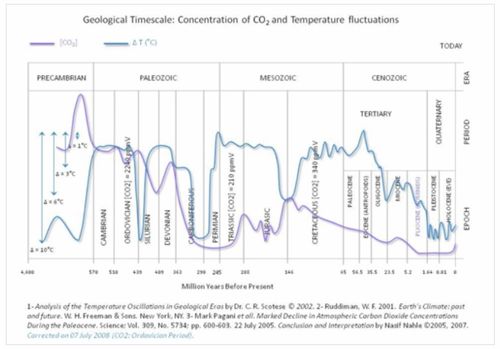
[19sep15 update] Below is another edition of a telling graphic that compares ET with atmospheric CO2 concentration. These comparative illustrations of data have been studiously ignored by the PGW promoters because it strongly counters all of their AGW arguments with which they preamble their PGW nostrums for an Agenda21 world. H/T to Russ Steele for including the link to the source of the figure in one of his comments below.
[23sep15 update] Today our Union hastily published an Other Voices column – ‘Columnist peddles discredited fossil fuel industry propaganda’ – by no less than the world’s most celebrated and denigrated meteorologist Michael Mann, the father of the famous global warming ‘Hockey Stick’ (q.v). Dr Mann took Nevada City’s Norm Sauer (on the Union’s Editorial Board) to task on Sauer’s 22sep15 piece – ‘If you control carbon, you control life’ – for citing the findings that “Mann skewed computer codes and used improper data.”
The arguments regarding preventable global warming (PGW) from True Believers and Skeptics continue in the same vein. Each discredits the other on their alleged sponsorships – pro-PGW sponsored by governments promoting Agenda21 goals, and skeptics sponsored by the “fossil fuel industry”. The government sponsorships are easy to prove, the oil company connections are tenuous at best.
What caught my eye was that while Dr Mann did once again cite consensus science as the strong argument supporting PGW, he avoided the dodgiest part of the pro-PGW ‘science’ most impacting public policies, namely the future as prognosticated by the general circulation models based on extremely spotty knowledge about earth’s climate dynamics and the poor record that GCMs have demonstrated in predicting earth’s temperature (ET). Nor did Dr Mann address the ‘Datagate’ scandal that surrounds the interpretation of longer term ET calculations like the one plotted above.
Readers may also find it interesting to track the progress of suit and counter-suit between Michael Mann and well-known PGW skeptic and conservative commentator Mark Steyn.


Leave a Reply