

Goerge Rebane
[This is the addended transcript of my regular KVMR commentary broadcast on 19 August 2015.]
US History is again being revised in our high schools. The new 2014 Advanced Placement US History ‘framework’ is now replacing the old 2010 AP framework, and its adoption will take students one giant step to the Left. Last month at Hillsdale College noted historian Wilfred McClay, now Blankenship Professor in the History of Liberty at the University of Oklahoma, gave a compendious speech on the state of history in America and its readily observed impact on our collective society and thought. The much published historian did not paint a hopeful future for our nation.
McClay states that the new 2014 version of our history “represents a lurch in the direction of more centralized control, as well as an expression of a distinct agenda—an agenda that downplays comprehensive content knowledge in favor of interpretive finesse, and that seeks to deemphasize American citizenship and American world leadership in favor of a more global and transnational perspective. The new framework is organized around such opaque and abstract concepts as “identity,” “peopling,” and “human geography.” It gives only the most cursory attention to traditional subjects, such as the sources, meaning, and development of America’s fundamental political institutions, notably the Constitution, and the narrative accounting of political events, such as elections, wars, and diplomacy.”
In recent decades the recounting of our common narrative has continued to fall into disfavor. History for the people is more than ever in short supply save for journalistic forays into the field like the much heralded and accessible The Greatest Generation by Tom Brokaw. Such volumes on national bestseller lists give evidence that history still does “strike a chord with the public”. But in the aggregate Americans today know very little about the country’s past and what little they do know is a fractured collection of narratives serving to divide rather than to maintain the ‘e pluribus unum’ that was our heritage. Again in McClay’s words.
“Gone are the days when widely shared understandings of the past provided a sense of civilizational unity and forward propulsion. Instead, argues historian Daniel T. Rodgers, we live in a querulous “age of fracture,” in which all narratives are contested, in which the various disciplines no longer take a broad view of the human condition, rarely speak to one another, and have abandoned the search for common ground in favor of focusing on the concerns and perspectives of ever more minute subdisciplines, ever smaller groups, ever more finely tuned and exclusive categories of experience. This is not just a feature of academic life, but seems to be an emerging feature of American life more broadly. The broad and embracing commonalities of old are no more, undermined and fragmented into a thousand subcultural pieces.”
So look around you. Today we do live in a brittle society comprised of many loosened pieces gathered haphazardly into two distinct and distant piles in which everyone seeks to highlight their differences with very little promise for a path to reunion. We are kept in a tentative peace by local constabularies that continue to lose our trust. And in our schools we are now removing the last vestiges of education that promote America as an independent and sovereign nation-state, substituting instead an ever focusing goal of global citizenship under an overarching global central government of elite technocrats who will determine what will be taken from whom according to their abilities, and given to whom according to their needs.
No matter your politics dear listener, as an informed citizen you can and should read Dr McClay’s entire essay and consider what’s in store for out next generation and how that portends for our republic. It is published in the online and print editions of the Imprimis of Hillsdale College, one of the most widely read publications on American society with almost three million monthly readers. I leave you with an exit question – ‘How widely shared is your own understanding of America’s past, and how comfortable are you with differing versions of that narrative?’
My name is Rebane, and I also expand on this and related themes on Rebane’s Ruminations where the transcript of this commentary is posted with relevant links, and where such issues are debated extensively. However my views are not necessarily shared by KVMR. Thank you for listening.
[Addendum] We can view the past schematically as a temporally sequenced collection of uncountable myriads of events, each one occurring when two or more worldlines (also world lines) cross or touch. The figure below illustrates (figure from ‘Does God Watch Paint Dry?’)
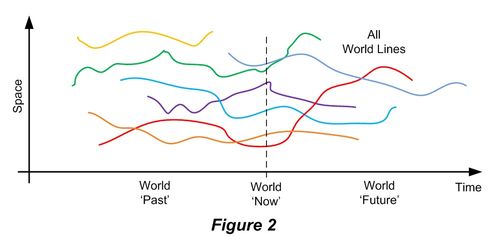
As a bit of background, “in physics, the world line of an object is the path of that object in 4-dimensional spacetime, tracing the history of its location in space at each instant in time.” In the present sense we use worldline to indicate the life paths of sentient creatures, primarily humans.
So the past of the human species is filled with gazillions of events, the overwhelming portion of which are lost in time. But enough of them have been captured and memorialized to present us with literally an unending tapestry that we can unravel and reweave as we will. And more of these events are being discovered daily through purposeful research and just serendipity.
All societies have generated narratives of their previous existence and achievements to give purpose and perspective to their present. In the distant past these narratives arose and were passed on as legends, myths, and ethnic sagas celebrated in poems and songs. In recent centuries such memorializing has become more formal in a field of study we now call history. The advent of history was mediated by the enterprise of chronicling which consisted simply of recording a sequence of events and related facts, and then storing them in some archive to serve as proof of a more or less stable version of the past. The events chronicled derived mostly from battles, deaths and births of important people, and changes in governance like coronations and papal successions.
When people began wanting to use the past to explain the present and predict the future, it quickly became clear that more was needed than just a specific collection of chronicled events. To achieve such aims the selected events needed to be connected within some common or shared basis. And those who could gather such collections of events under an overarching theme were the first propagandists who would later become known as historians, giving rise to collected bodies of work in a field we now call history. But initially it was the job of the propagandists cum chroniclers who were (self)commissioned to fabricate a cohesive narrative relating past events to explain away the present or justify the purpose for planning a particular future (e.g. a war, an expedition, the building of an aqueduct, a fortress, a cathedral).
Eventually the job of the historians was to discover a communicable fabric of causality that supported the achievement of a consistent (over time) objective which in some way gave a valid/just purpose and meaning to a culture, ethnic group, ideology, society, kingdom, empire, alliance, nation-state, …, even unto explaining the inevitable causes of its triumphs and tragedies. But, of course, since many of these entities had contending objectives with each other, the subsequent histories that would serve each adopted a different mantle under which were gathered (sheltered?) disparate sets of past events that could be conveniently cobbled together to create the needed narrative. This gave rise to various and quite different histories, each serving some societal function.
One, or perhaps the main, function of a society’s history is to communicate and continue its place in the world in the minds of its next generation(s). Modern societies do this through their collective educational programs. For millennia people have known that how you bend the twig you grow the tree. And in the 21st century human contentions are no longer limited to nation-states going after the same physical resources, save if that resource is the ideological cast of a human mind ‘properly’ formed.
Today the dimensions of the contending ideologies are along the size and role of the state in organizing human affairs. The specific ideologies more or less polarize themselves between the collectivist and the conservetarian (nee classical liberal and libertarian). Elsewhere in these pages we have devoted considerable real estate (ink?) to the features and foibles of the various ideological hues that paint the interval between the poles, so we will skip that enterprise in this dissertation. But instead we focus on the role of received history in promulgating and advancing societies toward either of these poles.
The main commentary above considered the alteration of US history from a framework that formerly delivered a “patriotic” version of America’s formation and past that was designed to maintain its founding principles and socio-economic norms. Such principles and norms were credited for the uniqueness and success of our form of governance within the community of nations that operate under Westphalian protocols – in short, the causal stream that indeed made America an exceptional nation, a ‘shining city on a hill’. People of the conservetarian ilk know that such supportive historical narratives exist and can be delivered to our youth without being excessively “ethnocentric, triumphalist, or uncritically celebratory”, and presented within a framework that does not cripple their ability to think critically about our past, or any other subject for that matter.
The alternative and characteristically post-national ideology that has taken root in our country comes in many flavors, but shares the common tenets that substitute class for individuality, and see the overarching state as Man’s greatest and most beneficent creation for organizing society. The logical end point for such a state is the rise of a global government that subsumes, and then digests into an undifferentiated amalgam, the current Westphalian community of nations. To do this, the people and especially the young of any nation – here America – must be carefully taught a history that first subtly and then robustly deconstructs the salutary characteristics of their nation, and substitutes a record of its inevitable travails and tragedies that their past and ‘erroneous and now outdated’ social values have visited on its people. A new set of suitable events is then selected and overlaid with a causal fabric that paints the desired consistent and cohesive picture of their collective past, a dreadful past that can only be salved by a new global collectivism. Such is the revised framework of our AP US History as fostered by socialist historians such as Howard Zinn (see in comment stream below).
The conclusion here is that perpetuation of a cohesive society requires a commonly accepted narrative of our past. Such a narrative then serves as the foundation of the larger common ground we establish and maintain to solve the unending train of foreign and domestic problems that confront every society. Without such a supportive common ground a society eventually splinters, with parts of it coagulating around a newly fashioned common narrative that serves a new cohesive progress into a different future. And that is why what we teach as history is extremely important.


 rebanesruminations.com
Leave a comment