

George Rebane
[This is the transcript of my regular KVMR commentary aired on 29 July 2015. Later – a slightly edited version of this piece was published in 7aug15 issue of The Union and on its website here.]
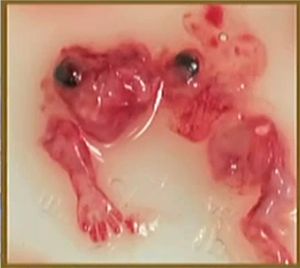
By now we have all seen the videos of Planned Parenthood physicians at lunch enjoyably selling their wares into an apparently lively market of fetal body parts. The casual abandon evident in those conversations was one upped by the most recent release of a video made in a body parts lab where the staff displayed sampled remains of tiny humans ready for shipment (see nearby photo). Whether you’re for or against abortion, the new revelations of these dealings in purposely killed human flesh gives most of us pause, and perhaps asks us to re-examine what kind of industry have we created, and where such obviously callous treatment of human life can take us. First some background.
 According to the Centers for Disease Control and the National Institutes of Health over 860,000 abortions are performed annually in the US. Over 330,000, or almost 40%, of these are performed in Planned Parenthood clinics. Never mind that they claim these abortions make up only 3% of their “services”, because of the way a ‘service’ is defined the real scope of the organization’s abortion factory is hidden from the casual reader. Another way to size the problem is to consider that more than one out of six pregnancies in America terminate in an abortion.
What, you ask, is really being aborted? We can all acknowledge that it is a pre-born human being who at 25 weeks into gestation has more than a 50-50 chance of surviving birth and growing into a normal adult. And by law, such premature infants are guaranteed the care they need to survive. Nevertheless, until 2003 Planned Parenthood and other private abortion clinics regularly performed partial birth abortions in which a viable baby was killed by mangling its brain with scissors or snipping its spinal cord while any part of it remained in the birth canal. Today it is still possible to kill a viable human in the same manner through an intra-uterine procedure – in short, you can circumvent the law by doing the deed before any legally defined components of the child are sticking out. Within these considerations it is up to each of us to define at what point in the gestation cycle, including the baby’s birth, does ‘fetal tissue’ become a human being.
Now we know that fetal tissue has been used beneficially for medical research for some decades, so that is not the issue here. Such tissue can be obtained from miscarriages and emergency abortions that sacrifice the child to save the mother’s life. No one is arguing that the use of tissues obtained from these fetal deaths should not be available for beneficial medical research. What we are considering is at what point in the development of a viable human being is it still legal to put it to death without due process. And what is the impact of that on today’s society, especially on the lives of the poor, and where is making abortion cheap and facile taking us as a society?
Today the careful crunching of babies is legal, and strongly motivated by both the profit motive and an encompassing government that seeks to inject itself into the most intimate parts of our lives. It is easy to see how profit motivates, but understanding government’s involvement requires digging a bit deeper. First, let’s dispense with notions like ‘Black lives matter’ – given the overwhelming murder of blacks by blacks, and that the share of abortions performed on poor black women, we know that black lives matter only in the rare cases when there are non-blacks involved in the death of a post-partum African-American. And in those cases it is obvious that another agenda is being promoted wherein such deaths, no matter their legitimacy, serve a useful purpose.
So where are we going as we demand that government pay for more and more of our daily upkeep? The more it does that, the more government claims a right to make decisions for the common good at the cost of denying the claims of any individual. How long until a subsequently diagnosed three-week old baby is put to death in order to save society the enormous cost of subsidizing its lifelong care, and spare its family the burden of giving such care? So for the common good, does it not serve a more noble purpose for Planned Parenthood to determine where best to crunch such infants so that their short lives can be of greatest benefit to us all?
My name is Rebane, and I also expand on this and related themes on georgerebane.com where the transcript of this commentary is posted with relevant links, and where such issues are debated extensively. However my views are not necessarily shared by KVMR. Thank you for listening.
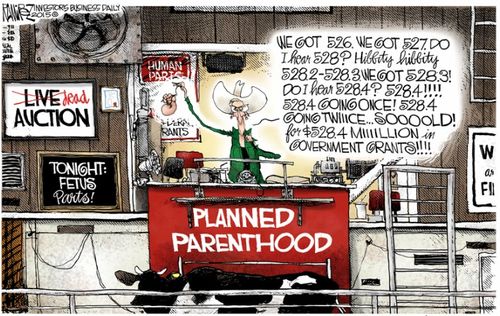
[We close with a H/T to reader for alerting me to Ramirez whose cartoons say so much in so little space.]


Leave a Reply