

George Rebane
‘We know best what’s good for the people.’ – from the Central Planning Bible
Lately several readers have been discussing the whys and wherefores of (economic) externalities. It’s a slippery concept to apply as may be deduced from its definition.
An externality is “a consequence of an economic activity that is experienced by unrelated third parties. An externality can be either positive or negative.” – Investopedia.
If a producer (Agent A1) provides a quantity (Q1) of goods/services to a customer (Agent A2) willing to pay price P1 for them, then we have the costs of production and price driven demand represented by the classical producer-demand curves showing the market realities arrived at by A1 and A2 – that is, Q1 exchanged for $P1. In this situation each agent has satisfied his own utility for money and goods.
Now enters agent A3 who is neither a producer nor consumer, and he determines that there are people out there negatively impacted by such production/consumption transactions. By fiat A3 (usually the government) has the power to assess, attribute, and allocate what it determines is the ‘social cost’ of such unhampered transactions. It attributes such a cost to a given industry (economic activity) and, in its wisdom, allocates a portion MEC (marginal external cost) to A1 – as a tax, tariff, license fee, imposed purchase of, say, carbon credits, etc – that A3 claims is a negative externality. But in reality A1 experiences MEC as an added cost of production to his existing MPC (marginal private cost) of production. This yields a new MSC (marginal social cost) production curve experienced by A1. And the new price point now shifts to P2 at which price A2 is willing to buy only quantity Q2. (See my modified figure below from Environmental Economics.)
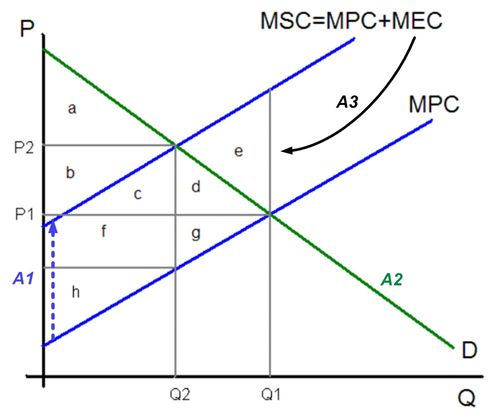
The details of what all the lower case letters mean are very interesting, and the reader is invited to study them (only one page of reading required). But the clear point is that when A3 comes in and imposes some arbitrary MEC on A1, the production cost curve jumps up as indicated (blue dotted arrow) thereby shifting the new market equilibrium point so that A2 buys a lesser quantity Q2 at a higher price P2. A1 now can only sell Q2 < Q1 which means that workers who contribute to his profit (wealth generation) must be reduced. The liberal will argue that ‘well, A1 may have to hire/shift workers to satisfy the new A3 imposed regulations that cost MEC, so perhaps the employment situation is not all that bad.’
But the situation really is bad from a number of perspectives. First and foremost is that A3 enters the picture with the power of the gun, and mandates an arbitrary increase in production costs. Doing so allows A3 to immediately pocket the cash in area b+c+f and take it out of the cost-benefit calculations of A1 and A2. You see, the arbitrariness of A3’s actions are that A3 has his own ‘social utility’ which invariably is something cooked up by bureaucrats who do not understand production, consumption, and the market that joins them – in short, their utility is much different from that of A1 and A2, and throws out the brown number MEC by which both A1 and A2 must now live. No one is allowed to look behind the curtain to see how that brown number was arrived at, it came down from God.
The result is that less of the product (Q2) is made and sold at a higher price (P2) to customers who demonstrated their need and willingness to buy more of it (Q1) at price (P1). So now it is up to the rest of us to determine whether we are getting our money’s worth by buying less for more. The ‘we know best what’s good for you’ central planners will argue from behind their impenetrable bureaucratic fortress that, since we have imposed ‘social justice’ in this market, everyone now benefits. Now just move along.
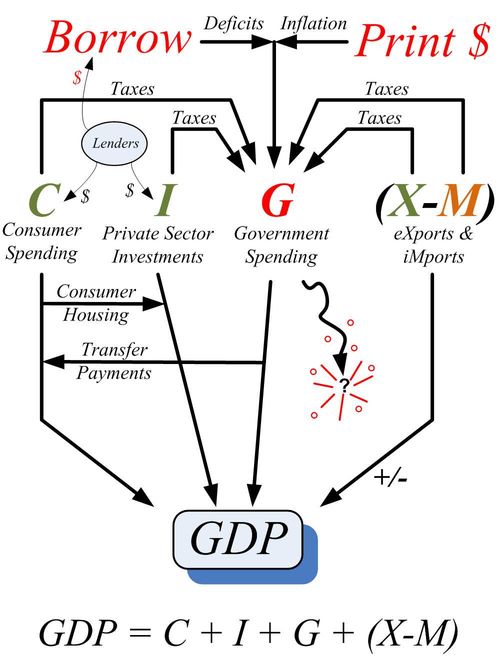
In the GDP figure below (explained here), it is the dollar amount (b+c+f) taken by government that will at best create wealth consumption and/or destruction, and such loss is indicated by the wiggly ‘poof’ line that just sucks money out of the economy.
The interested reader is also directed to a very lucid discussion of externalities at the Von Mises website.


 rebanesruminations.com
Leave a comment