

‘… when you’re rich, they think you really know!’ - Tevye the dairyman
George Rebane
[We continue examination of Guaranteed National Income that commenced in the previous post, ‘Guaranteed National Income guaranteed’.]
From the pantheon of America’s richest and wisest, we hear that Warren Buffett has now discovered systemic unemployment, especially of the kind that no amount of education spending will cure. And the man has also concluded that some form of Guaranteed National Income is required to keep blood out of the gutters. A couple of days ago he wrote a piece – ‘Better than Raising the Minimum Wage’ – that was picked up by a number of media outlets. I guess that makes official what we on RR have been discussing and debating for years.
Mr Buffett presents a sensible case for a more robust Earned Income Tax Credit to bring low earning workers up to a comfortable living standard. He correctly tells readers “In recent decades, our country’s rising tide has not lifted the boats of the poor. … No conspiracy lies behind this depressing fact: The poor are most definitely not poor because the rich are rich. Nor are the rich undeserving. Most of them have contributed brilliant innovations or managerial expertise to America’s well-being. We all live far better because of Henry Ford, Steve Jobs, Sam Walton and the like.”
Using many words and numbers, he makes the case that technology is moving employable human skill sets to ever higher levels that are simply not accessible to people in the lower cognitive classes. The whole concept was illustrated graphically in the nearby ‘thousand word picture’ (from ‘edX Meets the Workforce’). The problem of using such graphics to vividly illustrate our systemic unemployment is that the overwhelming number of our citizens don’t do graphics, neither do they do numbers. But my oh my, do they do soundbites that promise more.
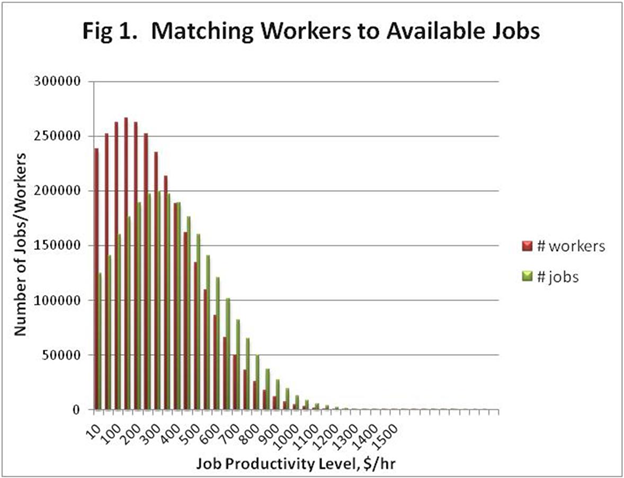
The above figure shows two overlapping distributions in the form of histograms. The green one indicates how many jobs are available at various levels of worker productivity. Of course, the higher the productivity level, the higher the required worker skill level. The red distribution shows the availability of workers at skill levels able to staff jobs at the indicated productivity levels. Where the green bars are higher than the red, we have jobs that the current workforce, represented by the red bars, cannot fill. And in the lower productivity jobs area, where the red bars stick up higher than the green bars, we have the systemically unemployed workers.
The problem is that new technologies cause the green distribution (bars) to migrate to the right. But the only thing that will increase the skill levels of workers, and therefore help the red distribution to also migrate to the right, is education/training. Unfortunately all those workers at the lower end of the productivity scale are not sufficiently educable. To keep blood out of the gutters, it is these people who must receive a GNI. (Long time RR readers may recall that I have recommended that a half-way route to GNI could be had through the Non-profit Service Corporations established under a dramatically reformed tax code.)
Before finishing, I want to remind readers the difference between welfare, as we know it today, and GNI. To receive some form of welfare you have to qualify under divers regulations, codes, and laws. And you will be vetted by endless bureaucrats to see for how much of this or that program you qualify. GNI, especially the outright grant type, requires very few people to administer, simply because it just pays you the difference between what you are able to earn yourself (maybe zilch) and what the law says you should as a minimum be able to spend every year.
And this brings us to a question asked by a liberal commenter under the previous GNI post – how would you decide which government workers are superfluous or not? From the commenter this came across as a gotcha question to rebut a proposal to save gazillions (for GNI) by reducing government workers. Well, to answer that requires no learning in rocket science or neuro surgery – just start by eliminating the non-performing bureaucracies that serve to dispense corporate and union welfare programs. Examples of these are Departments of Education, Commerce, Energy, and ‘administrations’ too numerous to list (others to follow after some consolidation of the few necessary functions they do perform). However, as more people like Buffett are now beginning to realize, we will need to establish something like the FTA, a somewhat lean, mean, and very focused bureaucracy to administer any future version of the GNI (FTA?, that would be the Federal Tit Administration).


 rebanesruminations.com
.jpg)
Leave a comment