

George Rebane
The Nevada County Board of Supervisors will be presented the ‘State of the Schools in Nevada County’ by Superintendent of Schools Holly Hermansen. (Download State of the Schools in Nevada County April 14, 2015) The presentation slides have the story, but not the complete story. In them Ms Hermansen tells the Supes about how many of what kind of schools we have, how population has declined, what laws the schools have to operate under, and the advent of Common Core here and across the nation. (H/T to reader for the PPT)
 There is nothing in there about the most important part of why parents send their children to school – to become educated in skills like reading, writing, and arithmetic, skills that prepare them for the workplace or advanced education and training. The accomplishments of our schools seem to be focused on reducing bullying in the school yards, period.
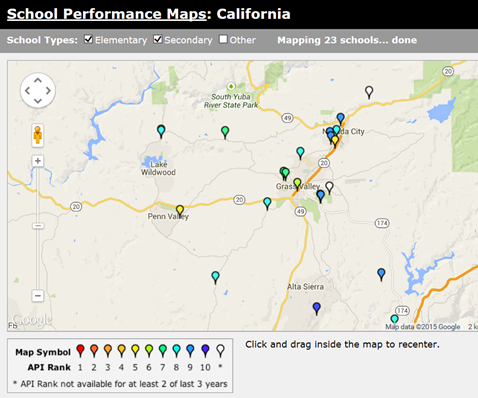
In California, Nevada County’s schools are not the brightest bulbs on the state’s education tree, in fact they’re pretty dismal for a community that does not have to contend with inner city, cross-cultural, and English language problems like those that overwhelm our metropolitan areas. One measure of this can be seen here.
I don’t know what other information the Supes have been given about our schools, but it sure seems that that the presentation by our schools’ superintendent should have a bit more meat on the bones. The material presented is essentially a generalized pabulum of data instead of information for decision making about our schools. It does not even come up to the level of confusing best efforts with achievement that is the standard fare when government units report to one another. (We recall that data is facts and beliefs about the real world, and information is data formatted to support decision making – i.e. presented in formats that address the specific decision areas for which it is intended.)
A more relevant presentation would include a stark assessment of where the county is relative to the state’s schools, what impact such a performance decrement has on our students’ attempts to enter colleges and the job markets, and what alternative programs and reallocations of available resources are possible to improve the educational product delivered to our children.
Countering liberal economists promoting various government welfare programs, there is nothing to compare with education as being the most important ingredient in combatting inequality in our society. Greenstein and Merisotis point out in a recent article some compelling statistics to make their point that ‘Education Does Reduce Inequality’.
MIT economist David Autor has an instructive thought experiment: The increase in wages for the top 1% between 1980 and 2005, if divided among the bottom 99%, would provide each household about $7,000 in additional income. But the wage gains of college graduates over the same period, divided among high-school graduates, would provide each household with $28,000 of additional income. All this comes into focus as we arrive at the end of another academic year.
During this time of the year we celebrate scholarships and commencements, and prepare to send Nevada County’s graduates (and dropouts) to join the nation’s annual 4.3 million young people who exit our education industry to join the workforce. In this light we have to consider our mostly futile attempts to improve our county’s economy. Do any wealth producing workers, who are also parents, really want to put their children into Nevada County schools?
Given what’s already under the rug, we need to pay more attention than ever to the wizards behind our education curtain.
[11apr15 update] In today’s (11apr15) Union the debate continues between longtime RR reader and contributor Greg Goodknight and Linda Campbell, member of the Nevada Joint Union High School District Board of Trustees. In ‘Common Cored, indeed’ Mr Goodknight responds to Ms Campbell’s 30may14 Union piece in which she took to task Mr Goodknight’s critique of math education in Nevada County.
I recall Ms Campbell’s rebuttal and attack last year as being extremely awkward and significantly off the mark regarding her claims and assessments. In his response today Mr Goodknight quotes Ms Campbell extensively. Being reminded of what Trustee Campbell said in print is somewhat jarring in the sense that we countenance such ignorance in those who serve to guide and make policy for our local schools. Her membership on the school district’s board of trustees does not promise change in our county’s low scholastic rankings – of more immediate concern, are the board’s other members equally qualified? Goodknight’s column underlines my recommendation that we take a closer look at our educational wizards behind the curtain.
[14apr15 update] Here is a graphic taken from the above linked site showing our local schools’ rankings in API performance which may serve as a proxy for other levels of instruction in the curriculum. As we see, none of our schools are above the median rank in the state.


 rebanesruminations.com
Leave a comment