

George Rebane
[I’ve been noodling doing a ‘predictions derby’ on RR since last summer as potential candidates started making noises about running in 2016, even before the 2014 mid-terms were held. If it worked, then the ‘derby’ would be held in three parts – who will be the declared candidates going into the conventions, who will be nominated, and who will win in Nov 2016. The output of this exercise would be periodic outputs of bar charts of probabilities (see below) that would be updated as new happenings took place and new evidence came in. Interested readers would evaluate such information that I would then aggregate in a Bayesian update formulation to post the new bar charts.
I have no idea how this will turn out with respect to reader interest and the work to track such political happenings; but since we track and comment on them anyway, I thought summarizing our collective take in an evolving graphical format would be interesting. I wrote the piece below last summer; and you should probably download it if you want to play. Note the bar charts start out at 0.5 probabilities for each potential but undeclared candidate. This shows that before considering evidence, we are 50-50 ignorant about whether they will run or not.]
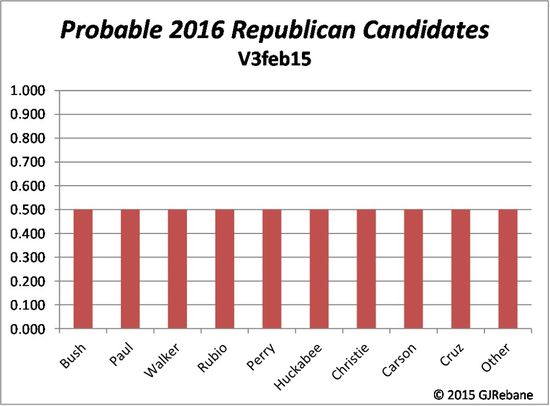
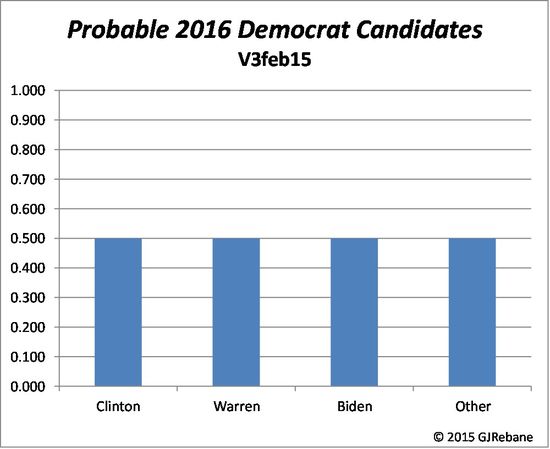
Ever since Nate Silver became a phenom prognosticator of some renown (The Signal and the Noise), I’ve considered starting a prognostication feature on RR that involves its readership. The methodology will be based on the Bayesian inference techniques on which I have reported before (search RR for ‘Bayes’). While Silver’s book is primarily a self-promotion that claims to explain his methodology but doesn’t, RR readers following my explication of Bayesian inference will be able to develop and use the methodology for countless purposes in their own private and commercial affairs. Look at it as part of the service 😉
What really tipped my decision to give this a try on RR was twofold – Silver’s disastrous performance at the FIFA World Cup predicting Brazil’s defeat of Germany (at around 0.68), and some ideas for commercial applications. But the already ferocious political maneuvering by both parties preparing candidates for the 2016 elections was the real clincher to motivate the development of a participative predictions process (think of it also as ‘crowd sourcing’ and integration of evidence). So I started to push some squigglies with Bayes theorem and came up with an easily understood formula that should provide some entertainment, and that also has a rigorous decision theoretic basis – that is, it’s not just idle fun.
The idea here is to predict who will run, and then who will be nominated as each party’s presidential candidate. If there is enough interest, I’ll extend the methodology to predict our next president. And all of this will be done by computing and updating our ‘collective’ beliefs about the future. The measure of belief is the probability that something yet unknown will come true. Belief calculations are based on a combination of hard probabilistic data, and subjective assessments all brought together under the celebrated formalism discovered long ago by the good Reverend Bayes (and rediscovered about 50 years ago when the methodology really took off).
So how will it work? Let’s discuss the ‘hat into the ring’ predictions first. We can all come up with a list of potential candidates from each party and add to the list an ‘Other’ candidate. The fundamental Bayes approach takes a prior chance, odds, or probability, and combines it with recent evidence to calculate an updated or posterior chance, odds, or probability that now reflects the latest evidence. The prior probability summarizes all the knowledge we had about each candidate’s propensity to throw their hat in the ring. And incorporating the latest evidence (news report, stump statement, lurid revelation, etc) will yield the updated posterior probability that again incorporates and summarizes all the previous knowledge we have about each candidate in the context of the hypothesis ‘s/he will throw his/her hat in the ring’. You can visualize the result as being a histogram with each bar labeled with a potential candidate’s name and having a height from zero to one. As time goes on, the bars will get taller and shorter, and some may appear while others are removed.
Everyone can bring evidence to the table and give his assessment of that evidence in how it impacts each candidate being tracked. We may debate the assessment as others refute/modify it, but I will be the final arbiter because, well dammit, it’s my blog (so there). But so as not to unreasonably piss off anyone, I will always do my best to found my adjudication. In any case, as opposed to Silver’s close-to-the-chest methodology, here you can refuse to accept the RR prediction and run a parallel one yourself, and show us all up.
[to continue reading this piece Download Predictions Derby]


 rebanesruminations.com
Leave a comment