

George Rebane
Schumer’s post-election epiphany. My comment yesterday on Senator Schumer’s belated insights on Obamacare is being echoed today in various national media outlets that have added some revealing detail. Besides the senator from New York admitting that “the law has been disastrous for Democrats”, he now, yes now, acknowledges what the rest of us argued years ago. The most important statistic he redredges is that only “about 5% of the electorate” benefits from Obamacare. The more important truth is that in the large, 100% of the electorate and everyone else suffers from the steady destruction of one of the world’s finest healthcare systems. And this plague has yet to run its course over our fair land.
The liberal leader of the Senate rues the mistake Dems made in overlooking the economy during the 2009 depth of the depression, and instead focused on something that only appealed to the nation’s weak thinkers. In Schumer’s words – “Unfortunately, Democrats blew the opportunity the American people gave them. We took their mandate and put all of our focus on the wrong problem: health-care reform.” (more here)
More evidence that liberals don’t do numbers appeared in the 25nov14 edition of The Union. RR infrequently deals with local issues, but when one can ‘shop locally’ to support a national thesis, then why not? Ms Lynn Wenzel, a devout local progressive and member of the newspaper’s editorial board responded to a critic decrying her (mis)use of numbers representing black and white household income. In her letter to the editor she reiterated that the average black household income is $6,314 compared to the average white household income of $110,500. And then she went on to give a flurry of references for those numbers.
Well, her ability to do such research leaves more than a bit to be desired, but is typical for her ideological ilk (e.g. wealth gap is not income gap). Those numbers actually refer to an arcane computation of net household wealth. The Pew Research Center reports that the actual net (assets minus debt) household wealth in 2011 was about $100K for blacks and $670K for whites. When it came to income, Pew reports that the “median adjusted income” of black households is about 60% of that of white households. This in no way ties with the preposterous numbers cited and erroneously referenced by Ms Wenzel.
When making such agenda driven comparisons, liberals habitually ignore the differential impact of household size (blacks have a greater fraction of single mom households) and the contribution of government transfer payments not counted as income that are received by these minority households. But the telling statement in Ms Wenzel’s correspondence that once more reveals and corroborates the liberal mind is when she implores her critic to agree “that the most important goal is not to dicker about figures but to solve the racial inequality in this country.” So, without “figures” how does one go about determining the existence, magnitude, scope, and causes of any of the country’s social problems that may or not involve various kinds of inequalities? Hint: for liberal minds and their compliant constituencies, considerations that transcend the anecdote are not an issue.
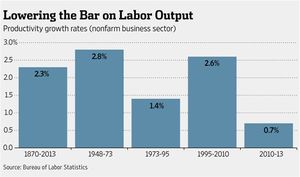
Prominent Princeton economist Dr Alan Blinder re-evokes the “unsettling mystery of productivity” in a 24nov14 WSJ column. There he readily admits that economists are very poor at understanding and predicting both measures of productivity and the GDP. In the most direct interpretation aggregate productivity is calculated from the total dollar value of output divided by the number of workers required to generate it. (In these pages I have offered a simplified yet relevant relationship between GDP and productivity that may serve as a review – here and here.)
 The problem with calculating national productivity measures is primarily what to put in the denominator when it comes to getting out something useful for making public policy. Do we use actual workers on the job, or the number of people in the current workforce (working or looking for jobs), or the number of people who could be in the workforce, or …? And at what point to we consider who contributes to what revenues along a production pathway of a good or service. It’s very hard to get your arms around such numbers except in the very small or the very large, and in the very large purview the definitions always become a matter of politics (and people wonder why economics is called the ‘dismal science’).
From Blinder’s nearby chart the historical average annual productivity growth has been around 2.3%. But look at the huge up and down jumps in productivity rates that no one can explain, let alone anticipate even though such predictions are the sum and stuff of the Fed’s cobbling together our monetary policy. As he argues for more research into the wily ways of measuring productivity, the good professor concludes –
In sum, here’s what we know—and do not know—about productivity growth. First, it’s been dismal for the past four years. Second, economists cannot predict swings in productivity growth. Each sharp swing shown in the chart took us by surprise. Third, while the Fed is now forecasting something near 2% productivity growth over the next several years, it really has little basis for choosing that number. That’s not a criticism; no one else has a better basis for a different number. We are all in the dark.
So you see the rock and the hard place. Labor wants to argue about the productivity of the American worker which requires minimizing the denominator to emphasize the highly skilled who can use technology to produce more. But that leaves out a whole bunch of reliable Democrat voters who also demand jobs or more in lieu transfer payments. Including them would make the denominator bigger and reduce the productivity number, thereby raising the specter of the inevitable growth of systemic unemployment which is a more taboo issue than Social Security’s notorious ‘third rail of politics’.
There is another interesting factor about productivity we’ll reserve for a future post. People continue to ask why productivity is not growing apace with the advance of technology, especially as its proxy measured in the number of granted patents would suggest.


 rebanesruminations.com
Leave a comment