

George Rebane
Last night the local LWV held yet the latest forum (debate?) on Nevada County’s Measure S, the voter initiative to alleviate the claimed medical marijuana (MMJ) access problem. The venue was NC’s Rood Center with both pro-S and anti-S sides well represented. Readers recall that the county’s current Ordinance 2349 already permits and regulates the growing of MMJ. The overarching state law governing MMJ production, distribution, and consumption is known as Prop215.
The following aspects of Measure S were claimed, admitted, and/or confirmed by its proponents.
1. No one knows the scope of the county’s ‘MMJ problem’, and the pro-S people continue to insist that having any relevant data about MMJ, most importantly the number of legitimate MMJ users and how many of those have access issues, does not constitute information necessary to inform the vote on S. Using a widely accepted statistical method and data from Colorado and (statewide) California, RR’s best estimate is that the county’s MMJ usership is in the 1,400 to 2,200 range. Without providing a basis of either method or evidence the pro-S people claim that the real number lies somewhere north of 20,000, or over 20% of the county’s population.
2. MMJ access difficulties in the county have been reported only anecdotally to Americans for Safe Access – Nevada County (the leading Measure S proponent).
3. Proponents of S admit that the measure’s purpose is also to expand the MMJ production industry in the county through large collectives that would enable the county to produce enough product for export, and become a state and national supplier of MMJ. (see 21oct14 update below)
4. Proponents of S want to expand the venues for grows from private residences (both indoors and outdoors), to ag lands, and also commercial buildings in business and industrial parks.
5. Proponents of S freely state that during the (6-8 week) fall MMJ harvest period that the needs of MMJ patients should trump those of nearby property owners and residents when it comes to odor and harvest/distribution related traffic.
6. Proponents of S claim that the state’s rapidly expanding MMJ market and distribution channels (see below) are too expensive and not sufficient to alleviate the claimed access problems of the county’s legitimate patients.
7. S is purposely vague on the details of the physical properties of MMJ grows, and instead relies on MMJ patients/growers to be good stewards of their crop, the land, and also good neighbors to nearby property owners.
8. S purposely omits MMJ grow enforcement provisions and calls for the county to draft follow-on enforcement and nuisance ordinances at its pleasure. (This invites to Nevada County the same statewide litigation storm that arose to challenge the passage of local ordinances required to clarify and enforce the equally ill-defined provisions of Prop215.)
9. Proponents of S stated that they purposely resorted to a voter initiative to define MMJ production and consumption in order to “prevent the county from coming in behind us” to make MMJ production and access more difficult in the future. Measure S will require another election to adopt a new MMJ initiative in order to change ANY aspect of the current measure. (The current MMJ county ordinance 2349 can be amended at will by the Board of Supervisors to balance the nuisance and need factors as they develop.)
While we are grappling with our own unknown and emotionally defined MMJ access problem, the world has moved on. MMJ is now becoming available from well-equipped dispensaries all over the state. Many of them provide delivery services that will soon let you order via a cell phone app (here). San Francisco, of course, leads the way in the ready availability of pot in all forms for all uses (here). Nearby MMJ dispensaries are located in Sacramento and Yuba City. No doubt others will be opening up soon at even more convenient locations – and then there’s the inevitable onslaught of recreational marijuana (RMJ) legalization that will be with us in a few years. I believe that voters should consider all these factors as they decide whether to abandon Ordinance 2349 in favor of Measure S.
The debate over Measure S, Ordinance 2349, MMJ access, and RMJ legalization has been covered extensively on RR in previous posts and their long appended comment streams comprised of various topical threads. Participants and contributors include the major proponents of both sides of the issue. I list and link the relevant posts below in order of their appearance –
‘Medical Marijuana Cultivation Initiative – Nevada County Ballot Measure S (updated 6sep14)’
‘Marijuana Ordinance Utility/Criteria’
‘Thoughts on Marijuana and Measure S’
‘Medical Marijuana, Property Rights, and Government Access’
‘Measure S – The Numbers Please! (updated 8oct14)’
[update] Just received an email with the following photo attached. This illustrates the intensity and chutzpah with which MJ legalization is being promoted across the country. This huge billboard (note size of truck) erected on Hwy 49 at the entrance to Grass Valley cost a bundle, and was made possible by the huge sums (as also reported here) that have been received by local pro-S supporters from MJ interests elsewhere. The sign’s claim of a “Ban on Medical Cannabis” in the county is a patently audacious lie.
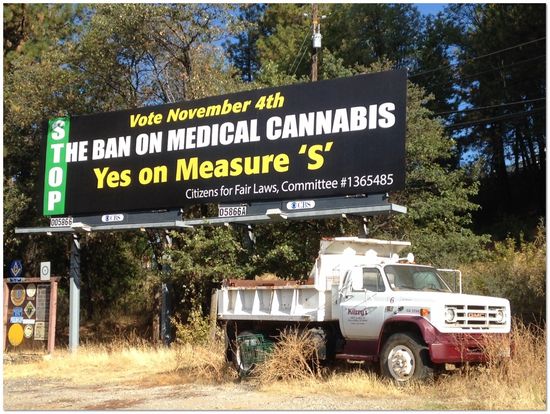
{21oct14 update] Ms Patricia Smith states in her 537pm comment below that she and ASA have never endorsed inter-state shipments of MMJ since that is illegal under federal law (as is all forms of MJ consumption in the United States). Therefore Measure S being silent on such transport should not be taken as endorsement of supplying out of state MMJ markets, MMJ growers doing this will be acting independently and on their own recognizance. Ms Smith stands by the billboard “ban” statement because 2349 does not allow MMJ growing on terraced slopes which she maintains is a constructive ban. Please read her own words and my response in the comments.


 rebanesruminations.com
Leave a comment