

George Rebane
People of a shared ethnicity individuate tactically and aggregate strategically.
The future described in these pages over the last several years is coming true in spades. The prime forces acting in accidental synchrony are the rampant advance of technologies, and the profoundly incompetent Obama administration that now rules through a camarilla of perfidious bureaucrats. The result is growing global chaos and an underclass emerging from systemic unemployment accelerated by misguided rules that accelerate substituting machines for human labor. The real news is that this ‘news’ is finally being picked up in the mass media and grudgingly accompanied by the lamestream which has always been the public apologist and mouthpiece of the Left.
Here I want to bring together four contemporary examples of such lightbulbs going off to illuminate that small part of the public forum that is still made up of ‘people of information’, a delightfully appropriate expression that was introduced in the first half of the 19th century. These consist of the featured essay on the world economy in the 4oct14 Economist entitled ‘The third great wave’, a comprehensive report that recognizes the information and knowledge technology revolution which now succeeds its predecessors – the early 19th century Industrial Revolution and the unnamed electro-mechanical revolution of the late 19th and early 20th centuries. We see these waves of disruption and invention in a global context as reported by Stratfor’s Robert Kaplan in a major essay entitled ‘Super Chaos’ that brings together and focuses our attention on an historical confluence of worldwide disorder and mayhem that is missed by the auto-distracted masses. In all this there are still some like the leftwing political scientist William Galston of the Brookings Institution who sees slim shimmers of light in an otherwise darkening tunnel as espoused in his hopelessly hopeful 8oct14 WSJ piece, ‘How to Stoke the Middle-Class Comeback’.
My purpose here is not to drag the reader through the long laundry list of arguments that support the early revelations posted here, but simply to highlight the corroborations of an existential worldview that is uncomfortably ignored by most sitting politicians and world leaders.
The Economist strongly acknowledges the reality that was detailed in Tyler Cowen’s Average is Over (2013), George Gilder’s Knowledge and Power (2013), and Charles Murray’s Coming Apart (2012), all covered here in previous posts. Much data is presented on the growing unemployment problem in the developed world due to three driving factors – 1) government regulations making the hiring/firing of humans more difficult and expensive, 2) rapid dating of workers’ skill sets, and 3) the acceleration of technology, specifically in the surge of all types of smart machines and robots. The Economist sees that government is critical to solving and ameliorating all three factors by reducing red tape, spending more on educating redundant workers, and easing the establishment of smaller businesses that take advantage of new information and fabrication technologies.
The ‘newspaper’ (as it calls itself) also suffers through an examination and awkward support of ideas such as higher minimum wages, and even a guaranteed minimum salary for all unemployed and unemployables. The Swiss are contemplating the latter, and the eyes of the world will be upon them. The authors of the piece recognize and enumerate the obvious (at least to the Right) weaknesses of such financial guarantees that do not reflect the individuals’ contribution to society save perhaps by convincing him not to join a violent revolt. There is no apprehension of establishing non-profit service corporations which I introduced some years back.
But their real ‘head in the sand’ stance is that they take no note of population growth and possible policies to limit that. The implication being that the world will contain at least nine billion inhabitants by 2050 with no indication that it will top out there (a demographic theory promoted by the UN). The obvious truth is that with a growing population we will have the inevitable growing number of the permanently unemployed. In desperation The Economist suggests that many of these will find their comfort in having time to pursue divers hobbies and the arts. The problem with that view is that such self-gratifying endeavors require more than a three digit IQ, and half the world doesn’t even have that.
Having said this I have to return to one of my rules for social stability – every individual seeks to become/remain relevant within the environment in which he finds himself. If that is not possible, he will migrate or fight to change that environment so as to achieve that relevancy. Unfortunately such individuals can only accomplish that through the violent simplification of the environments in which they find themselves redundant.
Now turning to a more sinister and hard-boiled world view as compiled by Stratfor’s Robert Kaplan in ‘Super Chaos?’. He gives the 50,000 ft overview starting in Russia, sweeping through the Mideast, then to China and east Asia, coming back to visible and invisible (millions killed by Congolese militias in the last two years) troubles of Africa, and then winding up in the Americas. The list is long and torturous, it reeks of the musty geo-strategic smell of a mighty hegemon that has hung up its badge and quit the stage. International anarchy among the nation-states is the order of the day. And no one in the West really knows or cares – the miked ‘man in the street’ is more disconnected and dumber than ever.
In the specifics Kaplan points out that Russia’s Putin has definitely “created a rule by a camarilla” (I had to look that one up). But the interesting conclusion there is that the way things are going “the partial breakup of Russia may be more likely than the emergence of Western democracy in Russia.” Readers may recall the admonition here that autocracy cum tyranny is the most stable form of governance experienced by Man – tyrants may come and go, but tyranny abides.
Turkey and Iran are forcefully contenting to be the Mideast’s hegemon, playing with their neighbor countries like so many chess pieces while millions die in the created cauldron of incessant war. There appears no hope of stability there, only an iffy containment if the US and its allies can maintain a semi-war footing, injecting force to knock down some insipient threat to the west now and then. I say that simply because the chafing Islamic cultures will not allow normalcy wherever they are found, and this will be exacerbated as alternative sources for fossil fuels are developed around the world.
In the great Asian landmass there are more hotbeds of discontent than one can count, and great powers like Russia and China will stoke one or the other of these as their interests dictate or their need to divert their discontented populations require. Specifically we note that “there is the possibility of sustained ethnic unrest at increasing levels among the Muslim Turkic Uighurs in western China and the Tibetans in southwestern China”
I have to agree with Kaplan’s conclusion that “just because autocracy has failed does not mean that democracy can work. And just because the tumultuous, dramatic weakening of central control in big states has not happened yet does not mean it is implausible.”
Here in America we can put a fine point on that as we revisit the growing systemic unemployment in these pre-Singularity years, a class divide that has established a stable, apparently permanent, and growing economic inequality in our population. With our nation on a financial downward spiral that is the product of what has been argued here, confirmed by Tyler Cowan in ‘Average is Over’, and given a bit more hopeful conclusion by William Galston in his ‘How to Stoke the Middle Class Comeback’.
President Obama’s pabulum recognizes the problem – “[O]ur economy won’t be truly healthy until we reverse the much longer and profound erosion of middle-class income and jobs.” – while doing everything possible to expand the erosion. Galston attributes the problem to –
… an unproductive stalemate. Many conservatives attribute falling median incomes to a witches’ brew of administration policies: the stimulus, huge budget deficits during the recession, the Affordable Care Act and the termination of the Bush tax cuts for upper-income filers. By contrast, many liberals point to the decades-long weakening of labor unions, the eroding value of the minimum wage, trade treaties that destroy middle-class jobs and an inadequate public-sector response to the biggest economic crisis since the 1930s.
He also recognizes the Great Doubling (q.v.) of the global workforce, with which regular readers are familiar, as a factor in our growing un/der employment situation. And he acknowledges that
… rapid advances in computer technology made it possible to substitute capital for labor not only in mass production, but further up the skills ladder as well, hollowing out a steadily widening center of the labor market. The Great Recession accelerated the decline: The majority of the jobs that unemployed workers have found thus far pay significantly less than the ones they lost during the crash.
Yet Galston’s version of the needed ‘stoke’ is nothing special, and most certainly no ‘how to’ policy that differs from the familiar palliatives of calling for government’s greater intervention with more “investment” in educating the un/der skilled and paying for R&D that in some unknown way will produce the results of a cavalry troop arriving in time to save the beleaguered circled wagons. In that he cites The Economist’s analysis covered above.
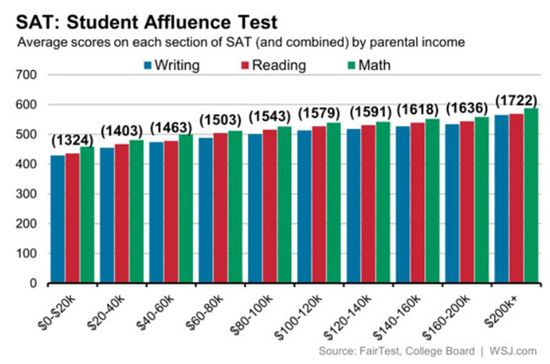
I want to conclude this with a very scary graphic from ‘SAT Scores and Income Inequality: How Wealthier Kids Rank Higher’ by Josh Zumbrun. How is government going to buy educated and supportive parents of means for poor kids with two-digit IQs, and even if they could, what good would it do?


Leave a comment