

George Rebane
Water, water everywhere, but not a drop is yours.
California’s drought induced by nature and amplified by government has migrated from reasonable discussion to political expedience. This ongoing problem in our state has drawn much interest from RR readers, especially those living in the Sierra foothills where water is still abundant.
Sacramento and the feds have taken the side of dubious environmental arguments such as the health and happiness of certain fish species, and against the farmers and residents, especially those living in the wetter parts of the state. After all, the votes are concentrated in the dry parts which must be made the last to feel any shortfall in the wet stuff.
The legal arguments fall into the classical Right/Left pattern as far as regulation and rationing are concerned. And it all starts with ‘who owns the water?’ The Left applies its classical mantra that all possible resources belong to the people (i.e. the state), and the Right says ownership of water is a complex matter that should be sorted out on an ad hoc basis that tilts heavily toward the maintenance of property rights. The specifics break down to how/whether flowing surface water should be treated differently from ground (or well) water.
In a previous comment stream, RR reader and advocate for the Left, Mr Steven Frisch, offered the following points of law for us to consider.
CALIFORNIA CONSTITUTION ARTICLE 10 WATER SEC. 2.
It is hereby declared that because of the conditions prevailing in this State the general welfare requires that the water resources of the State be put to beneficial use to the fullest extent of which they are capable, and that the waste or unreasonable use or unreasonable method of use of water be prevented, and that the conservation of such waters is to be exercised with a view to the reasonable and beneficial use thereof in the interest of the people and for the public welfare. The right to water or to the use or flow of water in or from any natural stream or water course in this State is and shall be limited to such water as shall be reasonably required for the beneficial use to be served, and such right does not and shall not extend to the waste or unreasonable use or unreasonable method of use or unreasonable method of diversion of water. Riparian rights in a stream or water course attach to, but to no more than so much of the flow thereof as may be required or used consistently with this section, for the purposes for which such lands are, or may be made adaptable, in view of such reasonable and beneficial uses; provided, however, that nothing herein contained shall be construed as depriving any riparian owner of the reasonable use of water of the stream to which the owner’s land is riparian under reasonable methods of diversion and use, or as depriving any appropriator of water to which the appropriator is lawfully entitled. This section shall be self-executing, and the Legislature may also enact laws in the furtherance of the policy in this section contained.
These from the State Water Resources Code:
102. All water within the State is the property of the people of the State, but the right to the use of water may be acquired by appropriation in the manner provided by law.
103. In the enactment of this code the Legislature does not intend thereby to effect any change in the law relating to water rights.
104. It is hereby declared that the people of the State have a paramount interest in the use of all the water of the State and that the State shall determine what water of the State, surface and underground, can be converted to public use or controlled for public protection.
105. It is hereby declared that the protection of the public interest in the development of the water resources of the State is of vital concern to the people of the State and that the State shall determine in what way the water of the State, both surface and underground, should be developed for the greatest public benefit.
(If readers find additional constitutional or code provisions for the disposition of water in California, please include or point them out in your comments, and I will append them hereunder.)
The first thing to note is that California’s constitution deals only with riparian rights and surface water. It is moot on ground water and clearly presumes that such water is the sole property of the landowner from which such water is drawn. Why so? Well, the framers of this constitution were well aware of water sources, and it would stretch reason to hold that they simply forgot to include ground water with surface water.
However, the much later drafted State Water Resources Code developed by people of a more collectivist mood corrected what to them was the framers’ oversight, and therein explicitly dictate that “All water within the State is the property of the people of the State, …” – a broad statement that clearly should have been in the constitution had its framers wanted to include ‘all water in the state’. And things get dicey from there, winding up where we are now looking at Sacramento bureaucrats telling everyone how much of what water from where and at what cost the water-owning people will be able to buy. The idea being that it wasn’t yours to begin with, any more than is the air you breathe for which we are working on a separate program of (you can be sure) equitable taxation.
Your making a decision to live in a low density part of the state with plenty of water makes no never mind to our betters. These folks know how to make sure that whatever water is made available to the people, it will be distributed in a socially just manner.
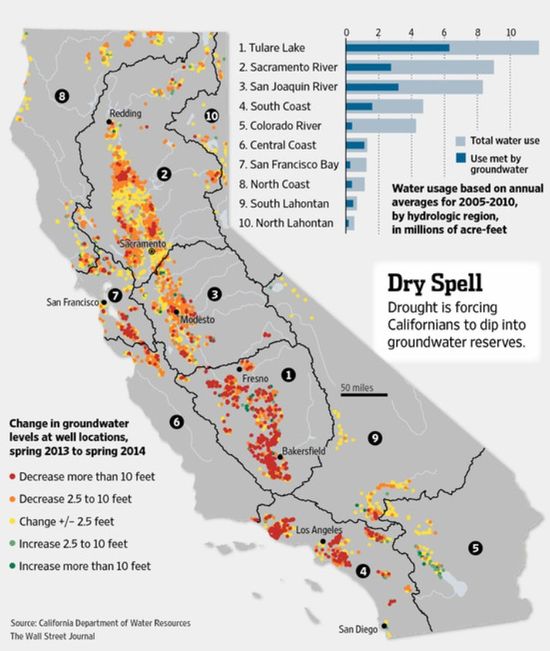
[update] Just discovered that the WSJ is publishing a piece on California groundwater in its tomorrow’s (29aug14?) edition (here). Below is the graphic filched from the article.


 rebanesruminations.com
Leave a comment